
Topic 3.10 key terms
- principal value
- The one answer an inverse trig function returns: arcsin gives an angle in [−π/2, π/2], arctan in (−π/2, π/2), arccos in [0, π]. It solves the equation, but it is usually not the only solution.
- partner solution
- The second angle in the same turn with the same sine (π − α, the mirror across the y-axis) or the same cosine (−α, the mirror across the x-axis).
- general solution
- Every solution of a trig equation, written with an integer n: for sin θ = 1/2, θ = π/6 + 2πn or θ = 5π/6 + 2πn. Tangent repeats every π, so tan θ = k gives θ = arctan k + πn.
- solving for the inside
- When the input is transformed, as in sin(3θ) or sin(π(t − 2)/6), solve for the whole inside expression first, then undo it. The repeat 2πn changes too (2πn/3, or 12n hours for the tide), because it is the period of the transformed function.
- trigonometric inequality
- A statement like h(t) ≥ 9. Its solution is a set of intervals: find the boundary values by solving the equation, then keep the stretches where the graph is on the correct side of the line. ≤ and ≥ include the boundaries; < and > do not.
- contextual domain
- The inputs a real situation allows, such as one day from 8 a.m. to 8 p.m. Of the infinitely many solutions of a periodic equation, only those inside this domain answer the question.
Transcript
2,391 words · 7 parts
The bottom of the ocean
This is the Bay of Fundy, in eastern Canada. At eleven o’clock this morning, you could walk around on the bottom of the ocean. Right here, where we’re standing. See that hole in the rock, way up over your head? Keep your eye on it. Now let’s speed up the afternoon.
The Bay of Fundy has some of the biggest tides on Earth. Twice a day the water here rises more than ten meters, about the height of a three-story building, in about six hours. By the middle of the afternoon, people paddle kayaks right through that hole. That’s how far up the rock the water comes.
And by five o’clock, the hole is gone. It’s completely underwater. By the end of this lesson, you’ll be able to plan a whole day here, every minute you can walk on the sea floor and every minute a kayak can get through that window. And you’ll see why high tide, when the water’s deepest, is exactly the wrong time to try.
All of that comes from running a trig function backwards, and remembering that a wave never answers a question just once. So let’s start with the simplest thing you can ask about this water, which is when it reaches a certain height.
Two answers, then infinitely many
Let’s rewind to eleven in the morning and stand a measuring stick against this rock. Zero is the lowest the water ever gets, and the floor you were standing on is three meters up. The window’s bottom edge, the ledge, is eight meters up, and to paddle a kayak over it you want at least a meter of water, so the number we care about is nine meters.
Here’s a model of the water level for the day. h of t equals six plus six sine of pi times t minus two, over six, where t is hours after noon. It repeats every twelve hours, very close to the real tide’s twelve hours and twenty-five minutes. Now you try it. Drag the clock forward from eleven, and stop it the first time the water reaches nine meters.
But is three o’clock the only time? Let’s keep the clock running. The water keeps rising to twelve meters at five o’clock, then turns around, and at seven, on its way back down, it passes nine meters again.
So h of t equals nine has two answers on today’s graph, three and seven, the same height once on the way up and once on the way down. And the tide does exactly the same thing every twelve hours, so there’s a three and a seven in the early morning too, and tomorrow, and yesterday, as far as you like in either direction.
So this one equation has infinitely many solutions, two for every tide. But you’re only here from eight in the morning to eight at night, and that throws away all of them except three and seven. Dragging a clock found them, but we need a way to find both with algebra, so let’s put this graph on the board.
On the board, the question is six plus six sine of pi times t minus two, over six, equals nine. First I want the sine by itself, so I’ll subtract six from both sides, and then divide by six, which leaves the sine of pi times t minus two, over six, equal to one half. So the tide question has turned into a smaller one, which is when a sine equals one half. Let’s answer that in its plainest form, then come back to the tide.
What the calculator doesn’t tell you
Let’s take sine of theta equals one half, where theta can be any angle at all. On the unit circle, the sine of an angle is the height of its point, so we want every point whose height is one half. A level line at that height cuts the circle in two places.
The graph agrees, because the same line crosses the sine curve twice in every cycle. Now ask a calculator. The inverse sine of one half is pi over six, the first point, and that’s all you get, because inverse sine only looks at the right half of the circle, from negative pi over two to pi over two.
That’s the restriction from the last lesson. The calculator isn’t wrong, it’s only looking at half the circle, so it misses the second point. The other point is its mirror image across the y-axis, at pi minus pi over six, which is five pi over six. Both points have the same height, one half, so both angles work. On the graph, the hump is symmetric, so pi over six is just as far before the peak at pi over two as five pi over six is after it.
And every full turn brings you back to the same two points, so every solution is pi over six plus two pi n, or five pi over six plus two pi n, for any integer n. So the inverse gives you one answer. The circle gives you its partner. And whole turns give you all the others.
Now try sine of theta equals negative one half, but only for angles from zero up to two pi. The calculator says negative pi over six, a small turn clockwise, and that’s not between zero and two pi, so we can’t keep it as it is.
But going counterclockwise almost all the way around reaches the same point, so we add one full turn and get eleven pi over six. Its mirror across the y-axis is pi minus negative pi over six, which is seven pi over six, so the two answers are seven pi over six and eleven pi over six.
Cosine works the same way with one change. Cosine is a point’s horizontal position, so on the circle, cosine’s line is vertical, and it cuts the circle once above the x-axis and once below it. Inverse cosine looks only at the top half, from zero to pi, so the partner it misses is the mirror image across the x-axis.
So for cosine of theta equals one half, the calculator gives pi over three, the mirror gives negative pi over three, and one more turn makes that five pi over three. Now you try one. Using the circle, find every solution of cosine theta equals negative root two over two, from zero up to two pi.
One turn of the angle is one tide
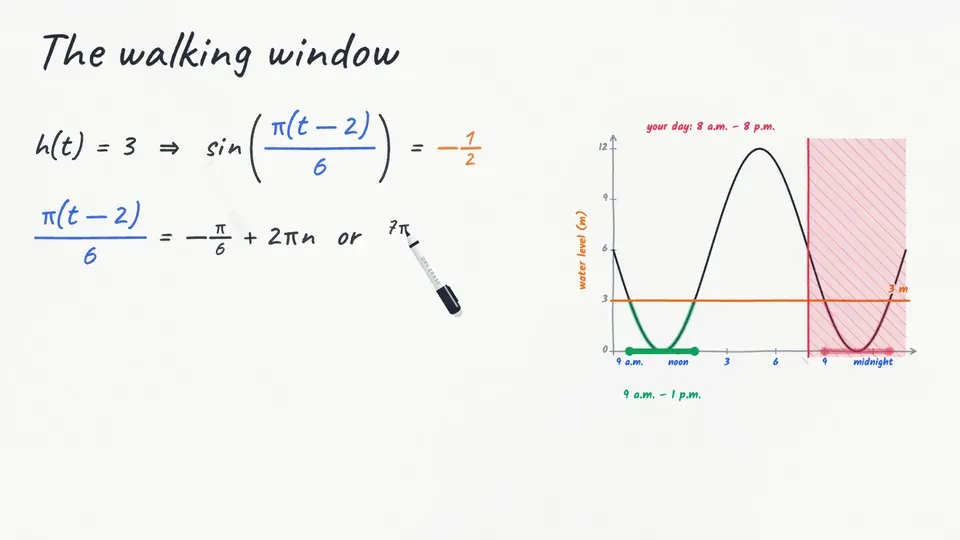
Back to the tide, where we’d got as far as the sine of pi times t minus two, over six, equals one half. Everything inside the sine is an angle, so it has to be pi over six plus two pi n, or five pi over six plus two pi n, the same two families we just found. To get t alone, I’ll multiply by six over pi, so t minus two is one plus twelve n, or five plus twelve n, and adding two gives t equals three plus twelve n, or seven plus twelve n.
Look at the two pi n. It turned into twelve n, because one full turn of the angle inside is one full tide, twelve hours, so the answers come in pairs, twelve hours apart. Your day, eight to eight, runs from t equals negative four to eight, so the only n that fits is zero, and that gives three in the afternoon and seven in the evening.
Here’s a faster wave: two sine of three theta equals one, from zero up to two pi. Before we solve it, how many answers do you think it has? Dividing by two gives sine of three theta equals one half, so three theta is the angle, and it must be pi over six or five pi over six, plus whole turns.
This is the step almost everybody misses. When theta runs from zero to two pi, three theta runs from zero to six pi, three full laps, and every lap has two answers, so there are six. Now divide everything by three, the two pi n too, so theta is pi over eighteen plus two pi n over three, or five pi over eighteen plus two pi n over three. n equals zero, one and two give all six.
Here are all six. Notice the repeats are two pi over three apart, because that’s this wave’s period. Tangent has one more twist, because its period is pi, so there’s no mirror to find, and the answers simply repeat every half turn. For tangent of theta equals negative one, the calculator’s negative pi over four repeats every pi, giving three pi over four and seven pi over four.
Your turn with a faster wave. What’s the complete set of solutions of sine of two theta equals root three over two, from zero up to two pi?
Above the line, below the line
Back at the cove, let’s change the question a little. Instead of when the water is at nine meters, let’s ask when it’s at least nine meters, deep enough to paddle over the ledge. The cove doesn’t change at all, but now every moment from three to seven counts, because the curve stays above the line that whole time, and its shadow on the time axis is the answer.
At five o’clock, in the middle, the water is twelve meters, so that’s certainly deep enough, even though the window itself is underwater right now, and we’ll come back to that. And the ends count too, because at three and seven the water is exactly nine, and at least nine includes nine.
Now the other end of the day. You can walk out to this rock while the water is no higher than the floor, three meters, so this time we want the curve below a line. From eight this morning to two tonight, the curve dips below three meters twice, once around low tide this morning, and again tonight. The night one doesn’t count, because your day ends at eight, so only the morning is left.
So mark your walking window. Drag the two ends of the ribbon until it covers exactly the time you can stand on dry sea floor today.
Each edge of that window comes from an equation too. The water is at three meters when the sine of the inside is negative one half, the equation we solved on the circle. In hours, its answers are one plus twelve n or nine plus twelve n, which in your day means nine in the morning and one in the afternoon.
So the method for any trig inequality is always the same. Solve the equation for the edges, use the graph or a test point, like five o’clock at the cove, to pick the side, let the inequality symbol decide whether the edges count, and keep only what’s in the domain.
On the exam, inequalities usually come without a story, so here’s one the way the exam asks it. For theta from zero up to two pi, when is two cosine theta plus one greater than zero?
High tide is the wrong time
Now the window itself, which has a roof as well as a ledge. The roof is at eleven point eight meters. Sitting in a kayak, you need about a meter of headroom, so the water has to stay at or below ten point eight. Picture a kayak trying at five o’clock, right at high tide. The water’s at twelve meters, higher than the roof, so the window is underwater.
At three thirty the water’s about ten meters, over the ledge with room under the roof, so it fits. So the water has to be between the lines, at least nine and at most ten point eight. The curve passes through that band twice, once going up and once coming down.
That’s why high tide is exactly the wrong time. The deepest water of the day is too deep. We know the nine-meter edges. They’re three and seven, so let’s find the other two on the board.
The kayak needs both conditions at once. The new edges are where the water reaches ten point eight. Subtract six and divide by six, and the sine of the inside equals zero point eight, which isn’t a special value, so this is a job for a calculator.
On a calculator in radian mode, the inverse sine of zero point eight is about zero point nine two seven three. Use that to find the first time the water reaches ten point eight meters. Give t in hours after noon, to the nearest hundredth.
For the second crossing, use symmetry. Three point seven seven is one point two three hours before high tide at five, so the other one is one point two three hours after five, at six point two three, which is about six fourteen.
So the kayak can get through from three until three forty-six, and from six fourteen until seven, about forty-six minutes each time, one window on each side of high tide. This is exactly how the exam likes to ask it, two conditions joined by and on a limited interval, and the answer is the time when both are true at once.
So let’s play your day back. From nine until one, you can walk right out to the rock. You can stand right under the window. At one, the water comes back over the floor. By three, it’s a meter over the ledge.
That’s your first window, so you have until three forty-six to paddle through, before the water gets too high for your head. So you wait out high tide while the window disappears, until six fourteen, when there’s a meter of headroom under the roof again.
Paddle back through before seven. Then you’re out the other side. And look, the sun’s going down. Every one of those times came from one model. One model, and the same few moves.
What to remember
To solve a trig equation, the inverse gives you one answer. The circle or the graph gives you its partner. Then add whole periods, using the period of whatever’s inside, like twelve hours for the tide.
For an inequality, find the edges and keep the stretches on the right side of the line. In a real problem, keep only what the situation allows. So the next time you’re standing somewhere the sea will cover by dinner, you’ll know exactly how long you’ve got.