
Topic 3.13 key terms
- polar grid
- Circles centered at the origin (each one distance from the pole) and lines through the origin. Each ray from the pole is one direction; each line through the pole holds two opposite directions, θ and θ + π.
- pole and polar axis
- The pole is the origin O. The polar axis is the positive x-axis, the ray from which every angle θ is measured (counterclockwise is positive).
- polar coordinates (r, θ)
- θ is an angle in standard position whose terminal ray lies on the line through the point; r is the signed distance along that line. Turn θ from the polar axis, then go r along the line.
- negative r
- A negative r means move along the line of the terminal ray in the opposite direction, so (−r, θ) is the point straight through the pole from (r, θ). (−r, θ + π) names the same point as (r, θ).
- x = r cos θ, y = r sin θ
- The rectangular coordinates of the point (r, θ): the unit-circle point (cos θ, sin θ) stretched by r.
- r = √(x² + y²), θ = arctan(y/x) (+ π if x < 0)
- Converting (x, y) to polar coordinates with r > 0. arctan only gives angles between −π/2 and π/2, so when x < 0 add π.
- complex plane
- The complex number a + bi is the point (a, b): real part across, imaginary part up. With r = √(a² + b²) and angle θ, a + bi = (r cos θ) + (r sin θ)i.
Transcript
2,600 words · 8 parts
One tenth of a second
This car is driving itself down a city street at night, just after the rain. In about a second, it’s going to have to make a decision. Someone in a dark coat just stepped off the curb up ahead. On a wet night there’s glare and reflections everywhere. A dark coat is about the hardest thing there is for a camera to pick out.
So let’s freeze time right here. Let’s look at the street the way the car really sees it. That black dome on the roof is a LiDAR. It spins about ten times a second, and every second it fires more than a million laser pulses and times how long each one takes to bounce back.
And it brings its own light. So the dark doesn’t bother it at all. But every one of those dots arrives as just two numbers, a distance and a direction. This one, on the person’s coat, says fourteen meters away, at an angle of a tenth of a radian.
Those two numbers aren’t map coordinates yet. Is this person already in our lane, or still at the edge of it? The car has a fraction of a second to decide, and neither number says it directly.
By the end of this lesson, you’ll be able to do the calculation this car does more than a million times a second, turning a distance and an angle into exactly where something is, and you’ll use it to decide whether this car has to stop. So let’s start with just one laser and one dot. Then we’ll work out what those two numbers really tell us.
Turn, then go
Let’s look straight down on the street, with the car pointing to the right. And let’s keep just one laser, the one that sweeps a flat circle around the car. Every time the beam hits something we get a dot, and its two numbers are how far the beam went and which way it was pointing.
Suppose all we knew about the person was the distance, fourteen meters. They could be anywhere on this circle, out in front of us or over on the sidewalk, or even behind the car. And if all we knew was the direction, a tenth of a radian, they could be anywhere along this ray, one meter away or fifty.
But put the two together, and there’s exactly one place where the circle and the ray cross, and that’s where the laser found the person. So a sensor like this sees the world as circles around itself and lines running through it, and that’s called a polar grid, where every circle is one distance from the sensor, and every ray out from the sensor is one direction.
Directions start from the same zero you’ve always used for angles, the positive x-axis, which for the car is straight ahead, and they count counterclockwise, so turning toward the car’s left is positive. A point written this way is a pair of polar coordinates, r and theta. Theta tells you which way to turn, and r tells you how far to go along that line.
Try it yourself. The car logged a return at six meters and two pi over three, so turn the beam, slide out the range, and find what the laser hit. Let’s lift that grid off the street. We’ll put it on the board, where we can draw on it properly.
The center, where the car’s LiDAR was, is called the pole, and the ray pointing straight ahead, the positive x-axis, is called the polar axis. We write polar coordinates as r, theta, distance first, even though you do them the other way round, turning first and then going.
Let’s plot four, pi over four. Turn pi over four, an eighth of a full turn, and then go four units out along that line. There’s one strange case. If r is zero you don’t go anywhere, so whatever angle you turn to, you’re still on the pole.
One point, many names
Back on the street, there’s a no-parking sign at four meters and pi over six. But the LiDAR doesn’t stop after one turn. One full turn later, when its angle has grown by two pi, the beam comes back around and hits exactly the same sign. So four, pi over six and four, thirteen pi over six are two names for the same point, because a full turn always brings you back to where you started.
Turning the other way works too. Go clockwise by eleven pi over six, almost a whole turn, and you land on the same sign, so four, negative eleven pi over six is another name for it.
Sensors really do this. One might put this fire hydrant on our right at negative pi over three, while another counts all the way around from zero and calls it five pi over three, and both point at the same hydrant. The strangest kind of name uses a negative distance. A laser can’t measure one, but there’s a machine that can actually move one, so let’s go and see it.
This is a sand table. A single steel ball rolls through the sand and draws with it, pulled along by a magnet hidden underneath. And the robot underneath works in polar coordinates. One motor turns an arm, that’s theta, and the other slides the magnet along it, that’s r, so its pattern files are just long lists of angles and distances.
Most tables only slide the ball from the center out to the edge, but our arm reaches all the way across. Let’s send the ball to three, pi over two. The arm turns to point straight up, and the ball slides out three rings. Let’s bring the ball back to the center. Now try negative three, three pi over two.
The arm turns to point straight down, and because r is negative, the ball slides backwards, out along the other end of the arm, the opposite way from where it points. And it lands on exactly the same mark. A negative r sends you the opposite way along the line, so pointing down and backing up three is the same as pointing up and going forward three.
Now you drive it. Put the ball on this mark at four, pi over six, but with a negative r on your slider. Let’s put all of these names on the board. Then we can compare them, side by side.
Here’s our point, four, pi over six. This rod through the pole is the line it sits on, with a positive end and a negative end. Adding a full turn gives four, thirteen pi over six, and taking one away gives four, negative eleven pi over six, and you could keep doing that forever.
Or turn half a turn more, to seven pi over six, and come back through the pole with r equals negative four. Negative four, negative five pi over six works too, since it points the same way. So every point has infinitely many names. You can add or subtract full turns, as many as you like, or you can flip the sign of r and add a half turn, pi, to theta.
Careful, though, because a negative angle and a negative r do different things. Four, negative pi over six turns clockwise and goes forward, below the axis on the right, and negative four, pi over six goes backwards, into the bottom left, so neither one is our point. Which one of these is not another name for the point four, pi over six?
From (r, θ) to (x, y)
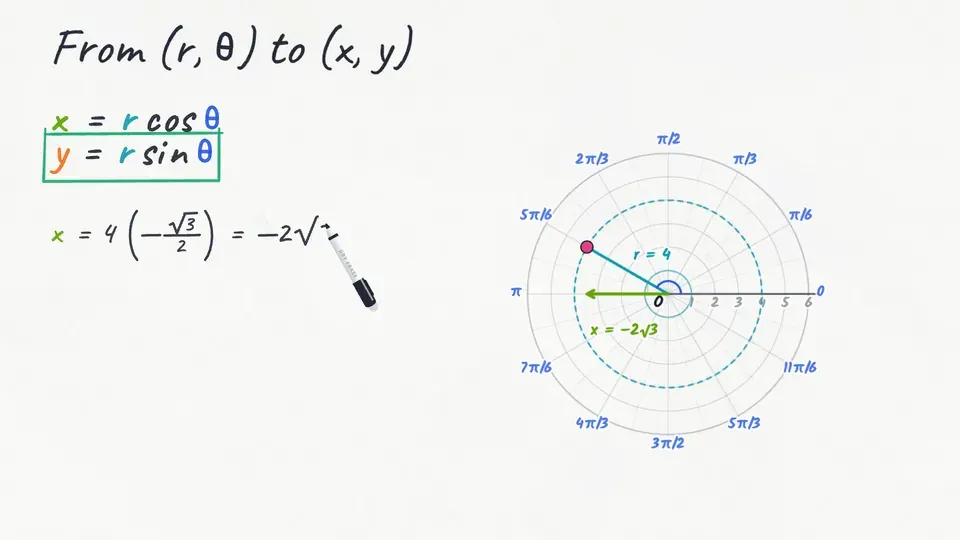
Back to the street. Behind us on the left there’s a parking meter. The laser has it at four meters and five pi over six. But a map can’t use those two numbers directly. It needs to know how far ahead or behind the meter is and how far to the left, which are its x and its y.
And you already know how to get them. On a circle of radius one, the point at angle theta is cosine theta, sine theta, and that’s where the beam would land if the meter were only one meter away.
But the meter is four meters away, and stretching the circle to radius four stretches everything by four, so the point becomes four cosine theta, four sine theta. Here they are on the street. The meter is about three and a half meters behind the LiDAR, which is a negative x. And it’s two meters to the left. Let’s work out those two numbers exactly.
So for any point r, theta, the x-coordinate is r cosine theta, and the y-coordinate is r sine theta. It’s just the unit-circle point, stretched by r. For the meter, the cosine of five pi over six is negative root three over two, so x is four times that, negative two root three, about negative three point four six. And the sine of five pi over six is one half, so y is four times one half, which is two.
So the meter is at negative two root three, two. And as a quick check, x squared plus y squared is twelve plus four, which is sixteen, four squared, so it really is four meters from the car.
The formulas even handle a negative r. For negative four, five pi over six, both numbers flip sign and you get two root three, negative two, the point straight through the pole on the other side. And this is exactly how the exam asks it, a point in polar coordinates that you convert to x and y exactly, with no calculator. Try one yourself. What are the rectangular coordinates of the point six, four pi over three?
Which way is the lamppost?
Now let’s go the other way. The car also carries a detailed map, and it checks where it is by finding things the map already knows. The map says there’s a lamppost three meters behind us and three to the left, at negative three, three. So where should the laser look for it? The distance is the easy part, just the square root of three squared plus three squared, which is three root two, about four and a quarter meters.
For the direction, the slope of the line from the car to the lamppost is y over x, three over negative three, which is negative one, and the inverse tangent of negative one is negative pi over four. So let’s aim there. And there’s nothing there. Negative pi over four points ahead and to the right, into the empty bike lane, the exact opposite direction from the lamppost.
The trouble is that negative three, three and three, negative three sit at opposite ends of the same line through the car, with the same slope. The inverse tangent can’t tell them apart. It always answers on the right half of the picture, the half in front of the car, between negative pi over two and pi over two.
So when x is negative, the point is on the left half, behind the car, and we add pi to swing the beam around half a turn. Negative pi over four plus pi is three pi over four, and there’s the lamppost. Let’s write that rule down properly.
So, to go from x and y to polar, r is the square root of x squared plus y squared, and theta is the inverse tangent of y over x, plus pi whenever x is negative. In the third quadrant, take negative three, negative three. The inverse tangent of one is pi over four, but x is negative, so we add pi and get five pi over four.
For three, negative three, x is positive, so negative pi over four is already right, or seven pi over four if a question wants an angle between zero and two pi. And if the point is on the y-axis, like zero, four, don’t divide by zero at all, just look at where it is. It’s four units straight up, so it’s four, pi over two. What’s the point negative one, negative root three in polar form, with a positive r?
One more name: a + bi
There’s one more way to name a point, and you’ve seen it before. In the lesson on complex zeros, we drew a plus b i as the point a, b, real part across and imaginary part up.
So one plus i is the point one, one. It’s root two from the origin at an angle of pi over four, so it’s also root two times the quantity cosine pi over four plus i sine pi over four. Multiply it back out, and root two times root two over two gives one, twice.
Our lamppost works the same way. As a complex number it’s negative three plus three i, and we already found its distance and its angle, so it’s three root two times the quantity cosine three pi over four plus i sine three pi over four. In general, a plus b i equals r cosine theta plus r sine theta times i, the same two formulas with new labels, and here r is a distance, so we keep it positive.
Going the other way, six times the quantity cosine five pi over three plus i sine five pi over three is six times one half, plus six times negative root three over two, times i, which is three minus three root three i. Write two times the quantity cosine five pi over six plus i sine five pi over six in a plus b i form.
Stop or go
Now let’s go back to that frozen moment on the street, because we finally have everything we need. The LiDAR has two returns ahead of us. The person is at fourteen meters and a tenth of a radian. The cyclist is at nine meters and negative three tenths of a radian.
Our lane runs one point eight meters to either side of the car’s center line, so what matters is how far to the side each of them is, and that’s their y-coordinate. The cyclist is closer, so you might worry about them first, but let’s check. How far to the left of our center line is the person? Use the calculator, and switch it to radians first.
So the car brakes for the person, and not for the closer cyclist. Let’s let time run again. The car just did exactly the calculation you did, and it does it for every one of those dots, more than a million times a second. Now you can turn a distance and an angle into exactly where something is, and back again.
What to remember
A point r, theta means turn by theta from the positive x-axis, then go r along that line, backwards if r is negative. Every point has infinitely many names. You can add full turns, or flip the sign of r and add pi. To get x and y you multiply, so x is r cosine theta and y is r sine theta. To go back, r is the square root of x squared plus y squared, and theta is the inverse tangent of y over x, plus pi when x is negative.
If x is zero, just look: straight up is pi over two, straight down is three pi over two. And a complex number a plus b i is just the point a, b, so it has a polar form too, r cosine theta plus r sine theta times i. Next time, instead of single points, we’ll let r change as theta turns, and watch whole curves draw themselves.