
Topic 2.13 key terms
- logarithm
- is the exponent you put on to get : . Here counts halvings, which is a time.
- inverse relationship
- and (for ): exponentials and logarithms with the same base undo each other.
- common base
- If (with , ) then , because is one-to-one.
- flipping an inequality
- Undoing a decreasing function (a base between 0 and 1, a log with base between 0 and 1, multiplying or dividing by a negative) reverses an inequality; with a base greater than 1 the sign stays.
- no solution
- for every real (when ), so an equation that needs to be zero or negative has no solution; the log of zero or a negative number does not exist.
- extraneous solution
- A value the algebra produces that fails the original equation (for example a log input that would be negative) or that the context rules out.
- base change
- : any exponential can be rewritten in any base, for example , each form answering a different question (how long to halve, how much a year, the continuous rate).
- inverse function
- For or , solve for by undoing the operations in reverse order, then swap the names; the domain of is the range of .
Transcript
2,460 words · 8 parts
Forty years on
That sound is a radiation meter. And it’s picking up something in the ground here… that you can’t see or smell. This is Pripyat, in the north of Ukraine, on an evening in late April, and that yellow Ferris wheel was supposed to open on the first of May, nineteen eighty-six. It never did. Forty years ago, about three kilometers from here, at the power plant on the horizon, a reactor exploded in the middle of the night, and the next afternoon about forty-five thousand people who lived in this town got on buses.
They were told the evacuation was temporary… and nobody has lived here since. What that meter is hearing is cesium, which the explosion spread over this ground, and every click is the meter catching one atom of it breaking apart. You’ve probably seen it online, that this place won’t be livable for twenty thousand years. So is that true?
By the end of this lesson, you’ll be able to take one reading from this ground and work out, to the year, when it drops below the line Ukraine’s law uses to decide whether people have to leave, and what that twenty thousand years really means. To do that… we have to get an unknown out of an exponent, because that’s where the year is hiding… So let’s start with what this meter is listening to.
Half every thirty years
I’m going to use the sky over this town as a graph. Say this patch of ground held forty curies of cesium per square kilometer in nineteen eighty-six, right on the old Soviet line for moving people out.
Ukraine’s law draws its line for cesium at fifteen, so at fifteen or more, people have to be moved out, and there’s a lower line at five, where people can choose to leave. Cesium breaks apart at a steady pace, so every thirty point zero eight years, half of whatever is in the ground is gone, and that’s what we call its half-life. Run the clock thirty years to twenty sixteen, and the forty is down to twenty.
Now you take the clock. Drag the year forward and find the first year this ground is below fifteen. The graph gets us close, but some questions have an exact answer you can count, like when this patch is down to five. Forty, twenty, ten, five: that’s three halvings, three times thirty point zero eight years, so twenty seventy-six. Let’s lay the sky down on the board… because that answer is sitting in the equation itself.
After t years, the cesium is forty times one half to the power t over thirty point zero eight, and the exponent counts the halvings. In nineteen eighty-six there are no halvings yet and forty curies, by twenty sixteen one halving leaves twenty, by twenty forty-six two halvings leave ten, and by twenty seventy-six three halvings leave five. In algebra, set it equal to five and divide by forty, which leaves one eighth.
One eighth is one half cubed, so the exponents have to match, and t is three times thirty point zero eight, ninety point two four years. They have to match because a power of one half never gives the same value twice. Now try fifteen. Fifteen over forty is zero point three seven five, and one halving leaves a half while two leave a quarter, so it’s one and a bit halvings.
How many halvings is that, exactly? That number has a name, log base one half of zero point three seven five, and numbers like it are what logs are for. So in this lesson, think of log base one half as a count of halvings, and since each halving takes thirty years, a count of halvings is really a time.
Peel it
To get t out, look at what happened to it, in order. It got divided by thirty point zero eight, became the power of one half, and got multiplied by forty. That’s three layers around t, and the last thing done is the first thing you undo, the way your socks go on before your shoes, but your shoes come off first.
The outside layer is the times forty, so divide both sides by forty, which leaves zero point three seven five on the right. Next comes the power of one half, and log base one half undoes it, so t over thirty point zero eight equals log base one half of zero point three seven five.
Your calculator does that as the natural log of zero point three seven five over the natural log of one half, which is about one point four one five halvings, one and a bit, just as we guessed. Multiply by thirty point zero eight to take off the last layer, and t is about forty-two point five six four years after the accident, late in twenty twenty-eight. On the exam, keep every digit in the calculator until the end and give three decimal places.
And if we run the town’s clock to exactly that moment, the curve sits right on the law’s line. The peel works on any equation, like five times two to the x minus three, plus one, equals forty-one. Subtract one, divide by five, take log base two and add three, and x is six, and five times two cubed, plus one, really is forty-one.
If you take the log of both sides first… you get the log of a sum. And no rule splits that. In three e to the two x, minus four, equals eleven, what’s the very first move?
Less means later
The question people here would really ask is when this ground is below fifteen, and that’s an inequality. We know it equals fifteen at forty-two point five six four years, so the answer is on one side of that number. Make a bet before we solve it. Which way does the inequality point? Now… let’s check your bet.
Over the town, look at the part of the curve that’s below the line. It’s everything after late twenty twenty-eight. Less cesium means later, because the smaller the amount you’re waiting for, the longer you have to wait.
Here’s why it turns. Each string joins an input on the bottom line to its output on the top. For two to the x the strings never cross, because a bigger input gives a bigger output, so the order stays the same. For one half to the x, every string crosses every other one, because a bigger input gives a smaller output, so the order turns around.
So in our inequality, dividing by forty keeps the sign, undoing the power of one half turns it around, and t comes out greater than forty-two point five six four. If you use natural logs instead, taking ln of both sides keeps the sign, because ln is increasing, and the exponent comes down in front.
Then you divide by ln of one half, which is negative, and that division is the flip, so it’s one flip for one decreasing step, never two. Undoing a decreasing layer turns the sign around, and undoing an increasing one leaves it alone.
Here’s one from your own evening. Say you drink a two-hundred-milligram energy drink at four in the afternoon, and caffeine’s half-life is about five hours. So, when is the caffeine in you below fifty milligrams? So that afternoon drink keeps you above fifty milligrams until two in the morning, which is worth knowing at four in the afternoon.
The floor
Back in Pripyat, forget the number on the meter for a moment. Just listen to the clicks. Even with every atom of cesium gone, this meter would still click about once every two seconds, from rocks, soil and cosmic rays. Your bedroom has that too.
So in our example, the click rate is the cesium part, one click a second for each curie, plus a floor of half a click a second. And the curve gets closer and closer to that floor, without ever reaching it. Run the clock to twenty-three hundred, and the curve sinks onto the floor and never touches it.
Now you grab the line… and drag it all the way down, to the floor. So if someone asks when this meter will read half a click a second, the honest answer is never.
In algebra, set the click rate equal to the floor, subtract the half and divide by forty, and you’d need a power of one half to equal zero. For a reading below the floor, like zero point three, you’d need a power of one half that’s negative. But a positive number to any power is positive, so neither one has a solution, and that’s why the log of zero or of a negative doesn’t exist.
Log equations fool you in a sneakier way, like ln x plus ln of x minus three equals ln four. Squeeze the left side into one log with the product rule, so x times x minus three is four, which factors to give four or negative one.
Check both in the original. Four works, since ln four plus ln one is ln four, but negative one asks for the log of negative one, which doesn’t exist, so it’s extraneous, an answer the algebra made up. The squeezed equation has a second branch over on the left, and negative one is where ln four hits that ghost branch, a branch the original never had.
It’s there because x times x minus three is also positive when both factors are negative, so the squeezed log happily takes a negative x, and ln x on its own never does. So check every answer in the original equation, and in a story, check it against the story too. Ask this patch when it read sixty, and the algebra says nineteen sixty-eight, about eighteen years before the accident, so the story throws that answer out.
This next one is exactly how the exam asks it. What are all the values of x for which ln of x cubed, minus ln x, equals four? Next… one curve. Three ways to write it.
Three costumes
Back over the town, here’s the cesium curve halving every thirty point zero eight years. You could also ask what it loses each year, about two point three percent, so, rounded, the same curve is forty times zero point nine seven seven to the t. A scientist would write it as about forty times e to the negative zero point zero two three t, and the curve doesn’t move at all.
One half to the t over thirty point zero eight is one half to the one over thirty point zero eight, all to the t, and that inside number is zero point nine seven seven two two. Write one half as e to the ln of one half, and the same curve is e to the negative zero point zero two three t. In general, b to the x equals c to the log base c of b, times x, so any base can be rewritten as any other, and each one answers a different question.
A meter that reads years
Now the meter gets a new job. Instead of solving one reading at a time, let’s solve for every reading at once by leaving the reading as a letter, R. R is the cesium curve plus the floor of a half, so there are four layers around t now. Peel them from the outside in, so subtract the half, divide by forty, take log base one half and multiply by thirty point zero eight.
What’s left is t as a function of R, the inverse function, built by driving the same road backward. Inside the log, R minus a half has to be positive, so the inverse only works above the floor, which is our never, written into the domain. And R itself, written in calendar years, is the exam’s shape, a times b to the x minus h, plus k, with a the forty, b the yearly factor, h the year the clock starts and k the floor.
Put that inverse inside the meter and it becomes a clock. Ten and a half clicks a second means sixty years after the accident, twenty forty-six, and at the floor, all it can say is no year.
The same move works when the middle layer is a log, like g of x equals two log base three of x plus four, minus one. Forward, it adds four, takes log base three, doubles, and subtracts one. If you run that road backward… which of these is g inverse?
Before we go back to Pripyat, here’s the whole lesson on one board. Peel from the outside in, match the bases when you can and count with a log when you can’t, turn the sign when you undo a decreasing layer… and check every answer in the original equation. Rewrite any base as any other, and build an inverse by driving the same road backward.
When can they go home?
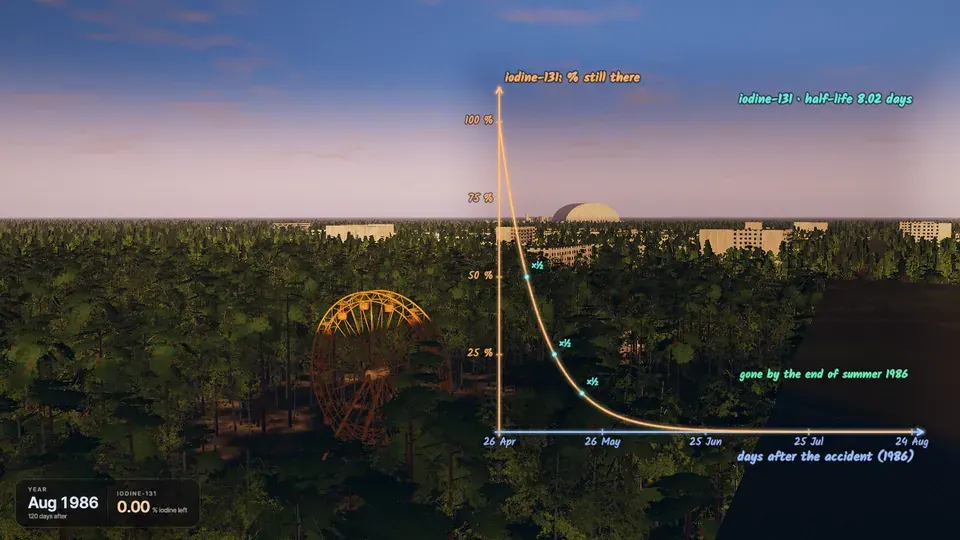
So, about that twenty thousand years. The explosion also spread iodine, with a half-life of eight days, so by the end of that summer it was essentially gone. Plutonium has a half-life of twenty-four thousand one hundred ten years, so nearly all of it is still here, and in twenty thousand years more than half would be. That’s most likely where the twenty thousand comes from. It’s roughly one half-life of plutonium… a time for half of it to break apart, and never a date.
Plutonium matters most on the ground closest to the reactor, and for most of the land around here, cesium sets the clock, and it says decades to a couple of centuries. Now it’s your reading. Point the meter at the moss at the foot of the Ferris wheel, and it reads fifty curies per square kilometer today. Grab the calculator. How many years from now until this spot drops below fifteen?
Here’s the whole town with a few more readings, all examples, because real readings change from one patch of ground to the next. Let the clock run, and each spot turns green in the year it drops below the line, the square in twenty forty-six, the school in twenty sixty-four, your Ferris wheel in twenty seventy-eight, and the hottest spot not until twenty one sixteen.
This model only knows about decay. Rain carries cesium down into the soil, which shields it, so real meters often read lower. And when people come back is for the law to decide, while the math only tells you when the ground crosses that line. But you took one reading from this ground and worked out, to the year, when it crosses that line, and you know now that twenty thousand years was never a date.