
Topic 2.3 key terms
- exponential function
- A function of the form with initial value and base , .
- initial value
- The constant in : the output at , since .
- base
- The constant in : the factor the output is multiplied by each time the input increases by 1.
- exponential growth
- An exponential function with and (the paper, ).
- exponential decay
- An exponential function with and (the light, per 35 m).
- domain of an exponential function
- All real numbers. Whole-number inputs count factors of the base; every other input fills in between.
- proportional over equal-length input intervals
- Outputs an equal input step apart always have the same ratio: .
- concave up / concave down
- The rate of change is increasing (concave up) or decreasing (concave down). An exponential function is one or the other everywhere.
- point of inflection
- A point where a graph changes concavity. Exponential functions have none.
- extrema on a closed interval
- An exponential function has no maximum or minimum except at the endpoints of a closed interval.
- additive transformation
- Adding a constant: . Use it when the outputs minus are proportional over equal intervals.
- horizontal asymptote
- A line the outputs approach as increases or decreases without bound. For it is .
Transcript
2,747 words · 9 parts
The blood was green
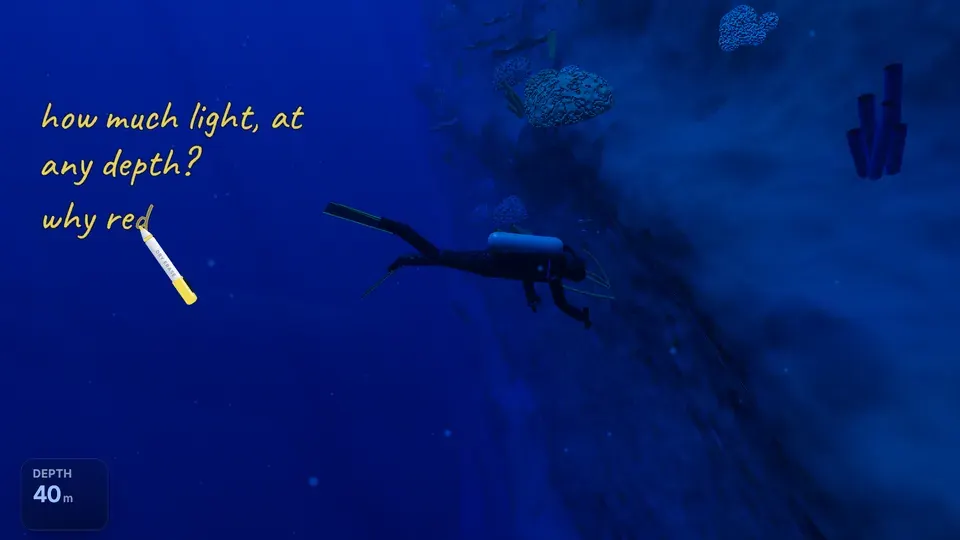
This is the sky from under the sea, the whole thing squeezed into one bright circle over your head. Follow this diver down the reef and watch the colors, because the reds fade first, then the oranges, and by twenty meters the whole world has turned blue-green. Thirty meters down there’s a sea fan, and it looks gray, almost black, so watch what happens when the torch goes on.
It’s bright red. It was red the whole time. So the sea took the red out of the sunlight on the way down. Jacques Cousteau’s partner once speared a fish thirty-seven meters down, and Cousteau wrote in his 1953 book, “The blood was green.” As they brought the fish up, the blood turned red again.
Here’s the promise. By the end, you’ll know how much light is left at any depth. You’ll know why red goes first. And you’ll see why, even a kilometer down, where it’s darker than any night you’ve ever seen, the light never actually reaches zero. So before we measure anything, how deep do you think sunlight really reaches?
Half the light
Let’s go down and find out, with some light meters. A meter measures how much of the sun’s blue light reaches it. Blue lasts the longest down here. Start at the surface. The meter reads a hundred percent.
That’s all of the sunlight. At thirty-five meters it reads fifty, so half the light is already gone. And at seventy meters it reads twenty-five, half of what we had at thirty-five, so the next stretch of water took half again. So in the clearest ocean on Earth, every thirty-five meters lets through about half of the blue light that reaches it.
Now it’s your turn to drop one. Find the depth where only an eighth of the surface light is left. Then let it go.
A hundred and five meters reads twelve and a half percent. That’s an eighth of the light, after three halvings. But water isn’t really sliced into stretches, so what does the meter say in between, at seventeen and a half meters?
About seventy-one percent. If you expected seventy-five, halfway between a hundred and fifty, that’s what adding would give you, but the ocean multiplies instead. Let’s lift these readings out of the water. Watch. They’re going on the board.
Here are our meters in a table. The first column counts the stretches of water, the second is the depth, and the third is how much light is left, which goes a hundred, fifty, twenty-five, then twelve and a half. Every row down multiplies the light by one half, so at a hundred and five meters it’s a hundred times a half, times a half, times a half.
Three factors of a half is a half cubed, so the exponent counts the stretches, and after n of them the light is a hundred times one half to the n. A hundred is where we started, and one half is what each stretch lets through.
Seventeen and a half meters is half a stretch, so n equals one half, and one half to the one-half is about point seven oh seven, the seventy-one percent on the meter. Two half-stretches make one whole stretch, so the half-stretch factor times itself has to give one half, and point seven oh seven times point seven oh seven is about one half. Every depth in the sea has a reading like that, so the exponent doesn’t have to be a whole number, and in fact it can be any real number at all, which is why the domain of an exponential function is all real numbers.
Forty-two folds
The ocean multiplies by a half, so let’s run the same machine with a number bigger than one, and all we need is a sheet of paper. It’s about a tenth of a millimeter thick, and every time you fold it in half, its thickness doubles. By the seventh fold that’s a hundred and twenty-eight layers, about where your hands give up, but math doesn’t get tired, so let’s keep folding.
Fourteen folds is as tall as a person, and on the twenty-third fold, the paper passes the top of the Burj Khalifa, all eight hundred and twenty-eight meters of it. Fold thirty reaches the edge of space, fold thirty-two passes the space station, and we’ll stop at fold thirty-nine, with the Moon still out ahead of us.
Here we are at fold thirty-nine. Think about it for a second. How much of the way to the Moon do you think the stack has gone?
Fold forty doubles it to about twenty-nine percent, forty-one to fifty-seven, and on fold forty-two the paper goes right past the Moon. Those last three folds did the other eighty-six percent of the trip, and then some, because every fold adds as much as the whole stack before it. So after n folds the paper is zero point one millimeters times two to the n, the same machine as the ocean, with a b of two that grows instead of a half that shrinks.
Three colors, three bases
So here we are, back at our gray sea fan. Why is red the first color to go? This lamp shines red, green and blue, and every meter of water keeps about ninety-eight percent of the blue, ninety-four percent of the green, and only seventy percent of the red. Ninety-eight percent a meter is our halving in disguise, because thirty-five factors of point nine eight make about one half.
Thirty meters down, the blue keeps more than half its strength, the green about a sixth, and the red about two thousandths of one percent, which is as good as nothing. That’s the gray fan, and the torch’s light crosses only a meter or two of water, so plenty of its red survives. Cousteau’s blood looked green for the same reason. The red light it would reflect was already gone, so all it could send back was a little of the dim blue-green light, and it looked dark green.
On a graph they’re three curves that start at a hundred percent and differ only in what they multiply by. Every exponential function has this form, f of x equals a times b to the x, where a is the initial value, the output when x is zero, and b is the base, what you multiply by each time x goes up by one. When a is positive and b is bigger than one, like the paper, it’s exponential growth, and when b is between zero and one, like the light, it’s exponential decay.
The base can’t be one. Then nothing ever changes. You just get a flat line. And it can’t be negative. Take negative two: negative two to the one-half is the square root of negative two, which isn’t a real number.
And a can’t be zero, since zero times anything is zero. And watch out for multiplying a and b together first, because zero point one times two to the forty-second goes past the Moon, while zero point two to the forty-second is far smaller than an atom. So with growth and decay back on the board, which of these four functions shows exponential decay?
No turning back
Each stretch of water takes half of what’s left, so the first takes fifty points of light, the next twenty-five, and the next only twelve and a half. So the light is always decreasing, but the drops are shrinking, which means the rate of change goes negative fifty, negative twenty-five, negative twelve and a half, still negative but climbing toward zero.
And a rate of change that keeps increasing is exactly what concave up means, so this curve is decreasing and concave up at the same time. That’s one of the most common mix-ups in this topic. A falling curve feels like it should bend down. It doesn’t.
The whole reason fits in one line. Every step multiplies by b, so the change from one step to the next is b times where you are, minus where you are, which is b minus one times where you are. For the light that’s negative one half, so each step loses half the current light, which is our ladder.
And since f is never zero, the change is never zero, so the curve never turns around and has no maximum or minimum. Its sign never flips either, because b minus one is a fixed number and f always has the same sign as a, so it’s always increasing or always decreasing.
Now look at the drops themselves. They go negative fifty, negative twenty-five, negative twelve and a half. Each one is up from the last. First by twenty-five, then by twelve and a half. The change keeps rising, so the curve bends up.
Why does that always happen? The change, b minus one times f, is itself exponential. So its own change is b minus one times that. That’s b minus one squared, times f.
Since b isn’t one, that square is positive. So the change of the change has the same sign as f. For the light, that’s positive. It always bends up, with no point of inflection.
That puts every exponential function in one of four corners, by whether b is above or below one, and whether a is positive or negative. The only maximum or minimum it can have is at the ends of a closed interval, so on a dive from the surface to a hundred and forty meters, the brightest point is the top and the darkest is the bottom.
Let’s fill in the bottom row with g of x equals negative two times one half to the x. As x increases, which way does g head, and which way does it bend? So g goes here, rising and bending down, and the last corner, a negative a with b above one, falls faster and faster, decreasing and concave down.
Two readings are enough
Here’s an AP exam classic. You get a table. You decide what kind of function it is. This one is from the real 2025 exam. The inputs go up by one, so divide each output by the one before, and you get one half every time.
That’s what the graders wanted. The reason only earned its point if it showed the same ratio for more than one pair. Just saying you ran an exponential regression didn’t earn it. And the table gives us the whole function, because a is the output at zero, three point five, and b is one half.
Sometimes you only get two points, and they aren’t neighbors, say one comma six and three comma twenty-four. It’s two steps from six to twenty-four, so six times b squared is twenty-four. That makes b squared equal to four. So b is two or negative two. It can’t be negative two, because the base has to be positive.
Then a times two is six, so a is three. That gives f of x equals three times two to the x. But sometimes the ratios won’t be constant at all. That isn’t always the end of the story.
Add one
This puzzle went on sale in Paris in 1883, and the man who invented it was the French mathematician Édouard Lucas. Here’s the game. Move the whole tower to the last post. Move them one at a time. And never put a bigger one on a smaller one.
With just one, it takes one move, and with two it takes three, because the small one goes aside, the big one goes across, and the small one goes back on top. Now you try it with three. Use as few moves as you can. Go ahead.
Four disks take fifteen moves, and five take thirty-one. Divide each count by the one before and you get three, then two point three three, then two point one four, so the ratio isn’t constant.
But add one to every count and you get two, four, eight, sixteen, thirty-two, exactly doubling, so the moves are two to the n, minus one. Lucas sold it with a legend he almost certainly made up, about sixty-four golden pieces whose last move would end the world, and at one move a second that would take about five hundred eighty-five billion years, more than forty times the age of the universe.
Our diver’s wrist computer uses the same trick. The longer you stay deep, the more nitrogen soaks into your body, and surfacing with too much of it can make you seriously ill. The dive computer works out point seven six bar of nitrogen, then one point nine six, two point five six and two point eight six, five minutes apart, which isn’t a constant ratio either. But the nitrogen in the air the diver breathes down here is about three point one six bar, and the gap between the body and that number halves every five minutes.
Back to the puzzle. The moves weren’t proportional. But M plus one doubled every time. So M is two to the n, minus one. The nitrogen readings weren’t proportional either, so subtract each one from three point one six, like three point one six minus point seven six, which is two point four, and three point one six minus one point nine six, which is one point two, and the gaps halve every five minutes.
So the gap is two point four times one half to the n. That makes the reading itself, N, three point one six minus that gap. Here n counts five-minute steps. So n is the minutes divided by five. When adding or subtracting a constant makes the outputs proportional, we model the function as an exponential shifted by that constant, and this one levels off at three point one six, not at zero.
The last light
Now let’s follow the light much deeper than any diver can go, in a little submarine. Two hundred meters is about five point seven stretches of thirty-five, so less than two percent of the light is left, and three hundred and fifty meters is ten stretches, about a tenth of a percent. These hatchetfish light up their bellies to match the faint sunlight from above, so a hunter looking up can’t see their silhouette, and that trick only works because there’s still a little sunlight down here.
On the board, the light gets closer and closer to zero, but each step only takes half of what’s left, so it never gets there. We write that as the limit, as x goes to infinity, of a hundred times one half to the x, equals zero, and y equals zero is a horizontal asymptote.
The ocean stops at the surface. The math doesn’t. As x goes to negative infinity, every step back doubles the output. So it increases without bound. Every exponential in this form ends one of three ways in each direction, growing without bound, falling without bound, or closing in on zero, depending on its corner of the map.
Back to the paper, h of x equals zero point one times two to the x, so what happens to h of x as x decreases without bound? We’re now about a kilometer down. That’s thirty halvings. The sunlight here is about a billionth of what it was at the surface. Let’s turn the lights off.
That’s a lanternfish, and down here almost all the light any animal ever sees is light that animals make themselves. So if you guessed a kilometer, you were right about what any eye we know of can see. And if you guessed all the way to the bottom, you were right about the math. The function never reaches zero.
What the sea taught us
Let’s put together what the ocean taught us. An exponential function starts at a and multiplies by the same b every step, and with a positive a, it grows when b is above one and decays when b is between zero and one.
Equal steps give equal ratios, so it never turns around and always bends the same way, and its input can be any real number. When the ratios aren’t constant, try shifting by a constant first, and at either end, a times b to the x heads to infinity, negative infinity, or zero, without ever touching zero.
And now you know how much light is left at any depth of the sea, and why the red goes first. And you know why, even a kilometer down, the light never quite runs out.