
Topic 2.14 key terms
- decibel (dB)
- Sound level L = 10·log(I/I₀) with I₀ = 10⁻¹² W/m²: +10 dB for every ×10 in intensity; 0 dB is the faintest sound you can hear, not silence.
- real zero
- The input where a model outputs 0. Together with a proportion (the output adds k each time the input is multiplied by r) it builds the model f(x) = k·log_r(x/x₀).
- proportion
- For a log model: multiplying the input by a fixed factor always adds the same amount to the output (×10 intensity → +10 dB).
- whole-number output
- When a log model gives a whole number, it counts how many times the initial value was multiplied by the proportion (60 dB = I₀ multiplied by 10 six times).
- logarithmic fingerprint
- Input values change proportionally (×2, ×2, …) over equal-length output intervals (−6, −6, …): the pattern of a logarithmic function.
- natural logarithm
- ln x = log base e of x; changing the base of a log model only rescales b, and calculator regressions use ln.
- logarithmic regression
- A technology fit of y = a + b ln x to data (LnReg); every x must be positive.
- domain of a model
- The inputs where the model's assumptions hold; outside it (the 194 dB wall, "audible past Pluto", 122 years at about $160 million) a model's predictions mean nothing.
Transcript
2,546 words · 8 parts
The loudest sound
It’s the morning of August twenty-seventh, 1883, in the strait between Java and Sumatra, and the sky has gone dark, because that island on the horizon, a volcano called Krakatoa, has been erupting violently since yesterday. Sailors out here have watched lightning flicker inside that cloud all night, and at two minutes past ten, the volcano does something much bigger. That explosion made what’s often called the loudest sound in recorded history.
It was also a terrible disaster, and more than thirty-six thousand people died, most of them in the tsunamis it set off. The sound traveled almost unbelievably far, and on a tiny island in the Indian Ocean, almost five thousand kilometers away, which is farther than New York is from Los Angeles, the chief of police wrote that it sounded like the distant roars of heavy guns.
And in Batavia, today’s Jakarta, about a hundred and fifty kilometers from the volcano, a machine at the gasworks was drawing the gas pressure on a paper chart with a pencil. At a quarter past ten the air wave arrived, and the pencil shot straight up, right off the paper. A jet engine thirty meters away is about one hundred and forty decibels, so how loud do you think the blast still was when it reached this gasworks?
By the end of this lesson, you’ll take that pencil line and turn it into decibels yourself. And you’ll know why nothing in our air can ever get much louder than Krakatoa. To do that, we need to know how the decibel scale is built. So let’s start at the very bottom of it, in the quietest room on Earth.
Below the floor
This room in Minneapolis is built to swallow sound, and it’s so quiet that people sitting in here say they can hear their own heartbeat. Wedges cover every surface, even the floor under this metal net, so almost no sound bounces back. Now let’s stand a ladder of light in here. Look at its bottom rung. It’s the faintest sound you can hear.
Its intensity is just ten to the negative twelve watts per square meter, and we call it zero decibels. Every rung you climb is a sound with ten times the intensity of the one below it, and every rung adds ten decibels. So breathing is one rung up at ten decibels, a whisper is three rungs up at thirty, and a conversation is six rungs up at sixty.
A rock concert is way up at a hundred and ten, and our jet engine is fourteen rungs up, at a hundred and forty. So every ten decibels counts one more time you multiplied by ten, and sixty decibels is the faintest sound times ten, six times over. A concert is about one hundred and ten decibels and a conversation is about sixty, so how many times as intense as the conversation is the concert?
To turn the ladder into a formula, we need an output that goes up ten every time we multiply the intensity by ten. And it has to be zero at the faintest intensity. Adding the same amount every time you multiply is exactly what a logarithm does, because the log of ten x is the log of x, plus one.
So we use ten times a log, because each factor of ten has to add ten decibels instead of just one. And inside the log we divide the intensity by the faintest intensity, so the faintest sound gives the log of one, which is zero. Plug in the faintest sound and you get zero, and ten times that intensity gives exactly ten decibels. That’s the recipe for this kind of model, a proportion that says what the output adds each time the input multiplies, and a real zero that says where the output is zero.
You’ll also see it written another way, because the log of a quotient is a difference of logs. The log of ten to the negative twelve is just negative twelve, so minus ten times that is plus a hundred and twenty. So dividing the input by the faintest intensity does the same thing as lifting the whole graph of ten log I up a hundred and twenty.
Now back to the quiet room. A sound meter in here reads something strange. Negative twenty-four point nine decibels, which is below the bottom rung, quieter than the faintest sound you can hear. A negative output just means the input is less than the faintest intensity, in here about a three-hundredth of it, since the log of a number below one is negative.
So what would perfect silence be? Turn the noise down toward nothing, and the meter just keeps falling, past negative fifty, past negative a hundred, and it never reaches a bottom. Silence isn’t zero decibels, and it isn’t on the scale at all, because as the intensity heads toward zero, the log heads toward negative infinity. Zero decibels is just where we chose to start counting. Now we can go back to Batavia.
The pencil line
That machine measured pressure, how hard the air was pushing, so we need the scale written for pressure instead of intensity. Its reading was point three seven inches of mercury, a unit barometers still use, and the pencil went even higher than the paper could show.
We need one new fact. A sound’s intensity grows with the square of its pressure. So ten times the pressure is ten squared, a hundred times the intensity, which is two rungs, so every factor of ten in pressure adds twenty decibels. The faintest sound you can hear pushes with a pressure of only twenty micropascals, so that’s where this scale is zero.
So which model gives the sound level from the pressure? Now the reading, point three seven inches of mercury, is about twelve hundred and fifty-three pascals. So how many decibels is that, at the very least? Give it to the nearest tenth.
So at least a hundred and fifty-six decibels reached the gasworks. If you guessed more than a hundred and fifty at the start, you were right. That’s sixteen decibels more than the jet engine, which is about forty times the intensity, from a hundred and fifty kilometers away. Building a model from a proportion and a real zero, then using it to predict, is exactly what this topic asks for on the exam.
Rings on the sea
That’s at least a hundred and fifty-six in Batavia. So how loud was it everywhere else? Let’s say the sound spreads out evenly in every direction, so twice as far away, the same energy covers a sphere with four times the area, which leaves a quarter of the intensity.
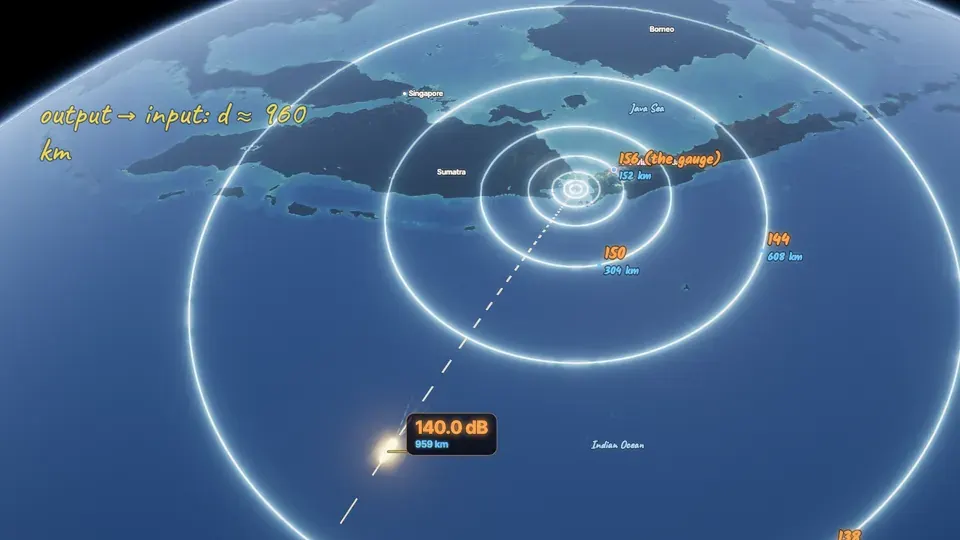
Ten times the log of four is about six, so a quarter of the intensity means about six decibels less. So the model’s rings go out like this, each one twice as far as the last, out to six hundred kilometers and then twelve hundred, and each one six decibels quieter. Going inward, seventy-six kilometers is a hundred and sixty-two decibels, and thirty-eight is a hundred and sixty-eight.
Now look at the shape of this, the gaps between the rings keep doubling, while the level drops the same six decibels every time. When the input multiplies by the same factor over equal steps of the output, that’s the fingerprint of a logarithmic function, whether it’s in a table or on the sea.
Here are the rings as a table. Distance goes on one side. The sound level goes on the other. The model through them is a hundred fifty-six minus twenty times the log of d over a hundred fifty-two.
Check it on the next ring, at three hundred and four kilometers. Twenty times the log of two takes off about six. So you get the hundred and fifty in the table. Now flip the question, how far away do you have to be to hear a given level? Every six decibels down doubles the distance, and that’s an exponential function.
It’s the same table read the other way, because a log is the inverse of an exponential, and AP questions test exactly that, so always ask which quantity is the input. Your move. Where does the model say the blast was as loud as that jet engine? Drag the boat out there.
That’s using a model backward, starting from an output and finding the input, and it matters just as much as predicting. But every model has edges, so let’s push the boat in toward the volcano. A hundred and sixty-two, a hundred and sixty-eight, a hundred and seventy-four, and about two kilometers out, it hits a wall at a hundred and ninety-four.
A sound squeezes and stretches the air, and the stretched part can’t get any thinner than empty space, so the biggest possible swing is the whole pressure of the atmosphere. Put about a hundred and one thousand pascals into your pressure model and you get a hundred and ninety-four decibels, the loudest sound our air can carry, and anything stronger is a shock wave.
Now ask the model the opposite question. Where does the sound fade all the way down to zero decibels? Set it equal to zero and solve, and d comes out to almost ten billion kilometers, way out past Pluto.
So taken at its word, the model says you could still hear Krakatoa out here. But this is space, and there’s no air to carry a sound at all. In reality the air soaks up the sound long before that, which is why that faraway island heard only a distant roar, so a model is only trustworthy inside its domain.
The one in your pocket
A hundred and fifty-six decibels was a volcano, but about a hundred is sitting in your pocket, because that’s where a lot of earbuds top out. Hearing safety experts set the limit at eighty-five decibels for eight hours a day, and every three decibels louder cuts the time limit in half.
Why three? Because ten times the log of two is about three, so three more decibels is twice the intensity, and twice the intensity gives you the same dose of sound in half the time. It’s also why two alarm clocks that each read seventy decibels only make seventy-three together, instead of a hundred and forty.
So let’s turn it up from eighty-five, three decibels at a time, eight hours, four, two, one, thirty minutes, and at a hundred decibels, fifteen minutes. Fifteen minutes a day at full volume, and the rectangle shows why, it gets twice as tall and half as wide each click, so its area, the daily dose, stays the same. And a hundred decibels is five clicks of three, so the time limit got cut in half exactly five times.
Let’s build that rule as a model from just two of its points, eight hours at eighty-five decibels, and one hour at ninety-four, using the natural log. The one-hour point is a gift, because the natural log of one is zero, so that equation says a equals ninety-four, all on its own. The eight-hour point then gives b equals negative nine over the natural log of eight, about negative four point three three.
So the model is ninety-four minus four point three three times the natural log of T, and it slopes down, because the longer you listen, the quieter it has to be. Now double the time, and the model changes by b times the natural log of two, which is exactly negative three, the three-decibel rule straight out of two numbers.
Any base would work, since changing bases only rescales b, but calculators and scientists reach for the natural log first. A rock concert is about one hundred and ten decibels. By this model, how long until you hit a whole day’s limit? So a two-hour concert at that level packs about eighty daily limits into one night.
197 countries and territories
Real data almost never hands you two perfect points, so here’s life expectancy against income for a hundred and ninety-seven countries and territories, rising steeply on the left, then more and more slowly. With this many points you let the calculator fit the curve, using logarithmic regression, and it gives fifty-eight point nine five plus five point two seven times the natural log of x. Every time income doubles, from eight thousand to sixteen, to thirty-two, to sixty-four, the model adds the same three point six five years, five point two seven times the natural log of two.
So it predicts about seventy-three and a half years for a country earning sixteen thousand dollars a person. To reach eighty years, it says a country needs about fifty-four thousand. But it never stops rising, so it says a country could reach a hundred and twenty-two years, the oldest anyone has ever been known to live, at about a hundred and sixty million dollars a person, which is far outside its domain.
Exactly how the exam asks it
This next one was on the 2024 AP exam, so it’s exactly how this topic shows up. A new video game sold forty thousand copies on day zero, and on day ninety-one it sold seventy-six thousand copies in that one day. The model for a single day’s sales was G of t equals a plus b times the natural log of t plus one.
Why the plus one? Because the natural log of zero doesn’t exist, and day zero has to be in the domain, so the log curve slides one unit to the left. At t equals zero we get the natural log of one, which is zero, so a is forty for free, the same gift as before. Then day ninety-one gives seventy-six equals forty plus b times the natural log of ninety-two.
Your turn. What does that make b? On the real exam, only about a third of students earned the point for a and b, and some lost it by rounding too early, so keep the calculator’s digits until the very end. And every doubling of t plus one adds the same b times the natural log of two, about five and a half thousand more copies a day.
The planet rang
Let’s go back to that morning one last time. This time, we’ll watch it from space. The air wave spread from the strait across the whole planet, met itself on the far side of the Earth near Colombia and came back, and barometers around the world recorded it, many of them at least seven times in about five days.
In 2022, an undersea volcano near Tonga did the same thing, and this time, people’s home weather stations recorded it too. So now you can build a logarithmic model from a proportion and a real zero, or from two points, and when one of them makes the log zero, a comes for free, or from real data with the calculator’s regression.
Every doubling of the input adds the same amount to the output, and you can run a model forward or backward, as long as you stay inside its domain. And that pencil line from Batavia, you turned it into at least a hundred and fifty-six decibels yourself, and the same model told you why our air can’t carry a sound much louder than a hundred and ninety-four.