
Topic 2.9 key terms
- logarithmic scale
- A scale on which each unit represents a multiplicative change of the base: marks instead of . Equal distances mean equal factors.
- logarithm
- is the exponent you must raise the base to in order to get : if and only if (, ).
- base of a logarithm
- The number in , the factor each step multiplies by. It must be positive and not 1.
- common logarithm
- The logarithm with base 10. When no base is written, means ; for example .
- logarithm of zero or a negative number
- and the log of a negative number have no value, because for every real exponent when . A negative logarithm, like , is fine.
Transcript
2,511 words · 9 parts
One ruler for everything
This ruler is drawn perfectly to scale, and that blazing ball way out at the far end of it is the Sun, about one point four million kilometers across. So where’s everything else, like the Earth, or Mount Everest, or you? Let’s go looking, back along the ruler, past a whole lot of nothing, until right at zero there’s one tiny glowing dot.
If we look inside that dot, the Earth is in there, and Everest, and you, and every atom you’re made of, all piled up in one tiny spot, because on an ordinary ruler, once the Sun fits, nothing else does. So let’s try a completely different kind of ruler, one where every step is ten times bigger than the step before it.
And now everything has room. There’s a proton, an atom, a red blood cell, an ant, you, a blue whale, Everest, the Earth, the Sun, the Milky Way, and way out at the very end, the edge of everything we can see.
By the end of this lesson, you’ll be able to put anything on this ruler, from a proton all the way out to the edge of the observable universe, and with just one subtraction, tell exactly how many times bigger one thing is than another. And this same ruler explains one of the strangest facts about numbers I’ve ever come across, but we’ll save that one for later.
Halfway between one and nine
It all comes down to how this ruler counts, so let’s test your instincts first. Here’s the stretch between the one-meter column and the ten-meter column, with one and nine marked on it.
Which number do you think belongs exactly halfway between one and nine on this ruler? In one study, the Munduruku, a people of the Amazon with no exact words for numbers above five, put the middle of one to ten at about three or four, and on this ruler, that’s right where the middle is.
On an ordinary ruler every step adds one, so the marks go zero, one, two, three, and on our ruler every step multiplies by ten, so they go one, ten, a hundred, a thousand. And the two rulers line up, because one is ten to the zero, ten is ten to the one, a hundred is ten to the two, and a thousand is ten to the three. That’s exactly how the AP exam pictures a log scale, and the phrase to know is that each unit means one more multiplication by the base, which here is ten.
A logarithm is an exponent
Now look at where the Earth is standing. The hairline says seven point one one, and ten to the seven point one one meters is about thirteen thousand kilometers, which is just how wide the Earth is. So a place on this ruler is really an exponent, the power you raise ten to, to get the size, and the name for that kind of number, the one you’ve probably heard and maybe even dreaded, is a logarithm.
The easiest logs to see are the columns themselves. A thousand is ten times ten times ten, three columns up from one meter, so we write log of a thousand equals three. For a power of ten the log just counts the zeros, so log of a million is six, and log of ten is one.
Now a different base. If I write two to the fifth, don’t tell me thirty-two yet, tell me what it says, which is five twos multiplied together. A logarithm turns that around and asks how many twos multiply to make thirty-two, and the answer, five, is log base two of thirty-two.
Let’s watch the pieces move with a smaller one. Two cubed is eight, and if I slide the pieces around, it becomes log base two of eight equals three. The base stays the base and drops down low, the eight becomes the number we take the log of, and the exponent, three, is the answer.
So in general, log base b of c equals a means b to the a equals c, and every log asks you the same question, b to what power gives me c? And when there’s no base written at all, like log of a thousand, the base is ten. Let’s see if it clicks. What’s log base three of eighty-one?
Here’s my favorite thing about this ruler. It doesn’t have to count in tens. Switch the base to two and every column becomes a doubling, one meter, two, four, eight, so eight meters sits three columns past one meter. And from the Planck length, the tiny scale where today’s physics breaks down, out to the edge of the observable universe, the whole ruler is only about two hundred and four doublings long.
Counting factors
You can work out a lot of logs right in your head. And two of them are worth knowing by heart, so let’s start there. Log base five of one is zero, because five to the zero is one, and in any base, the log of one is zero. And log base seven of seven is one, because it takes exactly one seven to make seven, and in any base, the log of the base itself is one.
Log base three of one ninth asks three to what power gives one ninth, and since one ninth is one over three squared, that’s three to the negative two, so the answer is negative two. On a ruler that counts in threes, that’s two steps to the left of one, just like the atom up in space standing at negative ten, so negative answers are perfectly fine.
Log base nine of twenty-seven looks harder, until you notice that nine and twenty-seven are both powers of three. So nine to the x is three to the two x, because a power of a power multiplies the exponents, and that has to equal three cubed, so two x is three, and x is three halves. And it checks out, because nine to the three halves is the square root of nine, cubed, which is twenty-seven. In the same way, log base four of two is one half, because the square root of four is two.
So on a ruler that counts in fours, two sits exactly halfway between one and four, because one times two is two and two times two is four. The mistake I see most is saying log base two of eight is eight divided by two, which is four. Dividing counts the twos you add, but a log counts the twos you multiply, and that’s three.
Here’s a close cousin of the example where we found three halves. What’s log base twenty-seven of nine? So negative answers are fine.
The ruler has no left end
But how far left does this ruler go? And is there a place on it for zero? Let’s walk the hairline left, past the atom, past the proton, past ten to the negative twenty meters, all the way to the Planck length, where the ruler fades into fog.
Every step to the left divides by ten, a tenth, a hundredth, a thousandth, and no matter how many times you divide, you never reach zero. Zero isn’t on this ruler, and neither is any negative number, because nothing has a size of zero, or of negative five meters.
In symbols, ten to any power is positive, so no power of ten equals zero, and none equals negative five. Log of zero point zero zero one is negative three, which is fine, because for a base like ten, a negative answer just means a number between zero and one. The base has rules too. A base of one gives a ruler where every column says one, so it never gets to two, or five, or anything else.
And a negative base breaks, because negative two to the one half is the square root of negative two, which isn’t a real number. So the base has to be positive. And it can’t be one. And you can only take the log of a positive number.
Between the columns
So far every log has come out whole or a nice fraction, but most things land somewhere between the columns. Here’s the Eiffel Tower, three hundred thirty meters tall, between you and Everest. Where do you think it belongs on this ruler? Drag it into place.
Halfway between a hundred and a thousand is about three hundred sixteen, because multiplying by the square root of ten, about three point one six, twice takes you from a hundred to a thousand, so the tower sits just past the middle. On a meter ruler the tower would be only four percent of the way from you to Everest, and here it’s more than sixty percent, because it’s nearly two hundred times your height but only a twenty-seventh of Everest’s.
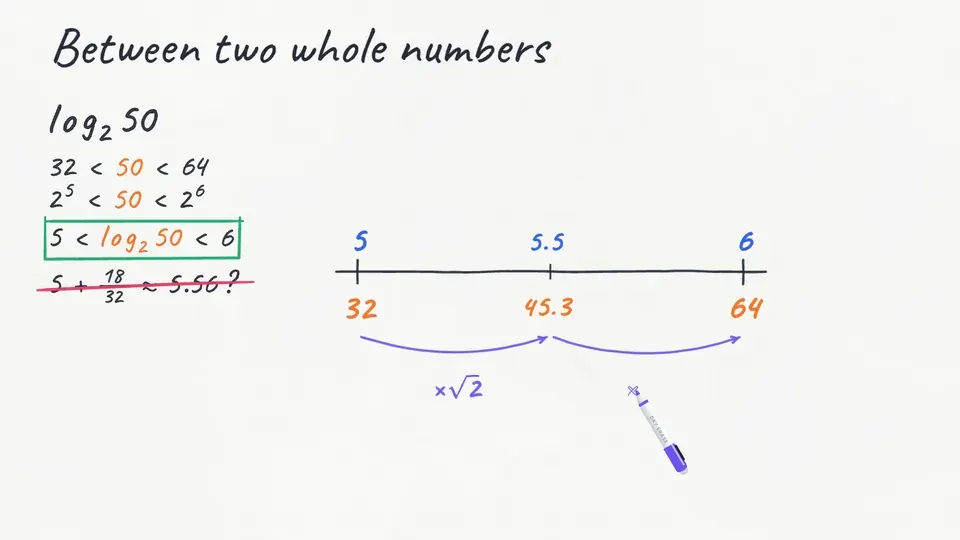
Now a base that isn’t ten, which is how the exam likes to ask it. Between which two whole numbers is log base two of fifty? Fifty is between thirty-two and sixty-four, two to the fifth and two to the sixth, so log base two of fifty is between five and six. Fifty is a bit past halfway from thirty-two to sixty-four, so you might guess five point five six, and that’s a little off.
On this ruler the middle of thirty-two and sixty-four is about forty-five, not forty-eight, because multiplying by the square root of two, about one point four one, twice takes you from thirty-two to sixty-four. So fifty is farther past the middle than it looked, and its log comes out bigger than five point five six. A calculator says about five point six four four, and two to the five point six four four comes out to just about fifty.
To justify an estimate on the exam, you name the two powers that trap it, so you’d say log base three of a hundred is between four and five, because a hundred is between eighty-one and two hundred forty-three. Try this one the same way. Between which two whole numbers is log base five of three hundred? Remember that strange fact about numbers? The one I promised you?
Thirty percent
Here’s nearly every country and territory on Earth, and each one’s population, rising off the map onto a ruler just like ours. They spread out across the columns, from Tuvalu’s ten thousand or so people to India’s one point four billion, and pretty evenly, which tends to happen when numbers grow by multiplying. Now let’s fold the ruler up like a carpenter’s ruler, so every column lies on top of the next, and each dot keeps its place in its stretch, so thirty-four million and three thousand four hundred land together.
That spot sets the first digit. If every digit got a fair share, each tube would get one in nine, about twenty-four countries. So let’s drop every dot into the tube for its first digit. Sixty-eight countries have a population starting with a one, almost a third of them, and only eight start with a nine, and nobody planned that.
So why a third? The ones own the stretch from one to two, which is log of two minus log of one, just log of two. You can even find log of two without a calculator. Two to the tenth is one thousand twenty-four, almost exactly ten cubed, so ten doublings take you about as far as three tens.
That means one doubling covers about three tenths of a step of ten, so log of two is about three tenths. So the ones own about thirty percent of every stretch between two columns, and since the dots are spread out evenly, they should get about thirty percent of the dots, and the real count, thirty-one percent, lands right on it.
Use the calculator’s scientific keys and the same idea on the nines, the stretch from nine to ten. What percent should start with a nine? Now here’s what happens when someone makes the numbers up.
In the early nineteen nineties a manager in Arizona’s state treasury wrote twenty-three checks to a vendor that didn’t exist, and almost all of his made-up amounts pile up in the sevens, eights and nines. Made-up numbers rarely follow the pattern, so auditors use it to flag data for a closer look, though it only works for numbers that span lots of powers of ten, and it never proves anything by itself. It’s called Benford’s law.
How many times bigger?
Now let’s keep the promise we made at the very beginning. How many times bigger is the Earth than you? You stand at zero point two three and the Earth at seven point one oh five, so the gap between you is six point eight seven five units.
Each unit is a factor of ten, so six whole units is a million, and the last point eight seven five of a unit is ten to the point eight seven five, about seven and a half. So the Earth is about seven and a half million times wider than you are tall, and its twelve point seven million meters divided by your one point seven meters agrees. That’s exactly how the exam asks about log scales, and a full answer names the gap, says each unit is a factor of ten, and turns the gap into ten to that power.
Now for the best part. Let’s swing the ruler around the Earth, so it measures distances instead of sizes. The Moon is at eight point five eight, the Sun at eleven point one seven, and here at thirteen point four one is Voyager 1, the farthest thing people have ever built.
It launched in nineteen seventy-seven, and November eighteenth, twenty twenty-six is the day it reaches one full light-day from Earth, the first thing we’ve ever built to get that far, so a signal from it takes a whole day to get here. And the nearest star after the Sun, Proxima Centauri, is way out at sixteen point six oh.
Use the ruler the way we just did. About how many times farther away is Proxima Centauri than Voyager 1? Everything Voyager has done, since it launched, is still more than three columns short of the next star.
Everything on one ruler
That’s the whole idea. So now let’s put all of it together on one board. A logarithm is an exponent, so log base b of c asks what power of b gives you c. Some logs you can work out by counting factors, and the rest you trap between two powers or get from a calculator. Only positive numbers have logarithms, and the base has to be positive and can’t be one.
And on a log scale every unit is one more factor of the base, so a gap on the ruler tells you how many times bigger. You started this lesson with everything crushed into one tiny dot, and now you can put everything from a proton to the edge of the universe on one ruler, and with one subtraction, say how many times bigger any of it is.