
Topic 2.4 key terms
- product property
- : climbing in two legs multiplies the two factors (m links of ×b, then n more).
- horizontal translation = vertical dilation
- For an exponential function, with : sliding the graph sideways is the same as stretching or squashing it vertically.
- negative exponent property
- : running the steps backward gives the reciprocal, never a negative number. Also .
- power property
- : bundling steps gives a new base for a longer step, e.g. .
- horizontal dilation = change of base
- for a constant : squeezing or stretching the graph of sideways gives the exponential with base . With it is a reflection over the y-axis: .
- unit fraction exponent
- for a natural number k, when the root exists: one ×b step split into k equal pieces, each a kth root of b.
Transcript
2,654 words · 9 parts
The top of the world
This is the top of Mount Everest, eight thousand eight hundred forty-nine meters up, a few minutes after sunrise. And the person standing up here is breathing like they’ve just sprinted up a flight of stairs, even though they’re standing perfectly still. The strange thing is that the air up here is still about twenty-one percent oxygen. It’s the same mix you’re breathing right now, but there’s a lot less of it.
You can see it in that bag of chips on the pack. It was sealed far below. Now it’s puffed up tight, because so little air outside pushes back. So how much less air is in every breath up here? Ten percent less, or half, or something even worse?
By the end of this lesson, you’ll be able to work that out yourself, from one simple rule about the air, and then we’ll check your answer against what a barometer actually read when someone carried one up to this exact spot. To get there, we’re going to rewrite one exponential function four different ways, and this mountain will show us every one of them. So let’s start at the very bottom, at the beach.
Half the air, every 5.5 km
Here’s the whole mountain from the side. It starts on the plains of India and Nepal, close to sea level. It rises to the summit, and the sky above it. Weather scientists use a handy rule of thumb. Climb about five and a half kilometers. The air pressure drops by half.
So if a breath at the beach holds a hundred units of air, then five and a half kilometers up, just above Everest Base Camp, the same breath holds only fifty. If that sounds familiar, that’s because the ocean did the same thing to sunlight in the last lesson, only here it’s upside down and a lot slower. Now, passenger jets cruise at about eleven kilometers, which is twice as high as that first line.
Look up at that jet. How much of the beach’s air do you think is outside its window? Climbing is really counting halvings, which is exactly what an exponent counts, so let’s lay the mountain on its side and make it a graph.
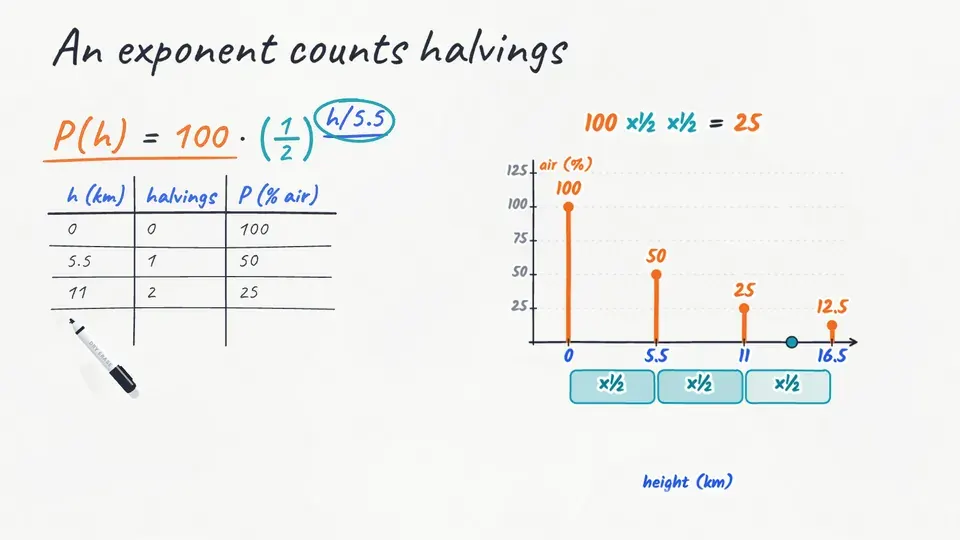
Here’s the rule as a function, P of h equals a hundred times one half to the h over five point five, where h is your height in kilometers and P is your air compared with the beach. The exponent, h over five point five, counts halvings. At zero kilometers that’s zero halvings and the full hundred. At five and a half it’s one halving and fifty, at eleven it’s two and twenty-five, and at sixteen and a half it’s three and twelve and a half.
Picture it as a chain where every link is one halving. Each link you cross multiplies the air by one half, so the exponent just counts the links, the number of times you multiply.
Now look at the summit. Eight point eight four nine over five point five is about one point six halvings, so what does it even mean to multiply by a half one point six times? You can’t do anything one point six times. So that question will take the whole lesson. We’ll go one move at a time.
Heights add, air multiplies
Most climbers start from Base Camp, about five thousand four hundred meters up, which is almost exactly one halving. So Base Camp is like a sea level with half the air. Every climb from there starts with about fifty-one percent of a beach breath. Here’s a question that sounds easy. Two climbers each climb two kilometers, one from the beach and one from Base Camp.
So what’s your guess? Which one loses a bigger fraction of the air they started with? So the same climb always multiplies your air by the same factor, wherever it starts. Why does that work? Let’s find out on the board.
Say you climb p kilometers, then q more. The first climb multiplies your air by one half to the p over five point five, the second by one half to the q over five point five, and together they match one climb of p plus q. On a chain, three links and then four links make seven links, so two cubed times two to the fourth is two to the seventh, and in general, b to the m times b to the n is b to the m plus n, the product property.
Here’s what that does to a graph. Base Camp’s climber measures from camp, so their curve is the beach curve slid five point three six four kilometers to the left. But by the product property, that slide is the same as squashing the beach curve to fifty-one percent of its height, and look, the two curves land right on top of each other.
In general, b to the x plus k equals b to the k times b to the x, so for an exponential, a horizontal translation is always a vertical dilation. Two to the x plus three is just eight times two to the x. Here’s how strange that is. Slide the window five and a half kilometers up and shrink the air axis by half, and the curve looks exactly the same, as if it refuses to change shape.
A parabola can’t do that, because sliding x squared sideways moves its lowest point, and no stretch puts it back, so this is something only exponentials do. And it’s an exam favorite. They hand you two to the x plus three, and they expect you to see eight times two to the x.
Coming back down
Now let’s run it backward. Every five and a half kilometers down, the air doubles, so from the jet’s quarter you come back to half, then to a full breath at the beach. And if you keep going, below the beach? Five and a half kilometers below sea level you’d have twice the air, and the exponent would be negative one.
There’s even a real place below sea level. The shore of the Dead Sea is about four hundred forty meters down, so the exponent is about negative zero point zero eight, and the air is about six percent thicker than at the beach. Going below zero gave us more air, never negative air, and that’s what a negative exponent does.
Let’s walk the pattern down. One half squared is a quarter, one half to the first is a half, and each time the exponent drops by one, we undo a halving, so we multiply by two. So one half to the zero is one, the beach, no halvings at all, one half to the negative one is two, and to the negative two, four.
The product property agrees. Climb up some number of halvings and the same number back down, and you’re where you started, so b to the n times b to the negative n is b to the zero, one.
So b to the negative n is the number that undoes b to the n, one over b to the n. That means two to the negative three is one over two cubed, one eighth, never negative eight, because a negative exponent flips the number over, just like the Dead Sea gave us more air. Here’s one in the exam’s language. Which of these is the same as two to the x minus three?
A new ruler
So far our ruler has been one halving, five and a half kilometers. What if you’d rather climb in bigger steps, eleven kilometers each? Two halvings make one eleven-kilometer step, so each step multiplies the air by a quarter, and look, the rungs move, but the air itself doesn’t change one bit. It’s the same air with a new base. And the algebra behind it is our next rule.
We start with one half to the h over five point five. That’s the same as one half squared, to the h over eleven, because two times h over eleven is h over five point five, and one half squared is a quarter. On a chain it’s bundling links. Three bundles of two links is six links, so two squared, cubed, is two to the sixth, and in general b to the m, to the n, is b to the m times n, the power property.
That’s the second strange graph fact. Squeeze two to the x sideways by a factor of two, and it lands exactly on four to the x, because two to the two x is two squared, to the x.
So for an exponential, a horizontal dilation is just a change of base, b to the c x equals b to the c, all to the x, for any c that isn’t zero. And when c is negative one, the squeeze turns into a mirror, so two to the negative x is one half to the x, the same curve flipped across the y-axis.
Let’s bring it back to the mountain. Which of these is the same function as one half to the h over five point five?
Half a halving
Now for the smallest ruler. Let’s split one halving into five equal steps, so each step is one point one kilometers of climbing. Five steps make one halving, so after five of them the air has to be exactly half.
So what do you think? Each of those steps multiplies the air. By how much? So where does zero point eight seven come from? Let’s go back to the board, because this is the most beautiful idea in the lesson.
Five equal steps multiply back to one half, so the step s, times itself five times, is one half, which makes s the fifth root of one half, about zero point eight seven. Here’s the simplest case, on a chain that doubles. Split one times-two link into two equal half-links, and ask what each half-link multiplies by.
It can’t be one and a half, because one and a half squared is two point two five, too much. It has to be the number whose square is two, the square root of two, about one point four one. So two to the one half is the square root of two. The power property agrees. Two to the one half, squared, is two to the one, which is two.
Now split every link into three pieces, then four, eight, sixty-four, and the posts fill in until they trace the smooth curve, so the curve itself is made of roots. Inside a single link, sixty-four tiny posts climb from one to two, each the sixty-fourth root of two times the last, and the thirty-second, halfway along, stands exactly at the square root of two, because thirty-two sixty-fourths is one half.
Here’s the general rule. B to the one over k is the kth root of b. That holds when the root exists. That’s the fine print. Negative eight to the one third is negative two, because negative two cubed is negative eight, but negative four to the one half doesn’t exist as a real number, since no real number times itself is negative.
And the rules stack. Eight to the two thirds is the cube root of eight, squared, which is two squared, four. Remember the ocean’s light at half a halving, about seventy-one percent? That was one half to the one half, which we now know is the square root of a half.
The hall of games
Now let’s take these moves somewhere with no air at all. If you’ve played a ranked game online, a rating picked your opponent, and the most famous rating system comes from chess. Say you’re rated twelve hundred, and you sit down across from twenty-eight eighty-two, the highest official classical rating, which Magnus Carlsen set in 2014.
The formula says the odds against you are ten to the gap over four hundred, and the gap is sixteen eighty-two, so the odds are about sixteen thousand to one. Play him on every board in this hall, and you’d expect to win just once.
Now watch a hundred and twenty points. Ten to the one hundred twenty over four hundred is almost exactly two, so climb a hundred and twenty points and half the hall goes dark. Another hundred and twenty, and half of what’s left goes dark, wherever you start. Rating gaps add, so odds multiply, the product property again.
Counting in hundreds of points, where each hundred is a quarter of four hundred, the base becomes ten to the one fourth, the fourth root of ten, about one point seven eight, so every hundred points multiplies your odds by that much. And from his chair the gap is negative sixteen eighty-two, so his odds of losing to you are ten to a negative power, one in about sixteen thousand.
Now you try it. Drag your rating until the odds against you are a hundred to one. A hundred is two factors of ten. Each factor of ten costs four hundred points. So it’s twenty eighty-two, eight hundred points below his rating.
On the exam
Here’s how this shows up on the exam. They give you three times two to the two x minus three. Then they ask for the form a times b to the x.
The product property splits off two to the negative three. The power property turns two to the two x into four to the x, and two to the negative three is one eighth, so the answer is three eighths times four to the x. And here’s a habit that saves points, checking both forms at x equals zero, where both give three eighths.
Watch for three traps the exam loves. Two to the x plus three is not two to the x, plus eight, three times two to the x is not six to the x, and two plus three, squared, is twenty-five, not thirteen. The rules handle sums in the exponent, never sums of the numbers themselves, and never two different bases.
This is exactly how the exam asks it. Which of these is equal to five times nine to the x over two plus one?
A third of a breath
Let’s put the four moves in one place. Heights add, so the air multiplies, and running the climb backward flips it over. A new ruler gives you a new base, and a piece of a step is a root. And two graph facts go with them. Sliding an exponential is the same as stretching it, and squeezing it gives a new base.
Now we can answer the question from the summit. Five of our little steps make one halving, and the summit, about eight point eight kilometers up, is eight of those steps. So the air up there is the fifth root of a half, eight times over, which is one half to the eight fifths, and eight fifths is one point six, the number of halvings we couldn’t make sense of at the start.
Grab the calculator for this one. What fraction of a beach breath is left on the summit? Look closely at that breath. Only seven of its dots are oxygen, where a beach breath had twenty-one.
And here’s the real measurement. In October 1981, a medical research expedition carried a barometer up to this summit, and it read two hundred fifty-three millimeters of mercury, which is zero point three three three of the pressure at sea level. Our rule of thumb landed within about one percent of it. It’s only a rough rule, so landing that close is partly luck, but a third of a breath is the real answer.
In 1978, Reinhold Messner and Peter Habeler stood right here breathing nothing but this air, a third of a breath at a time, when plenty of doctors warned that it couldn’t be done. And you worked out their number. One rule, and four moves. You can make them on any exponential the exam hands you.