
Topic 1.11 key terms
- equivalent forms
- Expressions that give the same output for every input and have the same domain. Rewriting must not change the domain: canceling a factor needs a restriction such as x ≠ 1.
- standard form
- A polynomial written as a sum of terms in descending powers of x. It shows the leading term (end behavior) and the constant term (the y-intercept).
- factored form
- A polynomial or rational function written as a product of factors. It shows real zeros (x-intercepts), holes, vertical asymptotes and the domain.
- polynomial long division
- The long-division algorithm applied to polynomials: dividing f by g gives a quotient q and remainder r with f(x) = g(x)q(x) + r(x) and deg r < deg g.
- quotient
- The polynomial part q(x) of a polynomial division. For a rational function whose numerator has degree one more than its denominator, y = q(x) is the slant asymptote.
- remainder
- The leftover r(x) of a polynomial division, with degree less than the divisor. The term r(x)/g(x) approaches 0 as x increases or decreases without bound.
- slant asymptote
- A non-horizontal line y = mx + b that the graph of a rational function approaches as x → ±∞; found as the quotient of long division.
- placeholder term
- A zero coefficient written for a missing power (x² − 1 = x² + 0x − 1) so the columns of a long division line up.
- Pascal's triangle
- The triangle of numbers in which each entry is the sum of the two entries above it. Row n gives the coefficients of (a + b)ⁿ.
- binomial theorem
- (a + b)ⁿ = the sum of terms (row n entry k)·aⁿ⁻ᵏ·bᵏ for k = 0 … n: the coefficients come from row n of Pascal's triangle; powers of a count down while powers of b count up.
Transcript
3,045 words · 7 parts
Tear me. I dare you.
If your phone’s anywhere nearby, grab it. Open the camera and point it at this code on the wall. It says, tear me, I dare you. And honestly, that’s the kind of thing I can’t say no to.
So let’s rip it. And scan it again. A whole chunk of it is gone. And your phone still reads every letter. So how does it know what was written on the part that isn’t there anymore?
The secret is that a QR code stores more than your message. It also carries extra numbers, and those extra numbers come from the remainder when you divide one polynomial by another.
By the end of this lesson, you’ll do that division yourself. Then you’ll use it on a message that got damaged on its way to you. You’ll find the damage, and fix it. That fix only works for one reason. A polynomial can be written in several different ways.
Same function, different outfits
Each way tells you something different. So let’s start there, with a plain old number. Take three hundred ninety-one. Written like this, it tells you right away how big it is, a little less than four hundred.
You can also write it as seventeen times twenty-three, and that version tells you something the first one completely hides, which numbers divide it. Same number, two outfits, and each one answers a different question, and polynomials work exactly the same way.
Here’s a polynomial in standard form, x cubed minus two x squared minus five x plus six, with the powers running from biggest to smallest. And here’s the same polynomial in factored form, x minus one, times x plus two, times x minus three, which multiplies right back out to the first line.
Factored form shows where the graph crosses the x-axis, because a product is zero only when one of its factors is zero. x minus one is zero at one, x plus two at negative two, and x minus three at three. Standard form shows you something too. The plus six at the end is where the graph crosses the y-axis.
It also answers a different question, what happens far out to the left and right. Way out there the x cubed term drowns out everything else, so the graph shoots up on the right and dives down on the left, just like x cubed. On the exam you’d write that with limits. As x goes to infinity, p of x goes to infinity, and as x goes to negative infinity, it goes to negative infinity.
Now let’s divide that same polynomial by x squared minus one, which gives us a rational function, r of x, and ask both of its outfits what they know. In standard form the top’s biggest power is x cubed and the bottom’s is x squared, so far from zero the whole thing behaves like x cubed over x squared, which is just x.
So there’s no horizontal asymptote, and the graph climbs on the right and falls on the left forever. Now factor the top and the bottom, x minus one times x plus two times x minus three, over x minus one times x plus one, and every one of those factors has a job.
The factors only on top, x plus two and x minus three, make the output zero, so the graph crosses the x-axis at negative two and at three. The factor only on the bottom, x plus one, makes us divide by zero at negative one, so that’s a vertical asymptote, where the graph shoots off toward infinity.
And x minus one is on the top and on the bottom, so at x equals one we’d get zero over zero. Everywhere else those two cancel, so all that’s missing is a single point, a hole, where the rest of the formula would give negative three. Both trouble spots come straight from the bottom’s factors, which hands us the domain too, every real number except negative one and one.
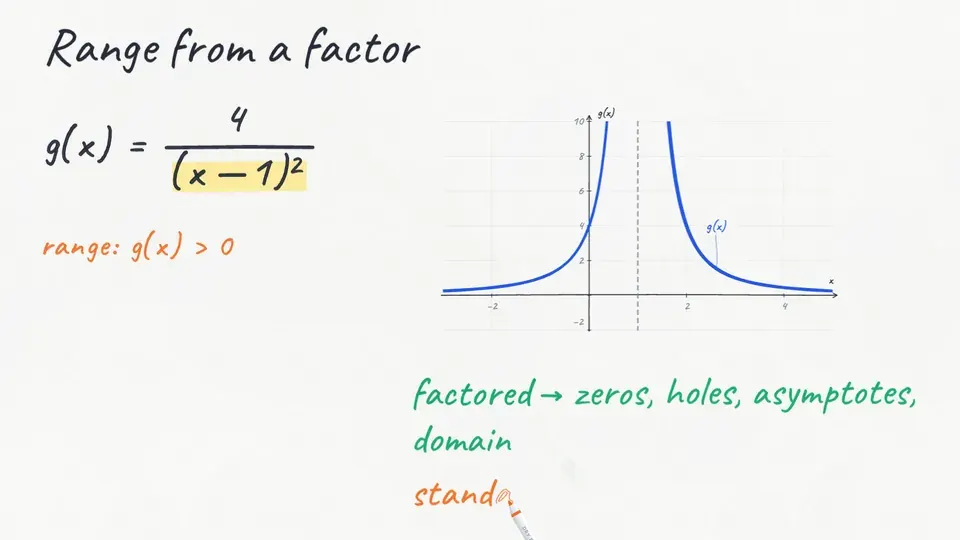
Factored form can even show you the range. In four over x minus one, squared, that squared factor is never negative, so every output is positive. Near one the outputs shoot up, and far away they sink toward zero, so the range is every number above zero. So factored form is the one you read zeros, holes, asymptotes and the domain from, and standard form is the one that shows where a function heads far away.
This is exactly how the exam likes to ask it. Which of these functions has a zero at x equals three, a vertical asymptote at x equals two, and a hole at x equals one? On the exam, factor first. The zeros, the holes and the asymptotes fall right out of the factors.
The machine that multiplies
Going back from factored form to standard form means multiplying the brackets out, which is fine for three brackets, but x plus two to the fourth means sixteen little products to write out and collect, and the tenth power means over a thousand. Luckily there’s a shortcut, and it’s so famous that people built a machine that does it.
This is a bean machine. You pour steel balls in at the top. On the way down, every ball bounces left or right, off one peg in each row. Let’s start small, with three rows, and drop a single ball. It goes left, then right, then right, and lands in its slot.
That ball just did a little algebra. Each row of pegs is one bracket, L plus R, and the ball picks left or right at each row, just like you pick one term from each bracket.
One route, one term. There are eight possible routes, so let’s send one ball down every one of them. One lands on the far left, three in each of the middle slots, and one on the far right.
The plaque under the second slot says three, and those three balls took left left right, left right left, and right left left, three routes that each picked two lefts and one right, so they’re the same term three times. Three routes, same term. That’s the three in front of L squared R.
Now let’s give the machine ten rows. That’s one thousand and twenty-four different routes, so we’ll load one ball for every route. How many do you think will land in the middle tube?
Here they come. Watch the middle tube. That’s where five lefts and five rights meet. Exactly two hundred fifty-two, and the others read one, ten, forty-five, a hundred twenty, two hundred ten, and back down, the numbers in front of the terms when you multiply ten copies of L plus R together.
The pegs have a secret too. Label every peg with the number of different routes that reach it, and the labels make a famous triangle of numbers, Pascal’s triangle. Every route into a peg comes through one of the two pegs just above it, so each number is the sum of the two above it. Three and three make six, four and six make ten, and that one rule builds the whole triangle.
Now back to x plus two, to the fourth. Four rows means four brackets, and a left means you pick the x while a right means you pick the two. Picking a two doubles the term, so let’s make every right bounce double the ball. Watch every right bounce split a ball in two. One, eight, twenty-four, thirty-two, sixteen, which are the coefficients of x plus two to the fourth, and the machine never had to write out any of those sixteen products to get there.
On paper you only need the triangle, so for the fourth power, take row four, one, four, six, four, one. For a plus b to the fourth, the powers of a count down from four, while the powers of b count up from zero. And the triangle puts a number in front of each term. That’s the binomial theorem.
For x plus two, a is x and b is two. So each term takes its number from the row, and its power of two from the count. Four times two is eight, six times four is twenty-four, four times eight is thirty-two, and two to the fourth is sixteen.
A quick way to check it is to plug in one for x, and the left side is three to the fourth, eighty-one, while the coefficients add up to one plus eight plus twenty-four plus thirty-two plus sixteen, also eighty-one. That’s also why the most common mistake here is so wrong. x plus two to the fourth is not x to the fourth plus sixteen. That drops the mixed terms in the middle, and at x equals one they’re worth sixty-four of the eighty-one.
Now try the row on a trickier one. What’s the coefficient of x squared when you expand two x minus one, all to the fourth power?
Long division is just division
Before we divide anything, look at the number eleven. Eleven squared is one twenty-one, eleven cubed is thirteen thirty-one, eleven to the fourth is fourteen thousand six hundred forty-one, and those are rows of Pascal’s triangle. That’s because eleven is ten plus one, so eleven to the fourth is x plus one to the fourth with x equal to ten, which means row four’s one, four, six, four, one land in the ten-thousands, thousands, hundreds, tens and ones places.
It breaks at the fifth power, where the row is one, five, ten, ten, five, one, and a ten won’t fit in one digit. Ten hundreds make a thousand, so we write a zero and carry one. Now the thousands are ten plus one, eleven, so we write a one and carry again, and we get one six one zero five one. In a polynomial nothing ever carries, because x can be any number, so the coefficients just sit in their places like digits, and you can think of a polynomial as a number written in base x.
So dividing polynomials should feel like dividing numbers, and it does. On the left is fifteen seventy-three divided by twelve, and on the right, x cubed plus five x squared plus seven x plus three, divided by x plus two. Twelve goes into fifteen once, and x goes into x cubed x squared times. Multiply back and subtract, and on both sides we’re left with the same thing, thirty-seven, and three x squared plus seven x.
In the next round, twelve goes into thirty-seven three times and x goes into three x squared three x times, and multiplying back and subtracting leaves thirteen on one side and x plus three on the other. One last round, twelve into thirteen once and x into x once, and both divisions finish with a remainder of one, with a quotient of one thirty-one on the left and x squared plus three x plus one on the right.
Now let’s erase every x and every plus sign on the right. What’s left are the exact same digits as the number division, row for row. With x equal to ten the top is fifteen seventy-three and x plus two is twelve, so it was the same division all along. And the polynomial version is actually easier. With numbers you have to guess whether twelve goes into thirty-seven three times or four, but with polynomials you just divide the leading terms, three x squared over x, which is three x.
Any division can be undone by multiplying back. Fifteen seventy-three is twelve times one thirty-one, plus one, and the polynomial on top is x plus two, times x squared plus three x plus one, plus one. In general, dividing f by g gives f equals g times q, plus r, with a quotient q and a remainder r. And you stop once the remainder’s degree is smaller than the divisor’s, just like you stop dividing numbers once what’s left is smaller than the divisor.
This next one is my favorite. Put seven in for x, so the top becomes six hundred forty and x plus two becomes nine. Without dividing at all, what’s the remainder when you divide six hundred forty by nine?
Now let’s divide our function from earlier, x cubed minus two x squared minus five x plus six, by x squared minus one, which has a trap built in. x squared minus one has no x term, and if you don’t write a zero x to hold its place, the columns slide out of line. So we write it as x squared plus zero x minus one.
x squared goes into x cubed x times. Multiply back to get x cubed plus zero x squared minus x, and then subtract the whole row, which flips every sign, so negative five x minus negative x is negative four x, not negative six x. Next, x squared goes into negative two x squared negative two times, and after the subtraction we’re left with negative four x plus four. That has degree one, the divisor has degree two, so we stop.
The line it becomes
So our function has a third outfit, x minus two, plus the fraction negative four x plus four, over x squared minus one, the quotient plus whatever’s left over, still divided by the divisor. This third outfit answers a question the other two can’t, which straight line the graph settles onto far away. Look at the graph next to the line y equals x minus two.
The leftover piece has the bigger power on the bottom, so it shrinks as x grows. At ten it’s about negative point three six, at a hundred about negative point oh four, and at a thousand about negative point oh oh four. So if we zoom way out, the leftover fades to nothing and the graph and the line become almost impossible to tell apart. That line, y equals x minus two, is a slant asymptote, and it came straight out of the quotient.
Back in lesson one point seven, the leading terms told you this asymptote runs parallel to y equals x, but a whole family of lines runs parallel to y equals x, and only the long division tells you which one. Let’s see you find one. What’s the slant asymptote of two x squared plus three x minus one, over x minus one?
Fix the message
Now we have everything we need to build a tiny code of our own, back on that wall. Our message is three, one, four, the first digits of pi. In base x that’s three x squared plus x plus four, and to make room for two check numbers we multiply by x squared, which shifts it over and leaves two empty places.
Then we divide by a polynomial the sender and the receiver agreed on ahead of time, x squared minus three x plus two, and this time we need two placeholders. x squared goes into three x to the fourth three x squared times, and multiplying back and subtracting leaves ten x cubed minus two x squared, with the zero x brought down.
Next, x squared goes into ten x cubed ten x times. Subtracting flips every sign, so negative two x squared minus negative thirty x squared is twenty-eight x squared, and we’re left with twenty-eight x squared minus twenty x. Last, it goes in twenty-eight times, and subtracting one more time leaves the remainder, sixty-four x minus fifty-six.
What we send is the message with that remainder taken away, three x to the fourth plus x cubed plus four x squared minus sixty-four x plus fifty-six, so the five numbers that go out are three, one, four, negative sixty-four and fifty-six. Why take the remainder away? Because f equals g times q plus r, so f minus r is exactly g times q, with nothing left over, which means the message we send divides evenly by x squared minus three x plus two.
And now the other outfit earns its keep. In factored form, x squared minus three x plus two is x minus one times x minus two, so every honest message we ever send is zero at x equals one and at x equals two.
So off it goes, and on the way a smudge turns the one into a six. The receiver can’t see which number changed, so let’s do what the receiver does and plug in one and two.
At x equals one, three plus six plus four minus sixty-four plus fifty-six comes out to five, not zero, so something is wrong. An honest message gives zero there, so that five is exactly the size of the damage.
At x equals two we get forty, and forty is five times eight, and eight is two cubed. Why does that matter? The damage added five times some power of x. At one that power is just one, but at two it became eight, which is two cubed, so the damage is sitting in the x cubed slot, the second number.
Take five away from that six and we’re back to one. We fixed the error without ever seeing the original message, using standard form to divide by and factored form to check with. Now you’re the receiver. This message arrived damaged, so use the two test buttons, work out which number got hit, and fix it.
Real QR codes do exactly this, with two upgrades. Their arithmetic keeps every number inside a single byte, from zero to two hundred fifty-five, so you’ll never see a check number like negative sixty-four. They also carry lots of check numbers. So they can fix many errors at once. That’s how your phone read this torn code.
Every outfit answers a question
So let’s line up what each outfit tells you. Factored form shows the zeros, the holes, the asymptotes and the domain, and standard form shows where it heads far away. Long division gives you the quotient, the remainder and the slant asymptote, and a row of Pascal’s triangle multiplies a binomial out in one go. The next time you scan a code on a scratched sticker or a torn poster, you’ll know there’s a polynomial division hiding inside it, and that you could do it yourself.