
Topic 1.8 key terms
- rational function
- A quotient of two polynomials, . Its domain is every real with .
- zero of a rational function
- An input in the domain with . The real zeros of are the real zeros of the numerator that are in the domain of .
- hole
- A point missing from the graph at a shared zero of the numerator and denominator whose multiplicity in the numerator is at least its multiplicity in the denominator (CED 1.10.A.1). It is not a zero of . If the denominator's multiplicity is larger, is a vertical asymptote instead.
- vertical asymptote
- A vertical line that the graph approaches without bound, at a zero of the denominator that is not canceled by the numerator.
- boundary point
- A real zero of the numerator or of the denominator. A rational function can change sign only at a boundary point.
- sign chart
- The real line cut at the boundary points, with the sign of on each interval, found from one test value per interval or by counting the negative factors.
- multiplicity
- The number of times a factor repeats. The sign of flips at when the total number of factors on top and bottom is odd, and not when it is even (a squared factor, or one canceled equally).
- rational inequality
- An inequality such as . Zeros of (numerator zeros that are in the domain) are included for or ; zeros of the denominator are never included.
Transcript
2,769 words · 8 parts
12:37 a.m.
In April 2026, four astronauts flew around the Moon in a capsule called Orion, the first people to go there since 1972, and on the way they got farther from Earth than anyone ever had. On April sixth, NASA’s mission blog said that at twelve thirty-seven that morning, the Moon’s gravity had started pulling on the spacecraft harder than Earth’s.
So let’s check it. Picture Earth’s pull and the Moon’s pull on Orion at that exact moment. The one toward Earth is still about two and a half times as strong as the one toward the Moon. So the Moon hadn’t taken over yet, not even close, which leaves a great question. Where along this trip does the Moon’s pull actually win?
By the end of this lesson, you’ll be able to find that exact spot. All it takes is one fraction. And you’ll find a second spot, way out on the far side of the Moon, that nobody even mentioned. So, let’s set it up.
The tug of war
Let’s put Earth’s center at zero and the Moon’s center at one, so a spot x on this line tells you what fraction of the way to the Moon you’ve gone. Gravity fades with the square of distance, so twice as far away means a quarter of the pull, and three times as far means a ninth.
Earth is about eighty-one times as massive as the Moon, so in Moon units Earth pulls with eighty-one over x squared, and the Moon with one over one minus x, squared, since one minus x is your distance to the Moon. Before we do any algebra, I want your gut feeling. Where along this line do you think the two pulls are exactly equally strong?
Let’s fly it out. Halfway, Earth’s pull is three hundred twenty-four against the Moon’s four, and even at three quarters it’s a hundred forty-four against sixteen, so Earth is still nine times stronger. And only when you get to nine tenths of the way do the two arrows finally match, a hundred against a hundred.
To see why it lands exactly there, let’s call the difference r of x, Earth’s pull minus the Moon’s pull. When r is positive, Earth is winning. When it’s negative, the Moon is. And the tie we’re hunting for is exactly where r of x equals zero. Two fractions are awkward, so I’ll give them one common bottom, x squared times one minus x, squared.
That means Earth’s eighty-one gets multiplied by one minus x, squared, and the Moon’s one by x squared, so the top becomes eighty-one times one minus x, squared, minus x squared. One polynomial divided by another like this is called a rational function, and today’s big question about it is a simple one, when is a fraction like this equal to zero?
Think about cookies. Zero cookies shared by five friends is zero each, but five cookies shared by zero friends doesn’t mean anything, and zero over zero isn’t a number either, which is a story for another day. So a fraction equals zero exactly when its top is zero and its bottom isn’t, and that one sentence does almost all of our work today.
For our tie we only need the top, so eighty-one times one minus x, squared, has to equal x squared. Between Earth and the Moon both of those distances are positive, so I can take the square root of each side, and the square root of eighty-one is nine, so nine times one minus x equals x.
Multiply it out, and nine minus nine x equals x. Add nine x to both sides, and nine equals ten x. So x is nine tenths, exactly where the beacon stopped. And the bottom is only zero at the centers of Earth and the Moon, so this really is a zero.
And I love what that square root is telling us. The Moon is eighty-one times lighter, but its pull grows with the square of how close you are, so you only need to be nine times closer to it.
Orion wasn’t flying exactly along our line, so it reached its own tie point a little farther out, at seven twenty-three that morning, almost seven hours after the blog said the Moon had taken over. To be fair to NASA, the line Orion crossed at twelve thirty-seven is real. It’s the Moon’s sphere of influence, where the Moon becomes the better guide to Orion’s path. But it isn’t where Earth and the Moon pull equally hard, and the blog mixed the two up. You caught that with one idea about fractions, so let’s see how far that idea goes.
Top zero, bottom not
In general a rational function is a polynomial p on top of a polynomial q, and the rule we just used says r is zero exactly where p is zero and q isn’t. Let’s watch it happen. Here’s a top, x squared minus x minus six, which hits zero at negative two and at three. And here’s a bottom, x minus one, which is zero at x equals one.
Now divide them and look where r crosses the axis, at negative two and at three, exactly where the top was zero, while at one, where the bottom is zero, r shoots off and comes back from the other side. The bottom never makes a zero of its own, because if the top isn’t zero, no bottom can make the fraction zero. All it can do is veto one, so let’s watch a veto.
Here’s x minus a over x minus two, with its zero at x equals a. As I slide a toward two, the zero walks right up to the asymptote, and when a lands on two, the zero is gone.
At two the top and the bottom are both zero, so the function isn’t defined there and what’s left is a flat line with one missing point, a story for lesson one point ten. On the exam you’d say the real zeros of a rational function are the real zeros of its numerator that are in its domain, which is top zero, bottom not, said carefully. Okay, now you try one. Look at this function and find every value of x where it’s actually zero.
Two ways to change sign
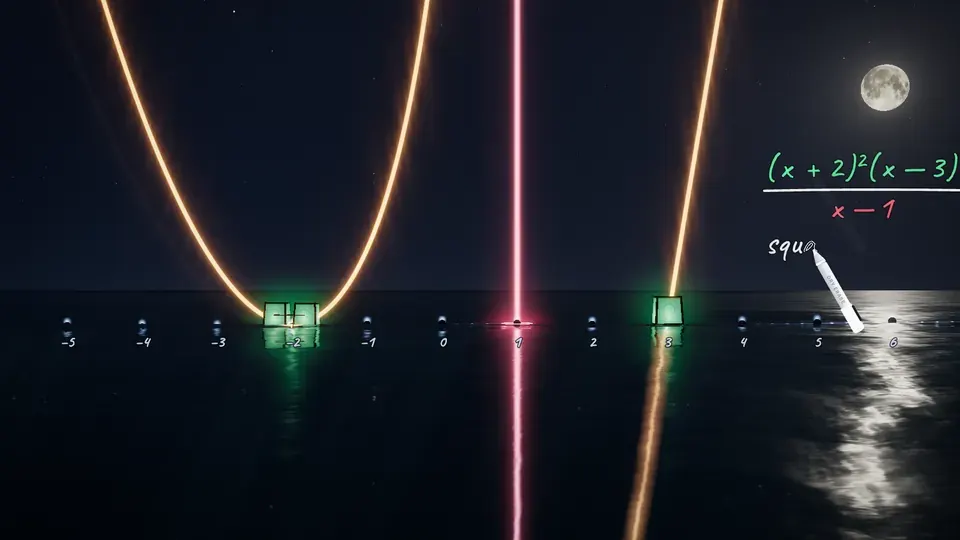
Knowing where r is zero is half the story, and the other half is where it’s positive or negative, so let’s go somewhere a little calmer. Remember x squared minus x minus six over x minus one? Factored, it’s x plus two times x minus three, over x minus one. The waterline is the x-axis, and the green lanterns float at the zeros of the top, negative two and three.
And this red pillar of light stands at x equals one, the zero of the bottom, where the function doesn’t exist. Here comes the graph as a ribbon of light. Under the water r is negative, above it r is positive, and at negative two it pierces the surface right through the lantern.
That’s the first way a rational function can change sign, by passing through zero, and it can only do that at a lantern, a zero of the top. Then it heads for the pillar, and as x gets close to one the bottom gets tiny, so r shoots straight up into the sky. Make the call, before it happens. Where does it come back?
And there it is, rising up out of the deep. The sign went from positive to negative, and the ribbon never even touched the water. The top is negative on both sides of this pillar, but the bottom, x minus one, switches from negative to positive right at it, and that alone flips the sign. That’s the second way to change sign, jumping across an asymptote, and it’s why the bottom’s zeros matter just as much as the top’s.
So a rational function can only change sign at a lantern or a pillar. Cut the line at the zeros of the top and the bottom, and on every piece in between the sign stays the same.
But a pillar doesn’t always flip the sign. If I square the bottom, x minus one, squared, is positive on both sides of the pillar, so everything left of it flips over, and now the ribbon dives into the deep on both sides. A squared factor on top does the same at a lantern, where the ribbon just kisses the water and turns back, so you can’t simply alternate plus and minus at every post. You have to check.
Now it’s your turn to build one. Drag the lanterns and the pillar so the ribbon is at or above the water on exactly this set, from negative two up to two, and from four on forever.
Solve it the AP way
Let’s solve one on paper the way the AP exam wants it, every x where x squared minus nine over x squared minus four x is at most zero. First I factor the top and the bottom, because the factors are where the sign can change. The top is x minus three times x plus three, and the bottom is x times x minus four.
The top is zero at negative three and three, and the bottom isn’t, so those are zeros of r. Since the question allows equal to zero, they’re in the answer, with filled dots, like lanterns. The bottom is zero at zero and four, where r doesn’t exist, so they’re never in the answer, whatever the inequality says. They get open dots, like pillars.
Four posts cut the line into five pieces, with one sign each, and I’ll get the signs from the factors, because each factor is negative to the left of its own zero and positive to the right. Take x plus three first. It’s negative to the left of negative three, and positive everywhere after it. In the same way, x is negative left of zero, x minus three is negative left of three, and x minus four is negative left of four.
Now count the minus signs in each column. An even number makes a positive and an odd number a negative, and dividing by a negative flips the sign just like multiplying does, so the bottom’s factors count the same way. We want at most zero, so we take the negative pieces plus the zeros of r, negative three up to zero, without zero, and three up to four, without four.
And the graph agrees, on or below the axis exactly there. Look where those intervals start and stop. Each runs from a zero of the top to a zero of the bottom, and that’s no accident. The zeros of both polynomials are the only places the sign can change, so they’re the only places a solution interval can end, and that’s exactly the idea the exam is checking.
Here’s a twisty one to try. It has a squared factor on top and a factor that shows up on both the top and the bottom, so think about which posts really flip the sign.
When the right side isn’t zero
On the exam the right side often isn’t zero, as in x plus four over x minus one is at most three. A student named Maya multiplied both sides by x minus one and got x at least three and a half. Her algebra looks clean, so take a moment with this one. Do you think Maya’s answer is right?
Look at the graph. Right of the asymptote the curve drops under three at three and a half, just like Maya said, but the entire left branch sits under three, every single x less than one.
Her mistake was multiplying by x minus one, which is negative whenever x is less than one, and multiplying an inequality by a negative flips it, so she couldn’t know which way the inequality should point. So never multiply by a bottom whose sign you don’t know. Get zero on one side first by subtracting three, then make it one fraction over x minus one.
Distributing the minus three, minus three times minus one is plus three, so the top simplifies to seven minus two x. Its top is zero at three and a half, which is exactly where the original fraction equals three, and its bottom is zero at one. And watch the top, because the minus in front of two x makes seven minus two x positive below three and a half and negative above it.
The bottom, x minus one, is negative below one, so below one the fraction is a positive over a negative, which is negative, and between one and three and a half both are positive. We want negative or zero, so that’s every x below one, and every x from three and a half on. On the calculator section you can check this by graphing both sides, but that open end at one only comes from the algebra.
The back wall
Now back to the Moon. When we found the tie, we skipped something. We assumed we were between Earth and the Moon, but the top of r is a quadratic, and a quadratic can have two zeros.
Past the Moon, both pulls point back toward Earth, since Earth and the Moon are now on the same side of you, and as you fly away the Moon’s pull drops much faster than Earth’s. So go find it. Fly the beacon out past the Moon and stop it right where Earth and the Moon pull equally hard again.
Here’s why it lands exactly there. The top is a perfect square minus a perfect square, nine times one minus x, all squared, minus x squared. A difference of squares factors into the difference times the sum, one factor with minus x and one with plus x.
Multiply out the nines, and each factor starts with nine minus nine x. Collect the x terms, and the top is nine minus ten x times nine minus eight x. The first factor gives our nine tenths, and the second one gives nine eighths. Our square root step assumed one minus x was positive, which isn’t true past the Moon, but the top found both zeros, and neither one makes the bottom zero.
Let’s draw r right on the trip. Near Earth it shoots up, since Earth’s pull is enormous there, it crosses down at nine tenths, plunges next to the Moon, and climbs back up through nine eighths. And look at the Moon. The graph dives on both sides of it, so the sign doesn’t flip, which makes sense, because right next to the Moon, in front or behind, the Moon wins. That’s the square in the bottom refusing to flip it.
And this doesn’t only happen along our line. In every direction there’s a spot where Earth and the Moon pull equally hard, and together those spots make a bubble around the Moon, about ninety thousand kilometers across.
Inside the bubble the Moon wins. Orion slipped in at seven twenty-three in the morning, swung around the far side that evening, and slipped out at six forty the next morning, almost a full day later. It never came anywhere near the back wall, which is why nobody mentioned it, but it’s out there, and now you know exactly where.
An AP question would ask this in context, so let’s ask it that way. For which x is Earth’s pull at least as strong as the Moon’s? That’s r of x at least zero. Earth wins everywhere outside the bubble, so it’s every x below zero, then zero up to nine tenths, leaving out zero itself, Earth’s center, and every x from nine eighths on. Each piece ends at a zero or an asymptote, just like the rule said.
What you can do now
So here’s what you can do now. A rational function is zero exactly where its top is zero and its bottom isn’t, because the bottom can only veto a zero. The sign can only change at a zero of the top or the bottom, so cut the line at those posts and check each piece. But where a factor shows up an even number of times in all, like a square, the sign doesn’t flip.
And when the right side isn’t zero, get zero on one side and make one fraction first. Next time someone says the Moon took over at twelve thirty-seven, tell them Earth and the Moon didn’t pull equally hard until seven twenty-three, at the edge of a bubble that starts at nine tenths, and that the bubble has a back wall, at nine eighths.