
Topic 1.2 key terms
- average rate of change
- Over an interval, the change in output divided by the change in input; the constant rate that gives the same change in output as the function does on that interval (the ghost rocket).
- units of a rate
- Output units per input unit: kilometers per second, tonnes per second, kilopascals per second.
- rate of change at a point
- The rate at which the output would change if the input kept changing at that point; approximated by average rates of change over small intervals containing the point.
- comparing rates at two points
- Use average rates of change over the smallest intervals containing each point; the size of a rate says how fast, the sign says which way.
- positive rate of change
- As one quantity increases or decreases, the other does the same (altitude and time).
- negative rate of change
- As one quantity increases, the other decreases (propellant and time).
Transcript
3,142 words · 7 parts
2:49 a.m.
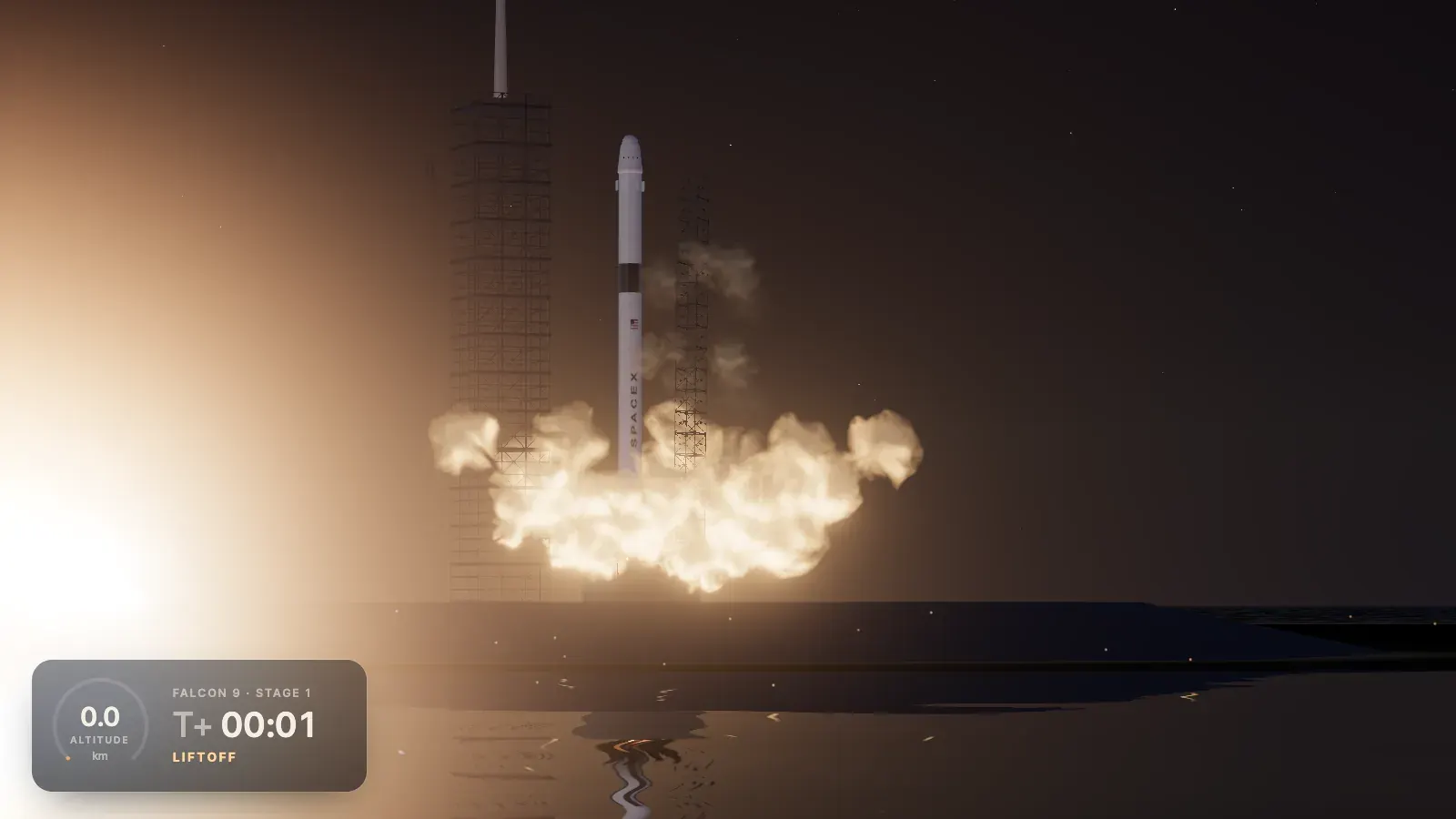
It’s two forty-nine in the morning on the second of March, 2019. Out on the pad at Kennedy Space Center, a Falcon 9 is about to launch the very first Crew Dragon, the spacecraft SpaceX built to carry astronauts.
Nobody’s on board tonight except a test dummy they named Ripley, after the hero of the Alien movies, so she gets the best seat in the house. Here we go. In the next two minutes and thirty-eight seconds this rocket will burn through about four hundred tonnes of fuel and liquid oxygen and climb eighty-five kilometers, and the whole way up, one number on the screen keeps ticking, its altitude.
Somewhere in its first minute or so, this rocket starts climbing faster than the speed of sound. By the end of this lesson, you’ll be able to find that moment yourself. All it takes is those altitude readings.
So let’s freeze it right here, exactly one minute after liftoff, because there’s a puzzle hiding in this frozen moment. Nothing can move in a single instant, because an instant has no time in it at all, and yet right now this rocket is climbing at some exact speed, so what does that speed even mean?
Eight kilometers in a minute
One minute in, the rocket is about eight kilometers up, and what I want to know is how fast it’s climbing at this exact moment. The first thing almost everybody tries is dividing the height by the time, so eight point one kilometers over sixty seconds, which comes out to about a hundred thirty-five meters every second.
That’s a sensible number, but before we trust it, I want you to make a call. Right at T plus sixty, how fast do you think the rocket is climbing, compared with one hundred thirty-five meters per second?
Let’s test it with a ghost, a second rocket that climbs at a steady hundred thirty-five meters per second for the entire minute, never faster and never slower. Watch how the race goes, because the ghost shoots ahead right away while the real rocket is still slow, and about halfway through it’s leading by almost two kilometers. But the real rocket keeps speeding up and reels the ghost back in, and look at that, they hit eight point one kilometers at the very same instant, exactly sixty seconds after liftoff.
And look at what happens right after the minute, because the real rocket blows straight past the ghost. That means at T plus sixty it has to be climbing faster than a hundred thirty-five. So that hundred thirty-five is really the ghost’s speed, the one steady rate that covers the same climb in the same minute, and it has a name.
It’s called the average rate of change. In general, the average rate of change is one constant rate. It’s the steady rate that would give you the same change in the output as the function really gave you over that interval. And that’s exactly what our ghost does. Here the output is the altitude and the input is time, so it’s h of b minus h of a, over b minus a, the change in altitude divided by the change in time.
For the ghost’s minute that’s eight point one minus zero, over sixty minus zero, which is exactly the hundred thirty-five meters per second we started with. That’s how average-speed cameras on highways in Britain and Italy catch people, because two cameras time your car, and if the distance over the time beats the limit, you get a ticket, even if you braked at both cameras.
Let’s do one properly, with webcast readings taken every thirty seconds, from liftoff all the way to two minutes. Now let’s find the average rate of change. We’ll start at sixty seconds, and end at ninety.
At sixty seconds the rocket is eight point one kilometers up, and at ninety it’s twenty point zero, so the change in altitude is twenty minus eight point one, eleven point nine kilometers, and the change in time is ninety minus sixty, thirty seconds. Divide one by the other and you get about point three nine seven kilometers per second, or roughly three hundred ninety-seven meters every second.
When the exam asks you to interpret an average rate, a number by itself won’t get you the point. So let’s build the full sentence, one piece at a time. It starts with the interval, from t equals sixty to t equals ninety seconds, because an average rate always belongs to a stretch of time. Then what changed and which way it went, so the rocket’s altitude increased, and we know it went up because the change in altitude came out positive.
Then the words at an average rate, because the rocket didn’t climb at that speed the whole time. Only the ghost did. And last, the value with its units, of about three hundred ninety-seven meters per second.
So the whole thing reads, from t equals sixty to t equals ninety seconds, the rocket’s altitude increased at an average rate of about three hundred ninety-seven meters per second. Now you try one with the next two webcast readings, and find the average rate of change of the altitude from T plus ninety to T plus one hundred twenty, in meters per second.
Shrink the window
To find how fast it’s climbing right at T plus sixty, we need a fairer ghost, because the one from the pad had to average in all those sluggish seconds right after liftoff. So let’s start this ghost at thirty seconds and finish it at ninety, centered on the moment we care about. In that minute the rocket climbs from about two kilometers up to about twenty, so this ghost needs about two hundred ninety-eight meters per second to keep up.
Squeeze the window to fifty through seventy and the ghost hugs the rocket even more closely, at about two hundred eighty-two. Now I’ll keep squeezing the window around T plus sixty, smaller and smaller, so keep your eyes on that number. Two hundred eighty, then two seventy-nine and a half, then two seventy-nine and a half again. Look, the number has stopped moving no matter how small I make the window, and the ghost and the rocket are flying as one.
That settled number is the rate of change at a point. At exactly T plus sixty, the rocket is climbing at about two hundred eighty meters per second, more than twice our first guess. That’s fast, but sound travels about three hundred meters per second up here, so it isn’t climbing faster than sound quite yet.
Let’s write those windows on the board. For each one we need two altitudes, where the rocket was when the window opened and where it was when it closed. These are the same windows you just watched, each one centered on T plus sixty and each one smaller than the last.
For the first window, the change in altitude is the end minus the start, about twenty thousand meters minus about twenty-one hundred, which is about seventeen thousand nine hundred meters, and the change in time is ninety minus thirty, so sixty seconds. Do the same subtraction for every window. Then look at what happens to those two columns as the windows shrink.
The change in altitude drops from about eighteen thousand meters to just fifty-six, and the change in time drops from a whole minute to a fifth of a second, so both of them are heading toward zero. And if you tried to do this at one single instant, you’d get zero meters in zero seconds, and zero divided by zero doesn’t mean anything at all.
But we never have to divide zero by zero, because we can divide while the numbers are small but not zero yet, so let’s divide every row. Look at that column, because while both numbers shrink, their ratio settles on two hundred seventy-nine and a half, and that settled value is what speed at an instant means.
So the rate at a point is approximately the average rate of change over a small interval that contains it, and the smaller the interval, the better the approximation. It also means something you can picture, because if the rocket held that climb rate steady from T plus sixty on, it would gain about two hundred eighty meters every second.
The altitude curve bends upward the whole way, because the rocket keeps speeding up, so a wide window always mixes slow moments with fast ones. But let’s zoom in on T plus sixty, closer and closer, and watch what happens to that bend. The closer we get, the straighter the curve looks, until it’s practically a straight line.
And I love this part, because that line climbs at the same two hundred eighty meters per second we found with the ghost. One mistake I see all the time is dividing eight point one by sixty and calling it the speed at T plus sixty. It isn’t, because that’s the ghost’s speed from the pad, slow start and all, and you’ve just seen that the real number at T plus sixty is about two hundred eighty.
Now it’s your turn. Fly the ghost around T plus one hundred. Drag the two moments in and keep shrinking the window until the climb rate stops changing. And now the screen can show the climb rate at every instant, by comparing two readings a split second apart and dividing, many times every second, which is the same trick your car’s speedometer uses.
Read it like an engineer
On the exam the readings usually come in a table like this one, and they won’t always be evenly spaced. Here the gaps run from ten seconds up to thirty. Let’s use it to compare the climb rate at T plus thirty-five with the climb rate at T plus one oh five.
We can’t shrink the window anymore, so we use the smallest interval in the table that contains each moment. Thirty-five sits between thirty and forty, so that’s three point six minus two point one, over ten seconds, about a hundred fifty meters per second. One oh five sits between a hundred and a hundred ten, so that’s thirty-three minus twenty-five point nine, over ten, about seven hundred ten.
So the altitude is increasing faster at T plus one oh five, almost five times as fast, and those two average rates are your evidence. Now you pick one, and tell me which interval from this table gives the best estimate of the climb rate at T plus fifty.
Draining the tanks
Every rate we’ve found so far has been positive, so let’s look inside the rocket at something that goes the other way. This is the first stage taken apart, with a tank of liquid oxygen on top, a tank of kerosene under it, and nine Merlin engines at the bottom.
Together those two tanks hold about four hundred eleven tonnes of propellant. Now let’s put it back together and slice it open, and in the first forty seconds, the nine engines drain it down to three hundred three tonnes.
That’s an average rate of change of three oh three minus four eleven, over forty, which is negative one hundred eight over forty, or negative two point seven tonnes per second. It’s the drain of a ghost tank that empties at one steady rate and ends up exactly where the real one does at forty seconds. That minus sign is telling you something real, because it says that as time goes up, the amount of propellant goes down.
Put the two graphs side by side and you can see it, because the altitude rises as time goes on, so its rate is positive, while the propellant falls, so its rate is negative. That’s what a rate of change really describes, how two quantities change together, and its sign tells you whether they move the same way or opposite ways.
Let’s run the film backward for fun and watch the altitude, because as time goes back toward one minute, the rocket sinks back down too. Time going down and altitude going down still move the same way, so that rate is still positive, and that’s why we say a positive rate means that when one quantity goes up or down, the other does the same.
And the propellant does the opposite, climbing back up as time runs backward, so its rate stays negative. Now watch the engines around the one-minute mark. Near Max-Q, when the air pushes hardest on the rocket, SpaceX throttles them down, and the tanks drain more slowly, only about one point nine tonnes per second. So which moment drains faster, T plus thirty at negative two point seven, or T plus sixty at negative one point nine?
Look at what actually leaves the tanks, because in the ten seconds around T plus thirty, twenty-seven tonnes of propellant disappear, and in the ten seconds around T plus sixty, only nineteen. So the tanks drain faster at T plus thirty, even though negative one point nine is the bigger number, because how fast something changes is the size of the rate, and the sign only tells you which way it’s going.
Now I’d like you to try it yourself. Drag the time marker to any moment, while the engines are still firing, when the propellant is draining more slowly than it was at T plus thirty.
So, what has the sign been telling us? Let’s write it down. A positive rate means that as one quantity increases or decreases, the other does the same, like the rocket’s altitude and time. A negative rate means that as one increases, the other decreases, like the propellant and time, and the exam loves this one, usually by handing you a negative rate and asking what it means.
When you write about a negative rate on the exam, put the direction into words, like this. From t equals zero to t equals forty seconds, the propellant decreased at an average rate of two point seven tonnes per second.
Either say it decreased at two point seven, or say it changed at negative two point seven, but never both at once. Something that decreases at a negative rate sounds like it’s going up. This next one is a classic on the AP exam. The average rate of change of the propellant from T plus zero to T plus one hundred is about negative two point five tonnes per second, so which of these statements is true?
Max-Q on the exam
Let’s go back to the moment when the air pushes hardest on the rocket, which engineers call Max-Q, short for maximum dynamic pressure. Dynamic pressure is how hard the air slams into the rocket, so it climbs as the rocket speeds up and drops as the air thins out higher up. On this flight it peaked about fifty-nine seconds after liftoff.
Here’s a model of it, the kind of function you’d see on the AP exam. Q of t equals t squared times the quantity one twenty minus t, squared, all over six hundred thousand, in kilopascals.
For the average rate of change over the first thirty seconds, Q of thirty is twelve point one five and Q of zero is zero, so that’s twelve point one five over thirty. That’s about point four oh five kilopascals per second, so on average the pressure increased by about four tenths of a kilopascal every second during the first half minute. Before you calculate anything, what do you think the average rate of change is from thirty seconds to ninety?
It’s zero, because Q of ninety comes out to twelve point one five, exactly where it was at thirty, so the pressure ended up right where it started. The ghost for this interval would just sit still at twelve point one five while the real pressure climbed to its peak and came back down. So an average rate of zero only tells you the output ended where it began.
The next part needs a calculator, because we’ll estimate the rate at T plus one hundred with a tiny window, from ninety-nine to one oh one. So grab the calculator and estimate the rate of change of Q at T plus one hundred, using that window from ninety-nine to one hundred and one.
That rate is negative, so at T plus one hundred the pressure is decreasing, by about half a kilopascal every second. Around T plus forty the same method gives about positive point four two seven, so at which of those two moments is the pressure changing faster?
It’s changing faster at T plus one hundred, because point five three three is bigger than point four two seven. That rate is negative, which just tells you the pressure is decreasing there, while it was increasing at forty.
Faster than sound
Let’s put the whole flight on one page, starting with the average rate of change, the change in output over the change in input, which is the ghost’s one steady rate. The rate at a point is what those averages settle on as you shrink the interval around that point. To compare two moments, use the smallest interval you can around each one.
And keep in mind that the size says how fast, while the sign says which way. A positive rate means the two quantities move in the same direction, and a negative rate means they move in opposite directions. And when you write it on the exam, give the interval, the words on average, the direction, the value and the units.
And now let’s keep the promise from the start of the lesson, and find the moment this rocket starts climbing faster than sound. Nine kilometers up, the air is about forty degrees below zero, and sound only travels about three hundred meters per second there, so we’re looking for the moment the climb rate reaches three hundred.
So it’s your turn one last time, and you can drag the purple point along the altitude curve and stop it where the rocket is climbing at three hundred meters per second. Two minutes and thirty-eight seconds after liftoff, the first stage drops away eighty-five kilometers up, and the second stage carries Crew Dragon the rest of the way to orbit.
Ripley rode that capsule all the way to the space station the next morning. About fifteen months later, a Falcon 9 just like this one carried two astronauts, Bob Behnken and Doug Hurley, off the very same pad.
You started this lesson with one frozen instant and a question about what its speed could even mean. Now you know it’s the number the average rates settle on as the window shrinks, and you can find it from a list of readings, even the moment a rocket starts climbing faster than sound.