
Topic 1.10 key terms
- hole
- A single point missing from the graph of a function, drawn as an open circle far bigger than the point itself. A rational function has a hole at when is undefined but the outputs on both sides of approach the same value ; the hole is the point . In calculus it is also called a removable discontinuity.
- domain restriction
- After canceling a common factor , the simplified expression agrees with only for . Canceling removes the factor but not the restriction, so stays out of the domain. It is a hole only if appears at least as many times on top as on the bottom.
- one-sided limit
- uses inputs less than (from the left); uses inputs greater than (from the right).
- limit
- means inputs sufficiently close to (never equal to ) give outputs arbitrarily close to . It exists when both one-sided limits equal .
- multiplicity
- The number of times a factor appears. At a zero of the denominator, compare its multiplicity in the numerator with its multiplicity in the denominator: top bottom gives a hole (top greater: the hole sits on the x-axis); bottom greater gives a vertical asymptote.
- derivative (preview)
- In calculus, the height of the hole in the average-rate-of-change formula at : the instantaneous rate of change at .
Transcript
2,348 words · 8 parts
Two equals one
I want to show you a proof. Let’s say a and b are the same number, and it isn’t zero. Multiply both sides by a, then take b squared away from both sides, and everything still balances. Both sides factor, and there’s an a minus b on each side, so let’s cancel it, and since a and b are the same number, a plus b is just two b.
Divide both sides by b, and the last line says that two equals one. Every step looks legal, and yet somewhere in here is a cheat, and the same cheat is hiding in this arch of light. It looks perfect, but one point is missing, right at the very top, and no screen or microscope on Earth could ever show you the gap.
By the end of this lesson, you’ll be able to put your finger on the exact line where that proof cheats, and you’ll find the exact address of a point that nobody can see. Let’s start with the arch, because you can walk right up to it. We’re on Abraham Lake in the Canadian Rockies in the middle of winter, where the ice is so clear that you can see bubbles of gas frozen inside it.
A trillion times closer
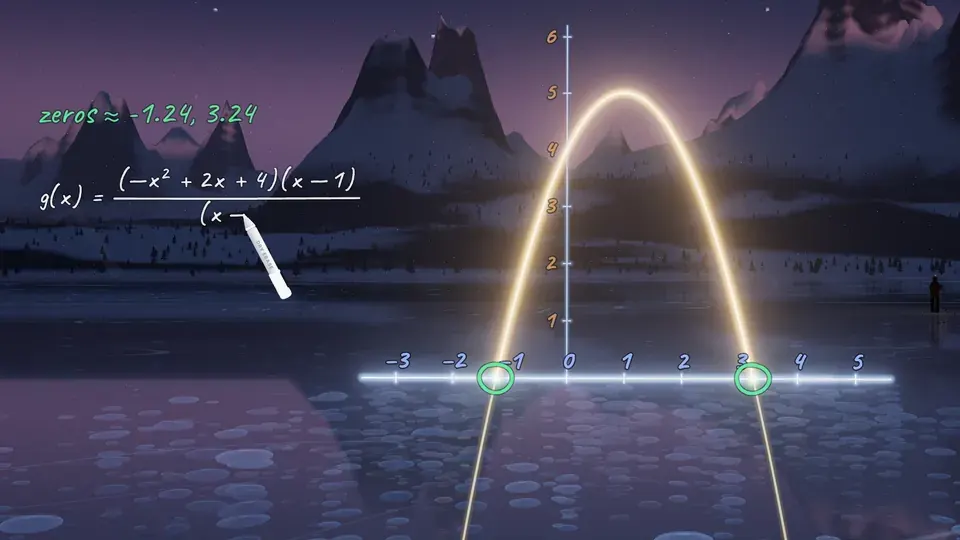
The surface of the ice is our x-axis, with one meter for every unit, and the arch meets it at its two zeros. The arch is the graph of this function, g of x equals negative x squared plus two x plus four, times x minus one, over x minus one.
So what happens at the top, where x equals one? The top of the fraction has a factor of x minus one, so it’s zero, and the bottom is one minus one, which is zero too. Zero over zero isn’t a number, so g of one doesn’t exist, and that’s exactly why the top of the arch is missing.
We’re going to zoom in on that missing point a trillion times. When we get all the way down there, what do you think we’ll see?
So let’s zoom in, ten times closer, then a hundred, where the screen is about as wide as your hand, then a thousand, where a single snowflake drifting past would fill a third of the screen. At a million times, a single red blood cell would almost fill the screen, at a billion, you could count the molecules of air drifting past, and at a trillion, we’re smaller than an atom. And look, the curve still doesn’t break, even down here.
That’s because a single point has no width at all. Every speck of ink on your screen covers infinitely many inputs, and only one of them is missing, so there’s no gap to see, and there never will be.
So we mark the spot by hand with an open circle, drawn much bigger than the missing point so you can see where it is. A missing point like this is called a hole. I could punch a thousand more holes in this arch and it would look exactly the same, and your graphing calculator will usually draw it with no gap at all, so we find holes with algebra, because our eyes never will.
The cheat
So let’s use some algebra and see why that point went missing. Let’s start with the simplest one there is, x over x. Any number that isn’t zero, divided by itself, is one, so x over x is one everywhere except at zero, where it’s zero over zero.
Our arch works the same way. For every input except one, x minus one isn’t zero, so the pair cancels, and g of x equals negative x squared plus two x plus four, as long as x isn’t one.
Canceling removes the factor, but it doesn’t remove the restriction. If you drop the part that says x is not one, you’d be describing the whole parabola, top point and all, and that’s a different function. And that’s the move the proof makes, because a plus b times a minus b, over a minus b, is a plus b everywhere except where a equals b.
So let’s go back up into the sky. This time, read the proof with that restriction in mind. Look at the seven steps again. One of them is a cheat. Which one?
So that’s the cheat. The proof made a and b equal and then canceled a minus b, at the one value where canceling is forbidden, the same kind of input where our arch lost its point. The proof used zero over zero to get a wrong answer, but our arch’s zero over zero is hiding a right one, so let’s find exactly where that missing point is.
The address of a missing point
We can’t land on x equals one, but we can sneak up on it, so here’s a bead at zero point nine and another at one point one, and both of them read four point nine nine. Move them in to zero point nine nine and one point zero one, and both read four point nine nine nine nine, then closer still, and both of them read four point nine nine nine nine nine nine.
Both sides keep piling up nines, so the outputs are closing in on five, but if we put a bead exactly at one, there’s nothing there for it to land on. Now it’s your turn, so slide both beads in toward the top until both readouts start with four point nine nine nine nine.
Let’s write down what the beads showed us. From the left, the inputs climb toward one, zero point nine, zero point nine nine, zero point nine nine nine, and the outputs pile up nines. From the right, the inputs come down toward one, one point one, one point zero one and one point zero zero one, and the outputs are exactly the same.
On the AP exam you’ll see this written as inputs sufficiently close to one give outputs arbitrarily close to five, and it means exactly what the beads did. In plain words, you can get the outputs as close to five as you like. Just move the inputs close enough to one.
We write the limit of g of x as x approaches one from the left equals five, where the little minus means from the left. From the right, it’s the same limit with a little plus instead, and it equals five too. When both sides agree, that’s the limit, so the limit of g of x as x approaches one is five, and the hole is at the point one, five.
Now look at these two lines side by side, because this is the strangest idea in the lesson. g of one doesn’t exist, and yet the limit is five. The limit only asks where the outputs are heading as the inputs get close, never what happens when you arrive, so nobody lives at this address, but the address is real.
There’s also a faster way that always agrees with the table. Cancel, keep the restriction, and plug one into what’s left, so negative one plus two plus four is five. It works because what’s left matches g everywhere except at one, and the limit never looks at one anyway.
The race to zero
Here’s a question that trips up a lot of people. The bottom of g is zero at x equals one, and in the last lesson, a zero on the bottom almost always meant a wall, a vertical asymptote. So why isn’t there one here? It’s because the top is zero there too, and when the top and the bottom are both racing toward zero, the faster one decides what happens.
We counted copies last lesson, so now let’s take control of how many copies of x minus one sit on the top and on the bottom. With one on each side it’s a tie, so the pair cancels, and we get our hole floating at one, five. Now let’s put a second copy on top. One pair cancels and a copy is left over on top. And look, the curve now passes through the ice exactly at the missing point.
It’s still a hole, but now it sits right on the x-axis, at one, zero, and one is not a zero of this function, because the function still has no value there. These green points are real zeros, and this one is a hole. Now let’s move the extra copy to the bottom instead. The bottom wins the race, the outputs blow up, and we get the vertical asymptote from the last lesson.
It’s your turn to run it. The bottom has two copies of x minus one, so use the buttons to give the top the fewest copies that still make a hole.
So why does the count decide? Near one, every copy of x minus one is tiny, and two copies multiply together, so when one copy is a tenth, two make a hundredth, and when one copy is a thousandth, two make a millionth. Every time x gets ten times closer to one, one copy picks up one more zero, and two copies pick up two, so two copies gain zeros twice as fast.
In a tie, the top and the bottom shrink in step. So their ratio settles on a number, and the hole floats. If the top has more copies, it drags the ratio down to zero and the hole sits on the axis, and if the bottom has more, the ratio blows up into an asymptote.
So if a zero shows up in the numerator at least as many times as it does in the denominator, the graph has a hole there. If it shows up fewer times on top, it’s a vertical asymptote instead. Notice that a tie counts. Only the difference between the two counts matters, so the easy way to see it is to cancel in pairs and read whatever’s left over.
Holes on the exam
Let’s do one the way the AP exam asks it, with f of x equals x squared minus nine, over x squared minus two x minus three, and the question is where its graph has holes and where it has asymptotes. The first move is always to factor, so the top is x minus three times x plus three, and the bottom is x minus three times x plus one, which is zero at three and at negative one.
At three, x minus three appears once on top and once on the bottom, and one is at least one, so there’s a hole. At negative one, x plus one is only on the bottom, so the bottom wins, and that’s a vertical asymptote. To find the height of the hole, cancel x minus three, keep the restriction, and plug in three, which gives six over four, or three halves, so the hole is at three, three halves.
Here’s f with the factor canceled. Plug in two point nine nine, and you get one point five oh one, just above one and a half. Plug in three point oh one, and you get one point four nine nine, just below it. So, this time, from the left, the outputs come down to one and a half. And from the right, they come up to it.
They still meet at the same height. And here’s the graph, with the hole at three and the asymptote at negative one. When the exam says give a reason, a full-credit answer has two parts. The graph has a hole at x equals three because x minus three has multiplicity one on the top and one on the bottom, and since the limit of f of x as x approaches three is three halves, the hole is at three, three halves. That limit statement is what justifies where the hole is, so don’t leave it out.
Here’s one that catches a lot of people, so take your time. What happens on the graph of this function at x equals two?
The number in the hole
I’ve saved one more hole for the very end. It’s my favorite one. And you’ve already met it. Remember this rocket? Sixty seconds after liftoff it was climbing at two hundred seventy-nine and a half meters per second, and we locked those digits in one at a time.
This graph shows the average climb rate over a window that starts at sixty seconds and lasts delta seconds. So every point on this curve is one whole window. Its width runs along the bottom, and its average climb rate runs up the side. On the left, a negative delta just means a window that ends at sixty instead.
When the window has no width at all, the rocket climbs zero meters in zero seconds, and that’s zero over zero. Shrink the window from the right. The averages slide down toward two seventy-nine and a half. Now shrink it from the left, and they climb up toward the very same number.
And right at zero there’s nothing, just a hole, so when we locked those digits in lesson one point two, we were walking up to a hole. How fast the rocket is climbing at one instant is the height of a hole. In calculus, that height is called the derivative.
Now let’s take windows that start at liftoff instead. Where do you think the hole will be this time? Think about that the next time you’re in a car. Every speedometer reading is the height of a hole. Just like this one.
Back to the lake
So a shared zero is a race, and the counts decide it. A tie floats a hole, extra copies on top sink the hole onto the axis, and extra copies on the bottom turn it into a wall.
And wherever there’s a hole, you find its address with the limit, the number the outputs close in on from both sides. We started with a proof that two equals one and ended with the speed of a rocket. Every hole along the way came from the same race to zero.