
Topic 1.5 key terms
- zero (root)
- A number a, real or complex, with p(a) = 0. It is a zero of the function p and a root of the equation p(x) = 0.
- linear factor
- For a real number a, (x − a) is a factor of p exactly when a is a zero of p; the graph then has an x-intercept at (a, 0).
- multiplicity
- The number of times a linear factor (x − a) is repeated. Even multiplicity: the graph touches the x-axis and the outputs keep their sign. Odd: it crosses.
- complex zeros of a polynomial
- A polynomial function of degree n has exactly n complex zeros when counting multiplicities.
- conjugate pair
- If a + bi is a non-real zero of a polynomial with real coefficients, then a − bi is also a zero.
- successive differences
- Over equally spaced inputs, the degree of a polynomial is the least n for which the nth differences of the outputs are constant.
- even function
- f(−x) = f(x) for every x: the graph is symmetric over the y-axis. x^n with n even is an even function.
- odd function
- f(−x) = −f(x) for every x: the graph is symmetric about the origin. x^n with n odd is an odd function.
Transcript
2,957 words · 11 parts
Never three
This is a ring of very thin glass, about six feet across, and it’s filled with smoke, so when we shine a light through it, we’ll see exactly where the light goes. So let’s switch on the laser. The beam goes into the glass, out into the hole, back into the glass and out again, so it pierces the glass four times. Now I’ll raise it slowly. Keep your eye on the two sparks in the middle, because they slide together, flash, and they’re gone, and now it pierces just twice.
Raise it more and the last two meet and vanish, and the beam misses. Aim this laser anywhere you like, and you will never get it to pierce the glass exactly three times. The program drawing this room is a ray tracer, the same kind of program that draws today’s animated movies. It finds those sparks by solving one equation for the beam. And that equation still has four answers, even when the beam misses.
By the end of this lesson, you’ll be able to read a beam’s equation and say exactly where it pierces the glass. You’ll know where its answers go when it misses. And that turns out to be the reason three is impossible. A whole ring is a lot of glass to start with, so let’s begin with something simpler, a glass ball.
Through a glass ball
This ball has a radius of one foot, and with the beam straight through its center, it pierces the glass twice, once going in and once coming out. Raise the beam to some height h above the center and it still pierces twice, and to find those sparks, we need each point’s distance from the center.
Let’s call a point’s position along the beam t, measured from the spot right above the center. That makes a right triangle with legs t and h, so by Pythagoras the distance squared is t squared plus h squared.
The point is inside the glass when that’s less than one, the radius squared, so when t squared plus h squared minus one is less than zero. So that’s the beam’s polynomial, p of t equals t squared plus h squared minus one, which is negative inside the glass, positive outside, and exactly zero on the glass itself, right where the sparks are.
With the beam back through the center, h is zero and p of t is t squared minus one, which equals zero at t equals one and at t equals negative one, exactly the two sparks. When an input makes a polynomial equal zero, we call it a zero of the polynomial, or a root of the equation p of t equals zero.
And every real zero comes with a factor. Here, t squared minus one is t minus one times t plus one, and each factor is the one that becomes zero at its own spark, right where the graph crosses the axis.
Now watch what happens when I lift the beam. The sparks slide toward each other, and at exactly one foot they meet in a single point, where the beam just grazes the top of the ball.
Lift it a little higher, to about one point four feet, and the beam misses the ball completely, and its polynomial has become t squared plus one. So make a call for me. The beam missed, and its equation is t squared plus one equals zero, so how many answers do you think that equation has?
Inside the glass
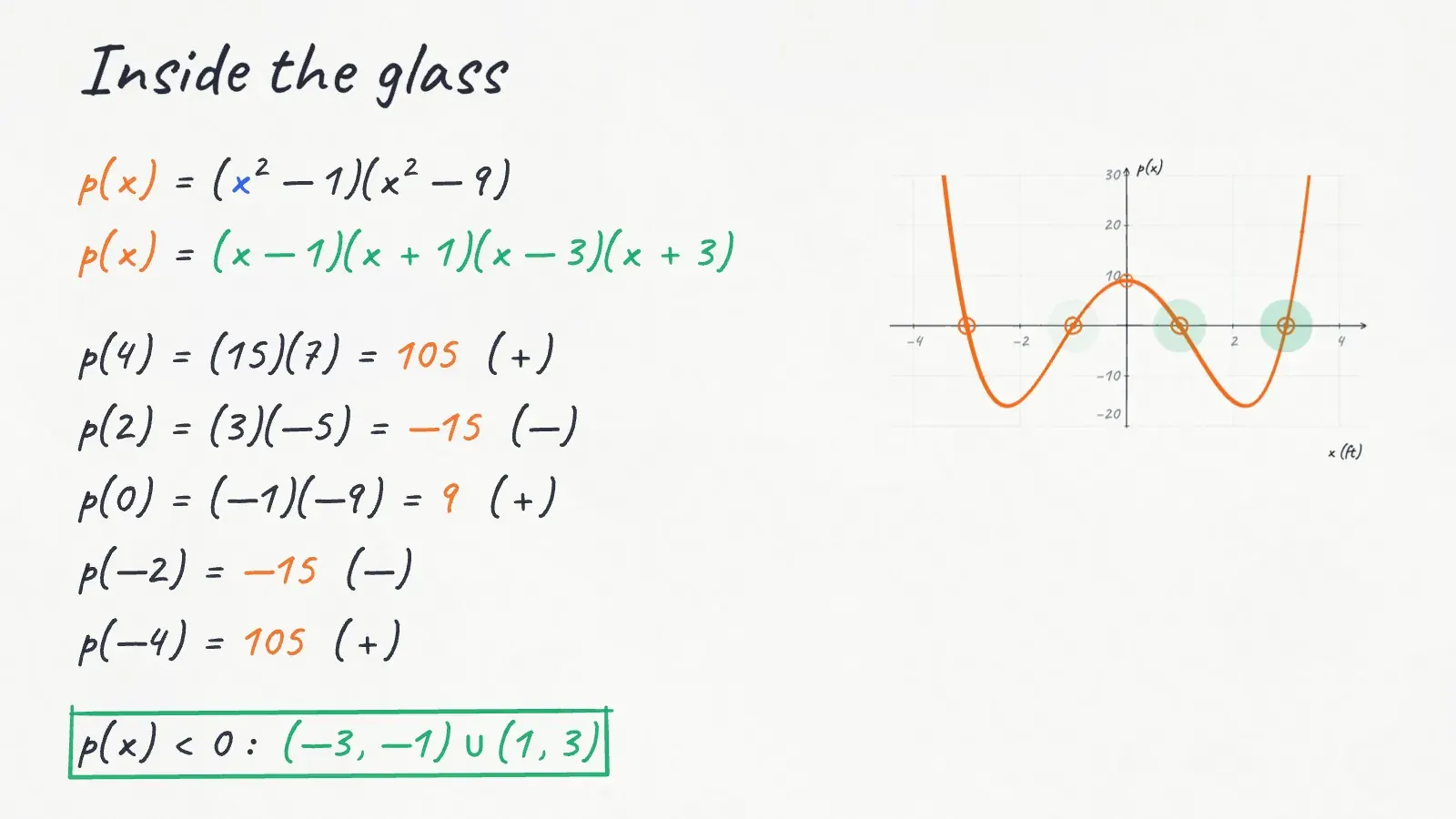
The ring works the same way. Seen face on, its glass is a band between two circles. The wall of the hole is one foot from the center, and the outer edge is three feet out. So with x for the position along the beam, a point is inside the glass when x squared plus h squared is between one and nine, and that gives the beam two factors, one for each wall.
The first factor is zero on the wall of the hole and the second on the outer edge, so the beam’s polynomial is their product. Inside the glass you’re past the first wall but not the second, so one factor is positive and the other negative, and their product is negative, which is why exactly those stretches are glowing.
Let’s draw it with the beam straight through the center, so h is zero. Then the polynomial is x squared minus one, times x squared minus nine, and both of those are differences of squares, so it breaks into four linear factors. Four linear factors give four zeros, at negative three, negative one, one and three, and the graph crosses the axis at exactly those points, one for each spark.
Now let’s walk along the beam from the right. At four we’re outside the glass and p is a hundred and five, at two we’re inside and p is negative fifteen, and in the hole, at zero, p is nine, positive again. The left half of the beam is a mirror image, so it’s negative fifteen at negative two and a hundred and five at negative four.
So p is less than zero from negative three to negative one and again from one to three, and the endpoints of those intervals are exactly the zeros, because the real zeros are the only places a polynomial’s sign can change. Now you try one with the same polynomial. Where is p of x greater than or equal to zero? Now, back to the laser.
The graze
This time, you’re going to find it yourself. Watch for the moment two sparks turn into one. Drag the laser up, slowly, until the two sparks in the middle become a single point of light.
At a height of one, the polynomial becomes x squared, times x squared minus eight, so the factor x shows up twice, and x equals zero is a double zero, a zero of multiplicity two. Look at the graph right below the kiss, which rises to the axis, touches it and drops back down, because the beam is inside the glass on both sides of it, so p is negative on both sides. In fact, the outline of every round thing a ray tracer draws is made of beams that just graze the glass, which means it’s made of double zeros.
Up close, a zero’s shape depends on how many times its factor appears. With x minus one once, the graph crosses like a line, squared, it touches like a parabola, and cubed, it flattens out but still crosses.
So an even number of times means the graph touches and keeps its sign, and an odd number means it crosses and flips. People call the touch a bounce, but on the exam, say it’s tangent to the x axis with the same sign on both sides.
Reading the factors
Let’s use all of that on a new one, p of x equals x plus two, times x minus one squared, times x minus three. The zeros are negative two, one and three, with one a double zero, so the multiplicities add up to four, the degree, and that’s all of them. So the graph crosses at negative two, touches at one, and crosses again at three, and there it is.
For the signs, start on the far right, where every factor is positive. Crossing three flips p to negative, at one it only touches, so it stays negative, and crossing negative two flips it back to positive. So p is less than zero from negative two to three, except at one, where it’s exactly zero, and forgetting that little gap is the most common slip on this kind of question.
Now let’s go the other way. This graph touches the x axis at negative one and crosses it at two, so which equation could it have? When a polynomial doesn’t factor nicely, like this cubic, a graphing calculator finds the zeros for you, about negative one point seven seven, zero point five two and three point two five.
Fold and spin
Look back at the ring’s graph for a moment. Its left half is a perfect mirror image of its right half, because the beam meets the same glass at negative x as at x. In symbols, p of negative x equals p of x, and we call a function like that even. Folding its graph along the y axis lands the halves on each other, and the name comes from even powers like x squared and x to the fourth.
Odd functions spin instead. Turn x cubed minus four x half a turn around the origin and it lands on itself, like a playing card that looks the same upside down, so p of negative x equals negative p of x. And this name comes from odd powers, like x and x cubed.
Now slide the ring two feet along the beam. It’s still degree four, but its zeros are negative one, one, three and five, and its mirror has moved over to x equals two, so an even degree doesn’t make an even function.
Now it’s your turn. Here’s one for you to try. Look closely at these four functions. Which one of them is even?
A machine that only adds
Let’s take a break from the beam for a puzzle. Put dots around a circle, join every pair with a straight line, and count the pieces. Just keep the dots uneven, so no three lines cross at the same point. One dot gives one piece. Two dots give two pieces.
Three dots give four. Four dots give eight. And five dots give sixteen pieces. So how many pieces will six dots make? Almost everybody says thirty-two, and it’s thirty-one, so it was never doubling at all.
So what is it really? Let’s visit a machine built for exactly this kind of pattern. This is Charles Babbage’s Difference Engine Number Two, which he designed between eighteen forty-seven and forty-nine to print tables of numbers without mistakes, and London’s Science Museum finally built it from his drawings, finishing the printer in 2002. Each column of wheels holds one number, and every turn of the crank adds each column into the next, so all it can do is add, and that’s all it takes to print a polynomial’s values.
Let’s set every column to one and turn the crank. One plus one is two. Two plus two is four. Then eight, sixteen, and thirty-one, our circle puzzle, coming out of a machine that can only make polynomials. And look at the last column, because it never changes. The circle numbers have constant fourth differences, so they come from a polynomial of degree four.
By hand, subtract each number from the next. Two minus one is one, four minus two is two, then four, then eight, and thirty-one minus sixteen is only fifteen, which is exactly where the doubling breaks. Now do the same thing to that row. Two minus one is one, four minus two is two, eight minus four is four, and fifteen minus eight is seven.
Do it again. Two minus one is one, four minus two is two, and seven minus four is three. One more time gives one and one. So on the fourth round, every difference is one. And the first number in each row is exactly what the engine’s wheels started on.
So whenever the nth differences are the first ones to come out constant, the polynomial has degree n. There’s one catch, though, because this only works when the inputs go up in equal steps. Your turn. Here’s the crank. Set the starting wheels so the engine prints the cubes, zero, one, eight, twenty-seven, sixty-four.
Where did the answers go?
Now back to the question from earlier. The beam missed the ball, and t squared plus one equals zero means t squared is negative one, which no real number can do. So mathematicians named a number that can, i, with i squared equal to negative one, and then i and negative i both make t squared plus one equal zero, so it has exactly two answers.
A number like two plus three i is a point on a plane, two steps along the real direction, and three steps up, in the imaginary direction. So i itself is one step up, and negative i is one step down.
Now watch the room. The line of the beam becomes the real axis, and the direction across it is the imaginary axis. That second direction isn’t anywhere in the room, so no beam can reach it. It’s a new direction for the input, and it’s where the missing answers have been all along.
Let me drop the beam and lift it again, slowly. The two zeros slide together along the real axis, collide when the beam just grazes the ball, then turn ninety degrees and walk off the line, one on each side, until they stand at i and negative i. Slide the ball’s center over to two and the same thing happens around two, so at the same height the zeros are two plus i and two minus i.
Now the ring. As the beam rises, the inner pair collides and turns, then the outer pair, and the counter never changes, because a polynomial of degree four always has four zeros. And that’s true of every polynomial. Degree n means exactly n complex zeros, if you count a double zero twice, and Carl Friedrich Gauss proved it in 1799, at twenty-two.
To see that they’re really there, let’s measure how big p is at every point of the plane. Then we make that size the height of a landscape. So the landscape can only touch the floor where p is zero. And it touches down at exactly four places, two under the sparks and two at the missing zeros.
And they always come in mirror pairs, so if we fold the plane along the beam’s line, every zero lands on its twin. Whenever you pause, you can drag the beam yourself and watch the answers move.
Mirror twins
We call two plus i and two minus i complex conjugates, because they have the same real part and opposite imaginary parts. They come in pairs for a simple reason. i and negative i both square to negative one, so any calculation that’s true for i stays true when you flip every i to negative i.
The ball’s polynomial has only real numbers in it. So flip every i in the true statement, p of two plus i equals zero. The polynomial doesn’t change, zero doesn’t change, and you get p of two minus i equals zero. With the ball at two, the zeros are two plus i and two minus i, so the polynomial is x minus the first, times x minus the second.
Grouped as x minus two, minus i, times x minus two, plus i, that’s a difference of squares, x minus two squared, minus i squared. And minus i squared is plus one, so we get x minus two squared, plus one, which is x squared minus four x plus five.
Every i canceled, and that’s exactly the equation of the beam over the ball, and it takes both twins to make every i cancel. On the exam it’s one line. With real coefficients, if three minus two i is a zero, then three plus two i is a zero too.
Never three
So now we can go back to the very beginning. And this time, we can prove the claim. Every beam through the ring has a polynomial of degree four, so it always has four zeros. The non-real ones come in mirror pairs, so there are none, two or four of them, which leaves four, two or none on the real axis.
Each place where the beam pierces the glass is a real zero, so it pierces four times, twice or not at all, and three times is impossible. But hang on, this beam has three points of light. Did we break the rule? The middle one is a graze, a double zero, so the zeros still add up to four, and the beam pierces the glass only twice.
One more. This one is worded exactly like a question on the AP exam. A degree five polynomial with real coefficients has two plus three i as a zero, and negative one as a zero of multiplicity two, so how many real zeros does it have, counting multiplicity? One last look at our ring.
Now let’s watch the ray tracer finish the picture, firing one beam through every pixel and coloring each pixel by how many times its beam pierces the ring. There’s a color for none, for two and for four, and not one pixel with one or three, and every edge between two colors is made of double zeros, beams that just graze the glass. Every pixel here is one beam and one polynomial of degree four, and that’s how the equation drew it.
What to remember
So here’s what to take with you. A real zero is an x-intercept that comes with a factor, x minus that zero, and an even multiplicity touches while an odd one crosses. Degree n means exactly n complex zeros, counting multiplicity, and with real coefficients the non-real ones come in conjugate pairs. When the inputs go up in equal steps, and the nth differences are the first to come out constant, the degree is n, and even functions fold while odd ones spin.
And here’s a picture to leave you with. Every point of light is a zero of a polynomial whose coefficients are all one or negative one, millions of them, and it’s a perfect mirror image from top to bottom, because not one of those zeros is missing its twin.