
Topic 1.12 key terms
- vertical translation
- moves every point of the graph of up units (down if ). An additive transformation of the output.
- vertical dilation
- , , multiplies every height by : a vertical dilation by a factor of . A multiplicative transformation of the output.
- reflection over the x-axis
- A negative in : every point goes to , like a drone's reflection in still water.
- horizontal translation
- moves the graph of units to the right (left if ): moves it 3 units right and moves it 3 units left, because reads at .
- horizontal dilation
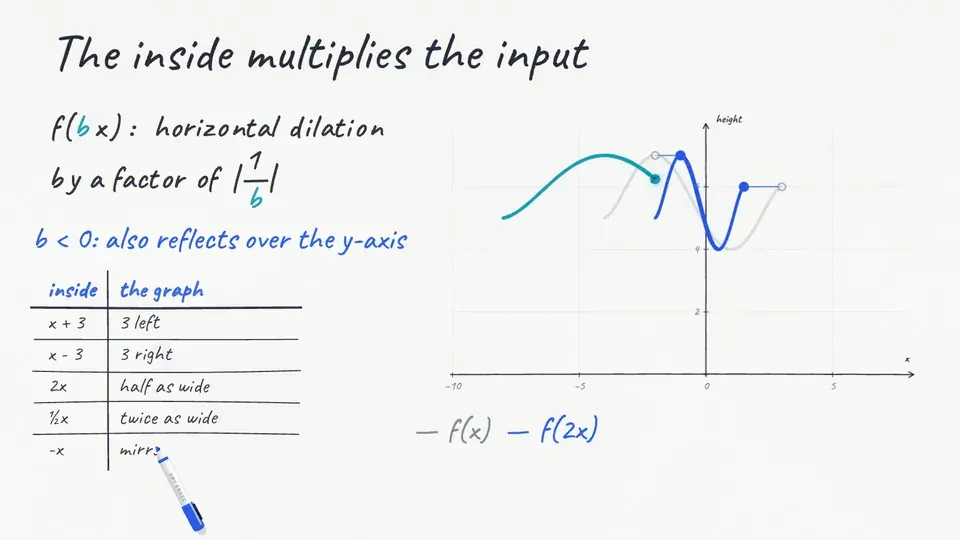
- , , is a horizontal dilation by a factor of : is half as wide, twice as wide.
- reflection over the y-axis
- A negative in : reads at the mirror input, so every point goes to .
- preimage
- The set of points before the transformations (the parent graph).
- image
- The set of points after the transformations (the transformed graph).
- point rule
- Under , the preimage point maps to the image point .
Transcript
2,508 words · 7 parts
The show that flew the wrong way
It’s a warm night on the river. Half the city has come down to the water. And out on that barge, a couple of thousand drones are about to fly. In May of 2026, a show in China flew more than thirty-three thousand drones as one single swarm, a world record, and every one of those drones was just a point of light in the sky.
So every picture this show makes is a set of points. Here the points line up into a curve. And a curve like that is a graph. Let’s call this wave f, so the drone above any spot x on the water flies at a height of f of x, and the four gold drones are landmarks we can follow wherever the picture goes.
Now suppose you’re running the show tonight. The director has one request. Move the whole picture thirty meters to the right. Every step on this grid is ten meters, so thirty meters is three steps, and the obvious thing to type is f of x plus three, because plus means right, doesn’t it?
Before you send it, stop for a second. Make a guess. Which way will the show fly? And there it goes, the whole show gliding thirty meters to the left, the exact opposite of what we asked for.
By the end of this lesson, you’ll be able to take control of a show like this and put it anywhere you want, as tall or as wide as you want, with just four numbers, and you’ll know exactly why plus three just sent it the wrong way. That wrong turn is the hardest idea in this whole topic, so let’s sneak up on it, starting with the numbers that do exactly what they say, the ones outside of f.
The outside does what it says
Let’s put the show back where it started and try a number on the outside first, f of x, plus two. Every drone climbs exactly twenty meters, the ones at the peak and the ones in the dip alike, because we added two steps to every height, so the trails come out perfectly parallel. Now let’s multiply instead, two times f of x, and this time keep your eye on the trails.
The drone at the peak was seventy meters up, and it climbs all the way to a hundred and forty. The one in the dip only goes from forty to eighty. So the higher a drone started, the farther it flies. Every height doubles, measured from the water, so the picture stretches up and away from the waterline, and that kind of stretch is called a vertical dilation.
Now get down low, right above the water, because the river has been doing a transformation of its own all night. Every drone has a reflection directly below it, exactly as far under the water as the drone is above it, so the peak at seventy meters shows up seventy meters down, and the reflection is the graph of negative f of x.
That negative flips the graph over the x-axis, the waterline, but it leaves the flipped show under the water, so to get it into the sky we take that reflection and lift it eleven steps straight up, and that’s negative f of x plus eleven. Eleven steps is just the right lift, because it brings the deepest reflection, seven steps down, up to four steps up, so the flipped show flies in the same band as before, between forty and seventy meters.
Let’s write down what we’ve seen, in exactly the words the AP exam uses. Adding k to the output is a vertical translation by k units, up when k is positive and down when it’s negative. Multiplying the output by a is a vertical dilation by a factor of the absolute value of a, and if a is negative, it’s also a reflection over the x-axis.
These two are easy to predict because they happen after f has already answered. In two f of x plus one, f hands back a height, then we double it and add one, so the point x, y lands at x, two y plus one. The x never changes, so the outside can only move points straight up or down.
Why plus three goes left
So let’s go back to the formula that went wrong, f of x plus three, and follow just one drone, slowly. Pick a spot on the water, say x equals negative five, and ask what height the new show wants right above that spot. The new height there is f of x plus three, so this drone has to go and ask f about negative five plus three, which is negative two.
And at negative two, f is sitting at its peak, seventy meters up, so the drone carries that seventy meters back to negative five, and that’s where the new show’s peak ends up. The peak used to be at negative two, and now it’s at negative five, three steps to the left.
And every other drone is doing the same thing at the same moment, each one copying the height of the drone three steps to its right, so the whole picture lands three steps to the left. That’s the answer to the question we started with. The plus three inside the parentheses tells every drone where to look for its height, three steps to the right, and when you copy from the right, your copy ends up on the left.
So now you can put the show where the director wanted it. Set the number inside the parentheses so it lands on that dashed outline, thirty meters to the right, and then send it.
There’s a quicker way on paper. It tells you where a landmark goes, and it’s the one you’ll use on every test. Take the landmark you care about, like the peak at negative two, and set the inside equal to it, so x plus three equals negative two, which gives x equals negative five, and that’s where the peak lands. Let’s keep a list of what the inside does. So far, x plus three moves the graph three to the left and x minus three moves it three to the right.
If that still feels like a trick, remember the rocket from lesson one point two, which lifted off at two forty-nine and three seconds in the morning. On the wall clock, counting seconds from two forty-nine, liftoff happens at three instead of zero, so everything happens three seconds later, the whole graph slides three seconds to the right, and its formula is h of c minus three. At five seconds on the wall clock, for example, the rocket has only been flying for two, so its height then is h of two, which is exactly h of five minus three.
Twice as fast, half as long
Now let’s put a number inside the parentheses that multiplies, f of two x. Look at that two. What do you think it’s going to do… to the width of the show?
The show squeezes in to half its width, so the peak slides from negative two in to negative one, and the end drone from three in to one and a half. It’s the same reason as before. Each drone at x looks up the height at two x, twice as far from the beam, our y-axis, so the picture it copies comes from twice as far out and lands at half the width.
With f of one half x it’s the other way around, so every drone copies from only halfway out, and the show spreads to twice as wide. If that feels backwards, don’t worry. You’ve known it for years. Let’s go over to the booth, where the show’s music is coming from.
This is the song the show is set to. How long is it? Exactly three minutes. Now watch what happens to its graph… when we play it at double speed. It’s over in a minute and a half, because ten seconds in, you’re already twenty seconds into the song, so every moment copies the moment twice as far along, just like the drones.
The sped-up songs that took over TikTok often run about one and a quarter times as fast, so a three-minute song lasts two minutes and twenty-four seconds, which is four fifths as long. It works the other way too. Dolly Parton’s Jolene came out on a forty-five, and if you play that record at thirty-three and a third, it runs about thirty-five percent longer and her voice drops so low it sounds like a man singing.
So the number inside works like a speed. And the length always gets divided by it. Turn the speed dial. Make this three-minute song last exactly two minutes. Watch the end of the graph as you go.
Back in the sky there’s one more inside number worth trying, and it’s negative one, f of negative x. Every drone at x copies the drone at negative x. That’s the one in the mirror spot, on the other side of the beam. So the show swings around the beam like a door, and comes out reversed. Your selfie preview does this to your face, and in a study back in 1977, people liked their mirror face better while their friends liked the real one.
In the exam’s words, f of b x is a horizontal dilation by a factor of the absolute value of one over b, so f of two x is a horizontal dilation by a factor of one half. And a negative b also reflects the graph over the y-axis, which is the door swing we just watched.
Now our list is complete. Two x makes the graph half as wide. One half x makes it twice as wide. And negative x flips it over the y-axis. If you take a photo of one board in this lesson, make it this one.
This next one is exactly how the AP exam asks it, and it’s built around the trap we just fixed. The function g is a horizontal dilation of f by a factor of two, a vertical dilation by a factor of three, and a vertical translation four units down. Use the table to find g of six.
Preimage, image, and the order
Now let’s give the show several numbers at once, two f of x minus four, minus three, with the trails on so we can see every drone’s whole trip. Every drone starts somewhere on the old wave. It ends somewhere on the new one. The points we start with are called the preimage. The points we end up with are called the image.
You can read every trip straight from the formula, because x goes to x plus four and y goes to two y minus three, so the peak at negative two, seven ends up at two, eleven. On an exam, a full-credit description of this g names every move. It’s a horizontal translation four units to the right, a vertical dilation by a factor of two, and a vertical translation three units down.
And for any formula a times f of b times the quantity x minus h, plus k, a point x, y goes to x over b plus h, a y plus k, which is the one rule behind everything we’ve done so far. Inside, x gets divided by b first, the squeeze we saw with two x, and then h slides it, while outside, a and k act on the heights exactly the way they say.
There’s one more trap, the one that catches strong students, and it hides in f of two x minus six. Look at the end drone, D at three, six. Where do you think it’s going to land?
Say you make the show half as wide, then slide it six steps to the right. The drones land way over here. And that’s the wrong place. The fix is to factor the two out first, f of two times the quantity x minus three, so it’s half as wide and then three to the right, and the whole show snaps into its real place.
The airspace
Real shows can’t fly just anywhere. Most fly between thirty and a hundred and twenty meters up, and this show has a box of river about a hundred and ninety meters long. Our wave flies between forty and seventy meters, so its range is four to seven, and it fits with room to spare. When we doubled every height, the range became eight to fourteen. And the peak poked through the ceiling, at a hundred and forty meters.
What value of k, counted in grid steps, would bring the top of the show down to exactly one hundred and twenty meters? A negative a is sneaky with the range. Negative f of x plus eleven flies in the same band, but the drone that was on top is now at the bottom. So the ends of the range trade places.
The domain moves too. f of one half x stretches the show from seventy meters of river to a hundred and forty, and one more stretch would push the end drones out past the sides of the box. On paper, the horizontal moves act on the domain and the vertical moves act on the range, so you push the ends of each interval through the same moves the points make.
With a rational function like one over x, the asymptotes move along with the graph, so two over x minus three, plus one, has asymptotes at x equals three and y equals one. The vertical asymptote of one over x was the line x equals zero, and the shift three to the right carries it to x equals three, while the plus one lifts the horizontal one from zero up to one. Its domain becomes every number except three, and its range every number except one.
Fly the finale
So let’s go back to the river. It’s time for the finale, and this time the show is all yours. The closing formation has to fly through these four gates, one for each gold drone, without touching the ceiling, so work out the width and the height first, and then slide it into place.
Set a, b, h and k so the whole show flies through all four gates, without flipping it. And there it is. So here’s what the show taught us tonight. The numbers outside of f act on the heights after f has answered, so they do exactly what they say, and the numbers inside f change which input f gets asked about, which is why they seem to work backwards.
That’s why plus three moved the picture left and two x made it half as wide, and a negative sign is a mirror, over the x-axis outside and over the y-axis inside. In the next lesson you’ll get to choose the parent function yourself, to fit real data, and that’s where these four numbers really start to earn their keep.