
Topic 1.14 key terms
- infinite limit
- lim_{x→a} f(x) = ∞ means f(x) increases without bound as x approaches a: for any bound you name, every input close enough to a (on that side) gives an output beyond it. ∞ describes the behavior; it is not a value.
- increases (decreases) without bound
- Gets larger (more negative) than any number you can name and stays beyond it for all inputs close enough to the target, or far enough out.
- vertical asymptote
- The line x = a is a vertical asymptote of f if at least one one-sided limit of f at a is ∞ or −∞. One side is enough.
- limit at infinity
- lim_{x→∞} f(x) = L means that for any band around L, however thin, f(x) is inside it for all x far enough out.
- horizontal asymptote
- The line y = L is a horizontal asymptote of f if lim_{x→∞} f(x) = L or lim_{x→−∞} f(x) = L. A graph may cross its horizontal asymptote.
- end behavior
- What a function does as x → ∞ and as x → −∞, described with limits at infinity.
- dominates (grows faster)
- g dominates f as x → ∞ if lim_{x→∞} f(x)/g(x) = 0. Exponentials bˣ (b > 1) dominate every power xᵖ, and every power (p > 0) dominates ln x.
Transcript
1,088 words · 3 parts
The keeper’s dare
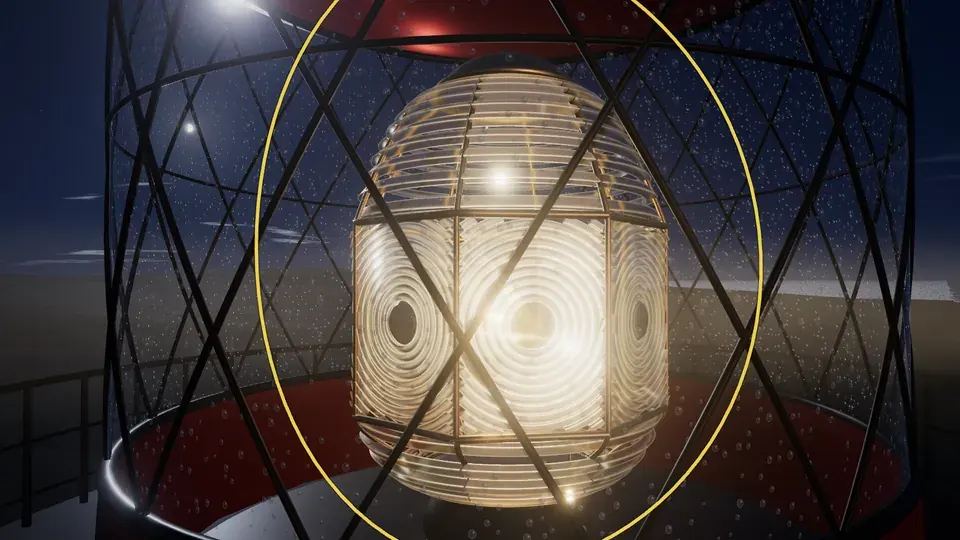
This is the lantern room at the top of a lighthouse, and that beehive of glass is its lens, taller than a person, with one small flame burning in the middle. The lens gathers the flame’s light into a picture of the flame, and right now that picture hangs in the mist about four meters out, upside down.
Now the flame slides toward this red mark. Watch the picture take off, a hundred meters, a kilometer, ten kilometers, right past the ship on the horizon. The formula behind this lens says it doesn’t stop there. Park the flame two nanometers from the mark, about the width of a strand of DNA, and the picture lands past the Moon, and a little closer still, it passes the Sun.
By the end of this lesson, you’ll be able to beat any distance anyone dares you with, even the Moon, and you’ll know exactly where light from something infinitely far away ends up. Let’s put the flame back where it started and find out what’s really going on as it closes in on that mark.
Name any distance
If d is the distance from the flame to the lens and I is how far the picture lands from the lens, then I of d is zero point nine two d over d minus zero point nine two. That red mark, ninety-two centimeters out, is the lens’s focal point, F, and it’s exactly where that bottom turns into zero. Now put the flame exactly on the red mark, so d is zero point nine two. What does the formula give for I?
Just off the mark is a different story, so let’s play a game. You name a distance by dragging that glowing buoy out to sea, as far as you dare, and then you have to beat it.
Set your dare with the buoy, then slide the flame until its picture lands beyond it. Raise the dare to ten kilometers and the zone shrinks under a tenth of a millimeter. Make it the Moon and the zone is just two nanometers wide, but it’s always there, so whatever distance anyone names, some zone next to the mark beats it.
That’s what we mean when we write that the limit of I of d, as d approaches zero point nine two from the right, is infinity. The little plus says d is a bit more than zero point nine two, so the flame comes in from the far side, and the infinity says the picture increases without bound, past every distance you could name.
Now slide the flame past the mark. The picture flips around behind the flame, the right way up, and because it’s on the flame’s side now, the formula gives its distance a minus sign. As the flame creeps back toward the mark from this side, that negative distance plunges, so the limit from the left is negative infinity. This graph shows both sides of the mark at once, so let’s put it on paper.
To keep the numbers friendly, let’s give the lens a focal length of exactly one meter, so I of d is d over d minus one. Write the top as d minus one, plus one. Now the fraction splits into one plus one over d minus one, and that little fraction causes all the trouble.
From the right, at one point one, one point oh one and one point oh oh one, the outputs are eleven, a hundred and one and a thousand and one. From the left, the outputs head the other way, to minus nine, minus ninety-nine and minus nine hundred ninety-nine. Each of these statements has two halves, the input’s trip written under the limit sign, and what the output does after the equals sign.
Let’s check that the dare works for a thousand. One plus one over d minus one beats a thousand exactly when one over d minus one beats nine hundred ninety-nine. For a positive d minus one, a bigger reciprocal means a smaller number, so that happens exactly when d minus one is less than one over nine ninety-nine, about a thousandth. Now you name the window. To beat a million instead, how small does d minus one have to be?
With no plus or minus at all, though, the two sides head opposite ways, so the two-sided limit as d approaches one does not exist. That gives us the calculus meaning of a vertical asymptote. In general, the line x equals a is a vertical asymptote whenever the limit from at least one side of a is infinity or negative infinity, and one side is enough.
Hunting vertical asymptotes
Let’s hunt down the vertical asymptotes of two x plus one, over x squared minus two x minus three. Factoring the bottom gives x minus three times x plus one, so three and negative one are candidates, and the top isn’t zero at either one.
Just right of three, the top is about seven, x plus one is about four, and x minus three is tiny and positive, so f shoots up to infinity. Just left of three, only x minus three changes sign, so f plunges to negative infinity. Now try negative one in your head before I say it. Just to its right the top and x minus three are both negative and x plus one is a tiny positive, so the negatives cancel and f shoots up.
On its left x plus one turns negative too, so f plunges. Two warnings from precalc still apply. If the top is zero there too, cancel first, because that can leave a hole instead of an asymptote. A squared factor is different. Squaring x minus one makes the bottom positive on both sides of one, so both sides shoot up, and we write that the two-sided limit is infinity.
It’s your turn to try one. What’s the limit of x plus one over x squared minus four, as x approaches two from the left?
When the exam asks you to justify an asymptote, the sentence that earns the point is short. Because the limit of f of x as x approaches three from the right is infinity, the graph of f has a vertical asymptote at x equals three. Saying the bottom is zero at three isn’t enough on its own, because a hole has a zero on the bottom too.
Suppose all we know about a function g is these three facts about x equals four. Which statement has to be true?