
Topic 1.9 key terms
- Squeeze Theorem
- If g(x) ≤ f(x) ≤ h(x) for all x near c (except possibly at c), and g and h have the same limit L as x → c, then the limit of f(x) as x → c is also L.
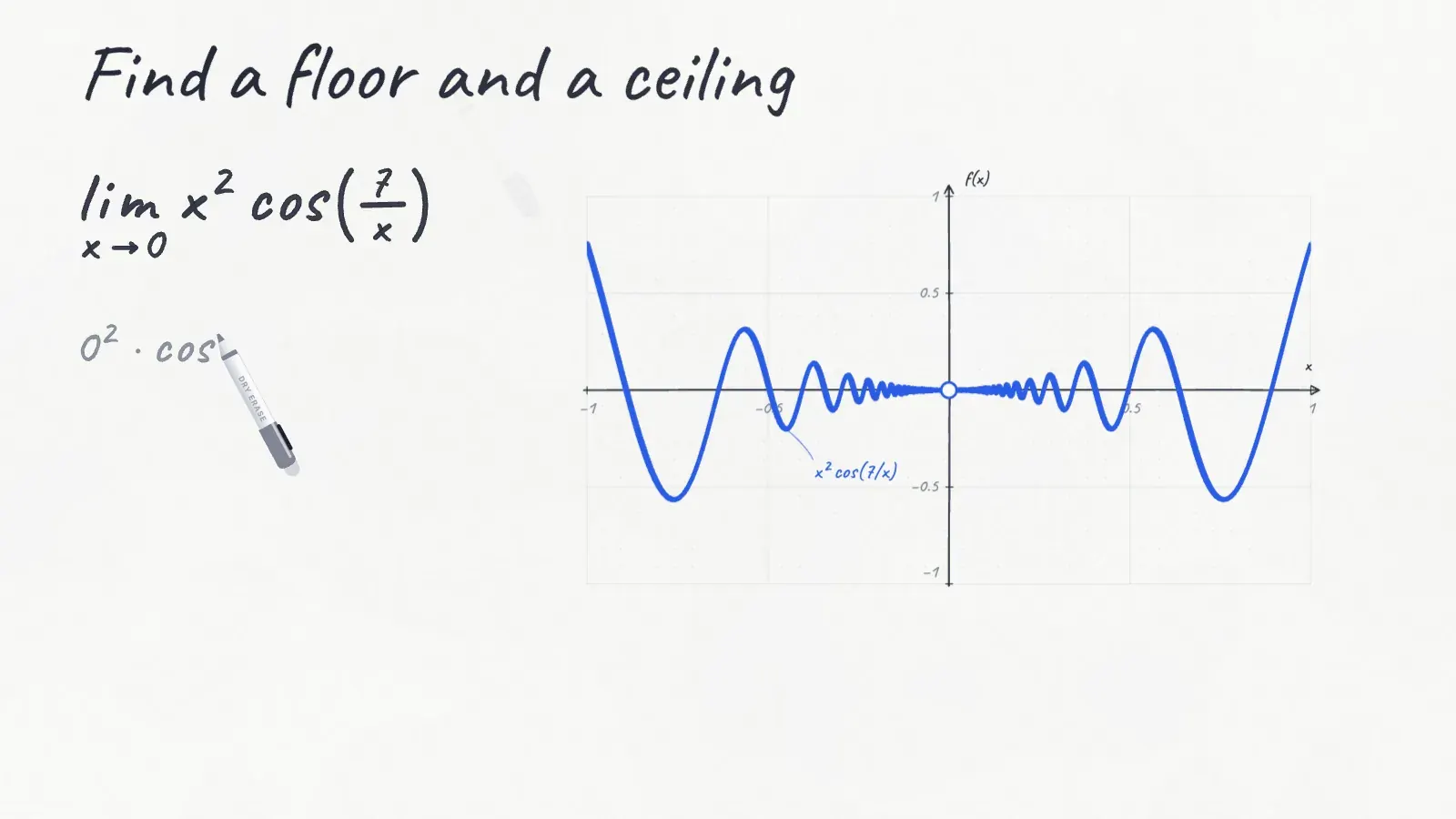
- bounding functions (floor and ceiling)
- Two functions that stay below and above the function you care about near the point and share one limit there; for a two-sided limit they must hold on both sides of c, for a one-sided limit only on the side approached.
- the two conditions to check
- 1. The inequality holds for every x near c (on both sides for a two-sided limit, on the approached side for a one-sided limit; c itself may be left out). 2. Both bounding functions have the same limit.
- bounds that disagree
- If the bounding functions have different limits, the Squeeze Theorem gives no conclusion; the middle function may or may not have a limit.
- lim sin x / x = 1
- As x → 0 (x in radians), sin x / x → 1, proved by trapping it between cos x and 1.
- lim (1 − cos x) / x = 0
- As x → 0, (1 − cos x)/x → 0: multiply by (1 + cos x)/(1 + cos x) and use sin x / x → 1.
- radians
- On a circle of radius 1, an angle of θ radians cuts an arc exactly θ long; the limit sin θ / θ = 1 needs θ in radians (in degrees it is π/180).
- indeterminate form 0/0
- What substitution gives when it can't decide the limit: a signal to look closer (factor, conjugate, match a sine, squeeze), never an answer.
- selecting a procedure
- Plug in first. A number: done if the function is continuous there. 0/0: factor, conjugate, or match a sine. A bounded wiggle times something going to 0: squeeze. |x| or a split rule: check each side.
- a table is evidence, not proof
- A table checks only the inputs it lists; it can suggest a limit, but justifying one needs an argument that covers every x near the point.
Transcript
554 words · 3 parts
One limit, four ways
Let’s look at sine x over x one more time, the ways an AP question might show you a limit. On a graph, the curve heads to one from both sides, with a hole at zero, because the function isn’t defined there. In a table, the values creep toward one from the left and from the right, and that matches the graph.
The squeeze is the formula version, and the only one of the three that proves it. In words, as x gets close to zero from either side, sine x over x gets as close to one as we like.
Here’s a table for the sine of pi over x, at a tenth, a hundredth and a thousandth. Every value is zero. What does this table tell you about the limit as x goes to zero?
That’s why a table is evidence and a squeeze is a proof. Tables are great for estimating, but to justify a limit you need an argument that covers every x near the point.
On the exam
Let’s finish with a question the way the exam asks it. A function f is trapped between five minus the square of x minus one, and five plus the square of x minus one, for x near one.
On top of that, f of one is eight. Find the limit of f as x goes to one, and justify it. Both bounds are polynomials, so we find their limits by plugging in one, and each of them gives five. Notice that f of one is eight, and that doesn’t change a thing. The limit only listens to x near one, so the graph has an open circle at five and a dot up at eight, and the limit is still five.
A full-credit justification says three things. It states the inequality and where it holds, and it shows that both bounds have the same limit, five. Then it concludes, by the Squeeze Theorem, that the limit of f is five. Just writing the words Squeeze Theorem won’t earn the point on its own. What earns it is showing the inequality and the two matching limits, because that’s what makes the argument work.
Now put two tools together. Using the same f, find the limit as x goes to one of f of x times the sine of three times the quantity x minus one, all over x minus one.
Silence
Let’s go back to where we started. Now you can say exactly why the dot ends up on the mirror, because its height is trapped between the floor and a ceiling that comes down to zero. Watch the orange ceiling come down one last time, and listen for the silence when it reaches the floor.
Spin it yourself this time. Pick a tilt, paint the dot wherever you like, and see if you can make it land anywhere other than the mirror.
Today you learned to trap a limit you can’t compute between a floor and a ceiling that meet. Then you used it to prove that sine x over x goes to one. You can also pick the right tool by looking first, and you know a table is a clue, not a proof. Next time something moves way too fast for anybody to follow, you’ll know how to prove exactly where it’s going.