
Topic 1.8 key terms
- Squeeze Theorem
- If g(x) ≤ f(x) ≤ h(x) for all x near c (except possibly at c), and g and h have the same limit L as x → c, then the limit of f(x) as x → c is also L.
- bounding functions (floor and ceiling)
- Two functions that stay below and above the function you care about near the point and share one limit there; for a two-sided limit they must hold on both sides of c, for a one-sided limit only on the side approached.
- the two conditions to check
- 1. The inequality holds for every x near c (on both sides for a two-sided limit, on the approached side for a one-sided limit; c itself may be left out). 2. Both bounding functions have the same limit.
- bounds that disagree
- If the bounding functions have different limits, the Squeeze Theorem gives no conclusion; the middle function may or may not have a limit.
- lim sin x / x = 1
- As x → 0 (x in radians), sin x / x → 1, proved by trapping it between cos x and 1.
- lim (1 − cos x) / x = 0
- As x → 0, (1 − cos x)/x → 0: multiply by (1 + cos x)/(1 + cos x) and use sin x / x → 1.
- radians
- On a circle of radius 1, an angle of θ radians cuts an arc exactly θ long; the limit sin θ / θ = 1 needs θ in radians (in degrees it is π/180).
- indeterminate form 0/0
- What substitution gives when it can't decide the limit: a signal to look closer (factor, conjugate, match a sine, squeeze), never an answer.
- selecting a procedure
- Plug in first. A number: done if the function is continuous there. 0/0: factor, conjugate, or match a sine. A bounded wiggle times something going to 0: squeeze. |x| or a split rule: check each side.
- a table is evidence, not proof
- A table checks only the inputs it lists; it can suggest a limit, but justifying one needs an argument that covers every x near the point.
Transcript
1,863 words · 4 parts
Floor and ceiling
This is the disk one second before it stops, seen from the side at the level of the mirror, and from here on the wobble only gets faster. The wobble speeds up without any limit, so here’s what I want you to decide. As the time runs out, does the dot’s height have a limit?
Underneath the dot there’s the mirror, and the dot can never go below it, so the mirror is a floor at height zero. Above it, the highest the dot can get is the top of the tilted rim, so that’s a ceiling, and a second before the end it’s about nine millimeters up.
Watch the last second in slow motion again. As the disk tips flatter, the ceiling comes down, and the dot has less and less room. On a graph of the height against the time left, the dot wiggles faster and faster, but it’s stuck in this funnel, and the funnel closes down to zero.
Now you try it. Drag the time-left handle toward the end, and find when the ceiling drops below five millimeters. Five millimeters isn’t special. Pick your own target, as small as you dare, and find the moment after which the dot can never escape it.
However small a target you pick, there’s a moment after which the dot stays inside it, and that’s what it means for its height to have a limit of zero. Let’s put this on the board, because what we just did has a name.
Let’s call the dot’s height y of t, where t is the time left, and the ceiling c of t. The dot is always between the floor and the ceiling, so zero is at most y of t, and y of t is at most c of t. As t goes to zero, the floor stays at zero and the ceiling comes down to zero too. The dot has nowhere else to go, so y of t has to go to zero.
This is the Squeeze Theorem, and some people call it the sandwich theorem. If something is trapped between two functions that head to the same number, then the thing in the middle has to head there too.
Trapped
Let’s try one where the answer isn’t so obvious. I’m thinking of a function f, and I won’t tell you its formula, only that near zero it’s trapped between three minus x squared and three plus x squared.
At x equals a tenth, that leaves f a window from two point nine nine to three point zero one. At a hundredth, f is within a ten-thousandth of three. Both bounds head to three, so the Squeeze Theorem says f heads to three too, and we never even needed its formula.
It doesn’t even matter what happens at zero itself. The value f of zero could be three, or nine, or not exist at all, and the limit is still three. One function that fits is three plus x squared times the sine of one over x, which wiggles infinitely many times near zero and is still pinned to three.
Let’s write the theorem properly. The floor is g, the ceiling is h, and c is the number x is heading to. Suppose g of x is at most f of x, and f of x is at most h of x, for every x near c except maybe c itself.
If g and h have the same limit L as x goes to c, then f has the limit L too. For a two-sided limit, check two things, that the sandwich holds on both sides of c, and that both bounds go to the same number. For a one-sided limit, like our disk, you only need the side you’re coming from.
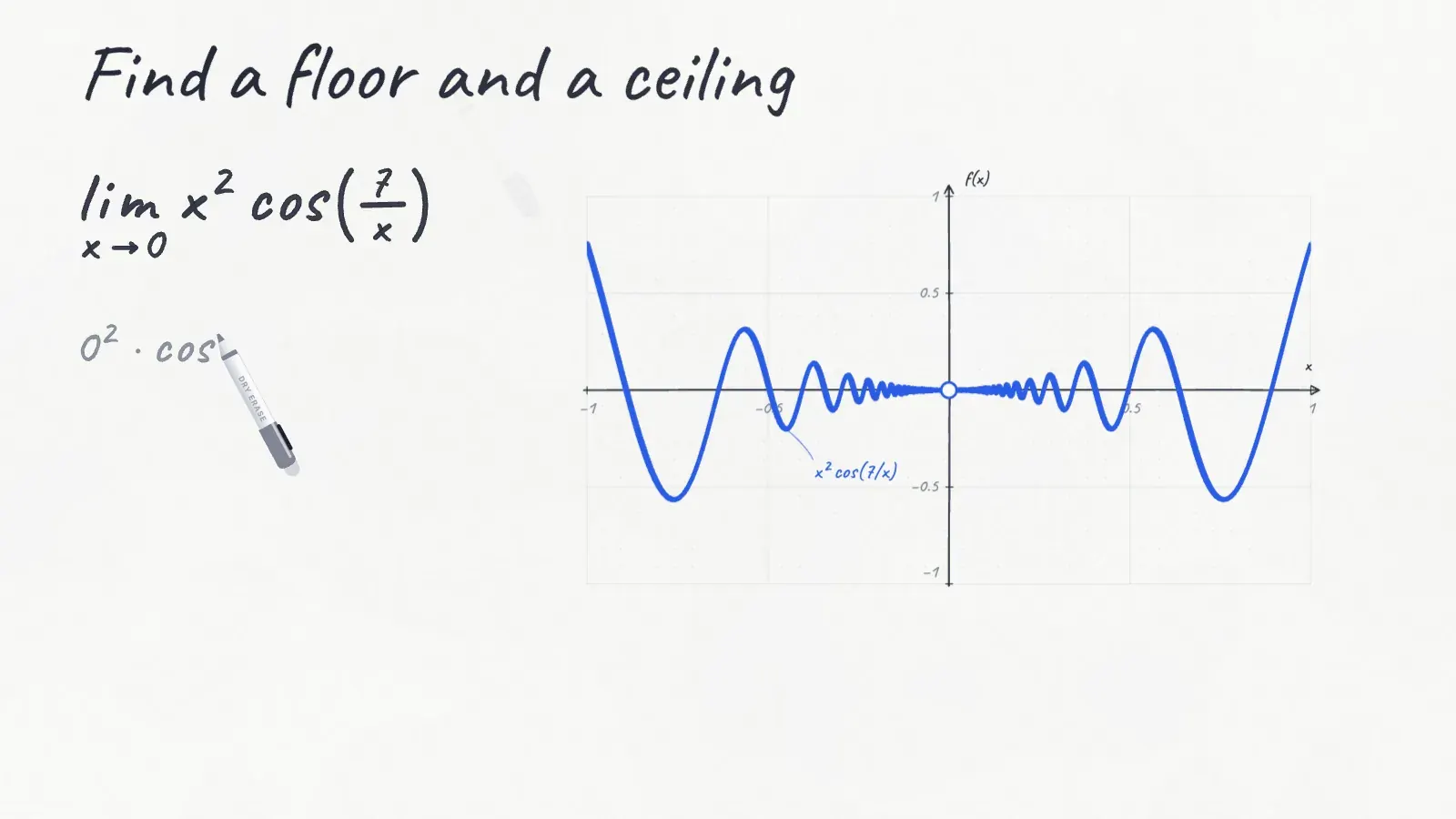
Let’s do one together, the limit of x squared times the cosine of seven over x, as x goes to zero. Plugging in zero fails, because seven over zero isn’t a number. It’s tempting to split it into the limit of x squared times the limit of the cosine, but that split only works when both limits exist, and this cosine has no limit. The answer will still turn out to be zero, though. We just need a better reason.
We need a floor and a ceiling. Which pair of bounds actually proves this limit? One warning before we move on. If your two bounds go to different numbers, the theorem says nothing at all.
Minus one and one fit the flat function zero, which has a limit, and they also fit the sine of one over x, which doesn’t. That’s exactly why minus one and one couldn’t prove our limit.
The harbor proof
Now for the famous limit I promised you, sine x over x, as x goes to zero. Plugging in gives zero over zero, and there’s no common factor to cancel, so the algebra from the last lesson won’t rescue us here.
A table makes a strong suggestion, because at a tenth and at a hundredth the values are already very close to one, so it sure looks like it’s heading to one. A table only checks a few points, though, so to be sure we need to squeeze it. The floor and the ceiling are hiding in a harbor you might remember.
If you took precalc with us, you’ve seen this light before, throwing its spot along the sea wall at a height of tangent theta. Let’s draw a circle of radius one around the light. Because the radius is one, the arc from the foot of the wall up to the beam is exactly theta long, as long as theta is in radians.
Inside the circle there’s a triangle from the light to the foot of the wall to the beam’s crossing point. Its base is one and its height is sine theta, so its area is sine theta over two.
Around it is the slice of light the beam swept across the water. It’s theta over two pi of the whole circle, and the whole circle’s area is pi, so the slice’s area is theta over two.
Around the slice there’s the big triangle out to the spot on the wall, with base one and height tangent theta, so its area is tangent theta over two. Each shape fits inside the next, so the areas come in order, and theta sits right in the middle of the sandwich.
Double the areas and you get three lengths standing on the wall, sine theta, then the arc unrolled, then tangent theta. This gauge shows how much of each shape the small triangle fills. It fills all of itself, about eighty-seven percent of the big triangle, and about ninety-five percent of the slice. That middle number, the slice, is sine theta over theta, the one we want.
Now take the light yourself. Turn the beam down toward the foot of the wall, below five hundredths of a radian, and watch the gauge. At a hundredth of a radian, the marks are almost on top of each other, so the fraction in the middle has nowhere to go but one. Here’s a way to break it. Flip the dial’s units to degrees and watch what happens to the number in the middle.
Let’s turn back to thirty degrees and drop a line straight down from the beam’s crossing point. It lands cosine theta from the light, so the gap left before the wall is one minus cosine theta. As the angle shrinks, that gap shrinks much faster than the arc does. Let’s take these shapes to the board.
For an angle between zero and a right angle, the areas give us this sandwich. Now divide the small triangle’s area by each area, just like the gauge did. That gives one, then sine theta over theta, then cosine theta, because sine over tangent is cosine. Dividing by a bigger area gives a smaller fraction, so cosine theta is at most sine theta over theta, which is at most one.
As theta goes to zero, cosine theta goes to one and one stays one, so by the Squeeze Theorem, sine theta over theta goes to one from the right. For negative angles, the two minus signs in sine of minus theta over minus theta cancel, so the left side goes to one too, and the whole limit is one. You’ll need this limit in the next unit to find the derivative of sine, and now you know why it’s true.
Its partner is one minus cosine x, over x, the harbor’s gap divided by its arc. Plugging in gives zero over zero again, but the gap shrank so much faster than the arc that I’d bet on zero.
To prove it, let’s use the trick from the last lesson and multiply the top and bottom by one plus cosine x. On top, that makes one minus cosine squared, which is sine squared x, by the Pythagorean identity.
Now it splits into sine x over x, which goes to one, times sine x over one plus cosine x, which goes to zero over two. One times zero is zero, so the limit is zero, just like the shrinking gap in the harbor.
Choose your tool
You now have a whole toolbox for limits, and the hard part on a test is knowing which tool to grab. Always start by plugging in and seeing what you get. If you get a number and the function is continuous there, you’re done. Zero over zero means look closer, for something to factor, a square root that wants a conjugate, or a sine to match.
A wiggle that stays bounded, times something that goes to zero, calls for the squeeze. That’s our spinning dot exactly, because its height is the ceiling times a wiggle between zero and one. An absolute value, or a rule that changes at the point, means checking each side.
Let’s sort a few, and name the tool before doing any work. The first one gives five over five, a perfectly good number, so the limit is one. The second gives zero over zero with a square root, so it wants the conjugate, and after canceling it goes to one sixth.
The third is zero over zero too, but it factors, and canceling x minus two leaves x plus two, which goes to four. The last one has an absolute value, so we check each side. It’s minus one from the left and one from the right, so the limit doesn’t exist.
Now one with a sine. In sine five x over x, the inside is five x but the bottom is only x, so let’s multiply the top and the bottom by five. That gives five times sine five x over five x, and since five x goes to zero along with x, that fraction goes to one, so the limit is five.
Now you try one. Find the limit of sine three x over two x, as x goes to zero, as a decimal. This one looks different. Which tool would you reach for first to find the limit of x times the sine of one over x?