
Topic 1.6 key terms
- limit laws
- If lim_(x→a) f(x) = L and lim_(x→a) g(x) = M (finite), then f ± g → L ± M, kf → kL, fg → LM, and f/g → L/M provided M ≠ 0, all as x → a.
- direct substitution
- For a polynomial, or a rational function whose denominator doesn't approach 0 at a, the limit as x → a equals the value at a, because the limit laws split it into pieces that each approach their value.
- limit of a composite
- If g(x) → M and the outside function F is continuous at M, then F(g(x)) → F(M).
- indeterminate form 0/0
- When substitution makes the top and the bottom both 0, the limit isn't determined yet: it could be any number or not exist. Rewrite first; never write a limit equal to 0/0.
- factor and cancel
- Factor the top and the bottom and cancel a common factor that is nonzero for x ≠ a; the new expression equals the old one near a, so it has the same limit.
- same nearby outputs, same limit
- If f(x) = g(x) for every x near a (except possibly at a), then lim f(x) = lim g(x) as x → a. This is why rewriting is allowed.
- conjugate
- For √A − B, the conjugate is √A + B. Multiplying the top and bottom by it (a fraction equal to 1) turns the difference of squares into A − B².
- Pythagorean rewrite
- sin²θ = 1 − cos²θ = (1 − cos θ)(1 + cos θ), which exposes a factor that cancels.
- one-sided limits (analytic)
- Find the limit from the left with the formula that holds just left of a, and from the right with the one just right of a. The two-sided limit exists only if they agree.
Transcript
2,031 words · 5 parts
Zero over zero, in gold
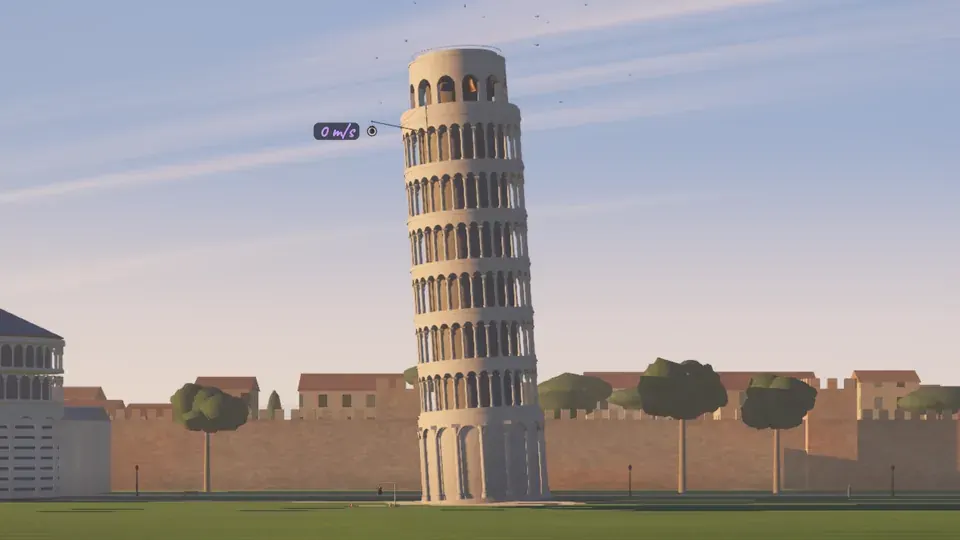
To crack the ball’s fraction, let’s pull four point nine out of the top. Forty-four point one is four point nine times nine, which is exactly why the fall takes three seconds, so what’s left is nine minus t squared over three minus t. Nine minus t squared is a difference of two squares, and we can turn that algebra into an actual strip of gold. The same picture comes back when we meet square-root and trig limits.
This is a gilder’s bench a few streets from the tower, and that’s gold leaf, gold hammered so thin that light shines through it. The gilder starts with a square three centimeters on a side, area nine square centimeters, and cuts a smaller square, t centimeters on a side, out of one corner. What’s left is an L of gold with area nine minus t squared.
One more cut splits that L into two pieces, a tall one up the side and a shorter one across the top. See if you can turn the top piece and lay it end to end with the side piece, so the two of them make one long strip.
Both pieces are three minus t wide, so the strip is three minus t wide. The tall piece is three long and the short one is t long, so end to end the strip is three plus t. Area divided by width is length, which means nine minus t squared over three minus t is simply the length of this strip, three plus t.
Now try to make the gold disappear. Drag the width down until the strip is thinner than half a millimeter, and keep an eye on its length.
Now let’s push the small square’s side all the way up to three. The strip gets thinner and thinner, down to a thread of gold, but its length doesn’t shrink at all, it settles in at six centimeters.
At exactly three there’s no gold left at all, no area and no width, which is our zero over zero. Every strip near three, though, is about six centimeters long, and that six is the limit. Let’s write it the way the exam would, with x as the big square’s side and three as the small one’s.
We want the limit of x squared minus nine over x minus three as x approaches three, and plugging in three gives zero over zero, so we rewrite. The top factors into x minus three times x plus three, the width times the length of our strip. As long as x isn’t three, x minus three isn’t zero, so we can cancel it and keep x plus three, which heads to six.
On a graph, the fraction is the line x plus three with one point missing, a hole at three, because you still can’t evaluate the original fraction there. We can cancel because we keep every nearby output exactly the same. The formula looks different, but the values approaching three haven’t changed, so neither has their limit.
On an exam, you would justify it in one sentence. The two expressions are equal for every x except three, so they have the same limit, and x plus three approaches six. The trap that really does cost points on the exam is writing that the limit equals zero over zero, or worse, that zero over zero equals one. Substitution gives zero over zero, and the limit is whatever the rewrite says.
Now we can finish the ball. Its readout is four point nine times nine minus t squared over three minus t, and that’s four point nine times the length of a strip, three plus t. As t heads to three from below, while the ball is still falling, three plus t heads to six. The speed heads to four point nine times six, exactly twenty-nine point four meters per second.
That’s about a hundred and six kilometers an hour, highway speed, so check it against your guess. It also fits the readout, which was climbing toward twenty-nine point four from below the whole time. Every number the readout showed was heading here, and now we know exactly where here is, twenty-nine point four meters per second at the instant it hits.
Let’s do one together where the top and the bottom both need factoring, x squared plus x minus six over x squared minus four, as x heads to two. Plugging in two gives zero over zero, so we factor. The top is x plus three times x minus two, and the bottom is x minus two times x plus two. They share x minus two, which isn’t zero near two, so it cancels and leaves x plus three over x plus two, which heads to five fourths.
Now try one on your own. As x heads to negative one, what does x squared minus one, over x squared plus three x plus two, head to?
The same strip, upside down
Factoring isn’t the only way to rewrite. Take the square root of x, minus three, all over x minus nine, as x heads to nine, which gives zero over zero with nothing obvious to factor.
Back at the bench, picture a gold square whose area is x, so its side is root x, with the same three-centimeter square cut from its corner. Its border has area x minus nine, and laid out as a strip it’s root x minus three wide and root x plus three long.
This time our fraction is the width over the area, upside down from before, so it equals one over the length. As x heads to nine, the length heads to six, and the fraction heads to one sixth.
I want the radical to disappear, so I’ll pair root x minus three with root x plus three. We call that partner the conjugate, and putting it on both the top and the bottom multiplies our fraction by one.
The new top is x minus nine, which also appears as a factor on the bottom. For x different from nine those factors cancel, leaving one over root x plus three, which approaches one sixth. The conjugate works because x minus nine is a difference of squares too, root x squared minus three squared, the same strip in disguise.
See if you can do this one. What does the square root of x plus four, minus two, all over x, head to as x heads to zero?
Trig in disguise
Trig functions can hide a difference of squares too. As theta heads to zero, one minus cosine theta over sine squared theta gives zero over zero, because cosine of zero is one and sine of zero is zero.
The Pythagorean identity rewrites sine squared as one minus cosine squared. That’s the same strip again, a square of side one with a square of side cosine theta cut from its corner. It factors into one minus cosine times one plus cosine, the one minus cosine cancels, and one over one plus cosine theta heads to one half. Now you take one. As x heads to zero, what does sine squared x over one minus cosine x head to?
Every instant, and the one it hits
We found the speed at three seconds, so let’s get greedy and find it at any instant a while the ball is falling. Call the ball’s height y. From instant a to a later instant t, the ball falls y of a minus y of t meters. Divide by the time between, t minus a, to get its average speed, then bring t toward a.
Let’s write both heights out, keeping the subtraction around the second one. The two forty-four point ones cancel, leaving four point nine t squared minus four point nine a squared, and pulling out the four point nine uncovers another difference of squares. t squared minus a squared factors into t minus a times t plus a. For t different from a, the t minus a cancels, leaving four point nine times t plus a. As t approaches a, t plus a approaches two a, so we get nine point eight a.
The speed at any instant a is nine point eight a meters per second, so every second the ball goes nine point eight meters per second faster. That’s what Galileo discovered, that a falling body’s speed grows steadily with time. If you’ve taken physics, you’ve probably used nine point eight t for a falling object’s speed, and now you know where it comes from.
What happens at exactly three seconds, though, when the ball hits? Let’s go back to Pisa and watch the impact once more in slow motion, with the ball’s speed riding beside it. Just before it hits it’s doing almost twenty-nine point four meters per second, and a split second later it’s sitting in the sand doing zero.
On a graph of speed against time, the line nine point eight t climbs to twenty-nine point four, then drops to zero the moment the sand stops the ball. In our model that stop is instant, while real sand takes a moment to bring the ball to rest. As t approaches three from the left, the speed heads to twenty-nine point four, and from the right it heads to zero. Those are one-sided limits, and each side uses its own formula.
The twenty-nine point four we found earlier is the speed from the left, while the ball was still falling. Right at three, the two sides disagree. Because the two sides disagree, the limit at three doesn’t exist, and on an exam you’d say just that, naming both one-sided limits and saying they’re different.
With a piecewise function, use the right formula on each side. To the left of two, x squared plus one heads to five, to the right three x minus one heads to five, and since they agree the limit is five.
Absolute value is a piecewise function in disguise. Left of two, the absolute value of x minus two is two minus x, the negative of x minus two, so the fraction is negative one, and on the right it’s positive one. Plugging in two gives zero over zero, yet the two sides rewrite to different numbers, so this limit doesn’t exist. Zero over zero tells you to rewrite, and it never promises an answer.
Let’s put both sides to work. If f is k x plus one to the left of two and x squared minus one from two on, what value of k makes the limit at two exist?
Any height at all
The forty-four point one canceled, which means the height you drop from shouldn’t change the speed at any given moment. Let’s test that with a second ball. Set the second ball at any height you like, at least five meters up, then drop them together and compare their speeds one second in.
Whatever height you choose, the two balls keep pace, speed for speed, for as long as both are falling. Now that we know the speed at every instant, let’s have some fun with it. Italian towns put up signs like this to show drivers their speed, and in most towns the limit is fifty kilometers an hour.
When does our ball start breaking the speed limit? Fifty kilometers an hour is about thirteen point nine meters per second, so find that instant to the nearest hundredth of a second.
Let’s let it go. The sign turns red after one point four two seconds, when the ball has fallen only about ten meters, and by the sand it reads a hundred and six. When you need a limit, plug in first. For a polynomial, plugging in gives the limit, and for a fraction of polynomials it works whenever the bottom isn’t zero there.
If you get zero over zero, rewrite, by factoring, with a conjugate or with a trig identity, and when a function changes formulas, take each side on its own. The no-calculator part of the AP exam is full of limits like these. The readout gave up on this ball, but you didn’t, and you found its speed at the instant it hit, twenty-nine point four meters per second, with nothing but algebra.