
Topic 1.15 key terms
- infinite limit
- lim_{x→a} f(x) = ∞ means f(x) increases without bound as x approaches a: for any bound you name, every input close enough to a (on that side) gives an output beyond it. ∞ describes the behavior; it is not a value.
- increases (decreases) without bound
- Gets larger (more negative) than any number you can name and stays beyond it for all inputs close enough to the target, or far enough out.
- vertical asymptote
- The line x = a is a vertical asymptote of f if at least one one-sided limit of f at a is ∞ or −∞. One side is enough.
- limit at infinity
- lim_{x→∞} f(x) = L means that for any band around L, however thin, f(x) is inside it for all x far enough out.
- horizontal asymptote
- The line y = L is a horizontal asymptote of f if lim_{x→∞} f(x) = L or lim_{x→−∞} f(x) = L. A graph may cross its horizontal asymptote.
- end behavior
- What a function does as x → ∞ and as x → −∞, described with limits at infinity.
- dominates (grows faster)
- g dominates f as x → ∞ if lim_{x→∞} f(x)/g(x) = 0. Exponentials bˣ (b > 1) dominate every power xᵖ, and every power (p > 0) dominates ln x.
Transcript
1,468 words · 5 parts
Infinity in, focal point out
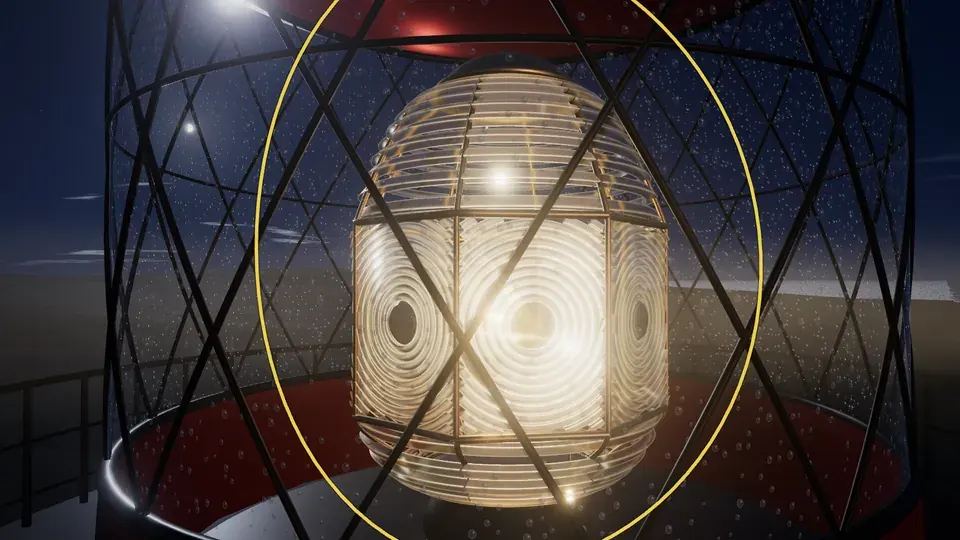
Now let’s turn the whole thing around. Put out the flame, and let the light come from the ship, thirty-seven kilometers out. Her picture lands on the land side, about twenty-three micrometers past the mark, a third of a hair’s width. It’s the same gap that threw the flame’s picture out to the ship, because light runs backward along the same rays, so the two spots simply swap. Now d is the ship’s distance, and I is where her picture lands.
As the ship sails away, her picture creeps onto the mark, and the Moon’s light lands about two nanometers past it, which is the Moon dare from the start, run backward. This time the input, the ship’s distance d, runs off to infinity and the output settles on zero point nine two, so infinity and the focal point have traded places.
Let’s try a new kind of dare, where you decide what counts as close. Drag the edge of this green band to set how near the mark her picture has to land, and then sail her out until it lands inside and stays there. Set your band, then sail the ship out until her picture lands inside it.
This is the lens’s whole graph, and it has both asymptotes, the red one where the flame meets the mark and the teal one that faraway light settles onto. We’ll take it to the board.
Back on our friendly lens, at eleven, a hundred and one and a thousand and one the outputs are one point one, one point oh one and one point oh oh one. The piece that blew up before now fades to zero, so the limit at infinity is one, and I equals one is a horizontal asymptote.
In general, y equals L is a horizontal asymptote when f approaches L as x goes to infinity or negative infinity. Limits like these describe a function’s end behavior, and they make the same promise the ship did, so pick any band around L and far enough out the graph stays inside it.
Divide by the biggest power
Now let’s find a limit at infinity with nothing but algebra, for four x squared minus x plus seven, over two x squared plus five. The top and the bottom both grow without bound, and infinity over infinity on its own tells us nothing. Infinity over infinity isn’t automatically one, because x over x, x squared over x and x over x squared all look like infinity over infinity, and their limits are one, infinity and zero.
What settles it is dividing every single term by the biggest power on the bottom, which is x squared. Four x squared becomes four, x becomes one over x, and so on down the line. As x runs off to infinity, every piece with an x on its bottom fades to zero, leaving four over two, which is two. At x equals a thousand we get just under two, which agrees with the limit we found.
For three x over x squared plus one, the bottom has the bigger power, so the limit is zero. Its graph goes right through the line y equals zero at the origin and comes back to it, because a horizontal asymptote only makes a promise about the ends.
For x squared over x plus one, the top wins, because dividing by x leaves an x on top that keeps growing. The function heads to infinity on the right and negative infinity on the left, so there’s no horizontal asymptote at all. The biggest powers decide. A bigger bottom gives zero, a tie gives the ratio of the leading coefficients, and a bigger top grows without bound, so check its sign at each end.
Now you try one. Find the limit of five x cubed minus two x plus one, over two x cubed plus x squared plus nine, as x goes to infinity.
Square roots add one twist. In x over the square root of x squared plus one, the square root acts like the square root of x squared, which is the absolute value of x. On the right that’s x, and the limit is one. On the left it’s negative x, because at x equals negative a hundred the root is about positive a hundred, so the limit is negative one. This function has two different horizontal asymptotes, one at each end.
A speed limit in space
Let’s leave the lighthouse for something that really is heading off to infinity. This is three-I ATLAS, a comet from another star, which swung around our Sun at the end of October twenty twenty-five and is now leaving forever.
At its closest pass it was moving about sixty-eight kilometers every second, and the Sun’s gravity has been slowing it down ever since. In this gravity model it keeps slowing down forever, while its speed stays above a limit of about fifty-eight kilometers a second. Pick how close counts by dragging the top of the green band, then drag the comet forward in time until its speed is inside.
Physics gives its speed from its distance r from the Sun, measured in astronomical units, where one AU is the distance from the Earth to the Sun. The formula is the square root of thirty-three sixty-two plus seventeen seventy-four over r. As r goes to infinity that second piece fades to zero, so the speed approaches the square root of thirty-three sixty-two, about fifty-eight kilometers per second.
When the exam asks what a limit like this means, answer in context and with units. As its distance from the Sun increases without bound, the comet’s speed approaches about fifty-eight kilometers per second. In this model it never actually reaches its limiting speed, and slowing down forever doesn’t have to mean slowing down to zero. The distance it covers grows without bound, but its speed settles near fifty-eight, so an amount can run off to infinity while its rate levels out.
Who grows faster?
That leads to the last idea, comparing how fast things grow, so let’s race x to the hundredth against e to the x. At x equals a hundred, x to the hundredth is a one with two hundred zeros while e to the hundredth has only forty-four digits. What do you think happens when x gets really, really big? Which one ends up bigger?
Let’s see why it had to happen. Each time x goes up by one, e to the x grows by a factor of e, forever. x to the hundredth only grows by a factor of one plus one over x, to the hundredth, because x plus one is x times one plus one over x. That factor sinks toward one, and by x equals a thousand it’s only about one point one, while e to the x keeps multiplying by about two point seven, so e to the x pulls further ahead with every step.
That’s why the limit of x to the hundredth over e to the x is zero, and we say e to the x dominates. Any exponential with a base bigger than one beats any positive power of x, and any positive power beats a logarithm. Of these three families, logarithms grow slowest. Divide the natural log of x by the square root of x, and the ratio falls from about point seven at ten to about point zero one at a million, on its way to zero.
On the exam it looks like two e to the x plus x to the fifth, over three e to the x minus four x squared. We’ll divide every term by e to the x, because it outgrows both powers. Those two fractions approach zero, leaving two over three.
The Moon dare
Let’s put the whole lesson on one board. When a limit is infinite, the function beats any bound you name, and one infinite side makes a vertical asymptote. For a rational function, cancel common factors first, then check where the bottom is zero and the sign on each side. When the limit at infinity is L, the graph eventually stays inside any band you choose around L, and for a fraction, you divide every term by the fastest-growing term in the bottom. Last, the limit of a ratio tells you which of two functions grows faster.
I promised you’d beat any distance anyone dares you with, so let’s go back to the lighthouse. I’m daring you with the Moon. Zoom the magnifier all the way in and park the flame close enough to the mark that its picture lands past the Moon.
You just beat the Moon with a flame and one fraction, and you know why light from infinitely far away lands right on the focal point. Next, we’ll use a limit to find how steep a curve is at a single point.