
Topic 1.7 key terms
- Squeeze Theorem
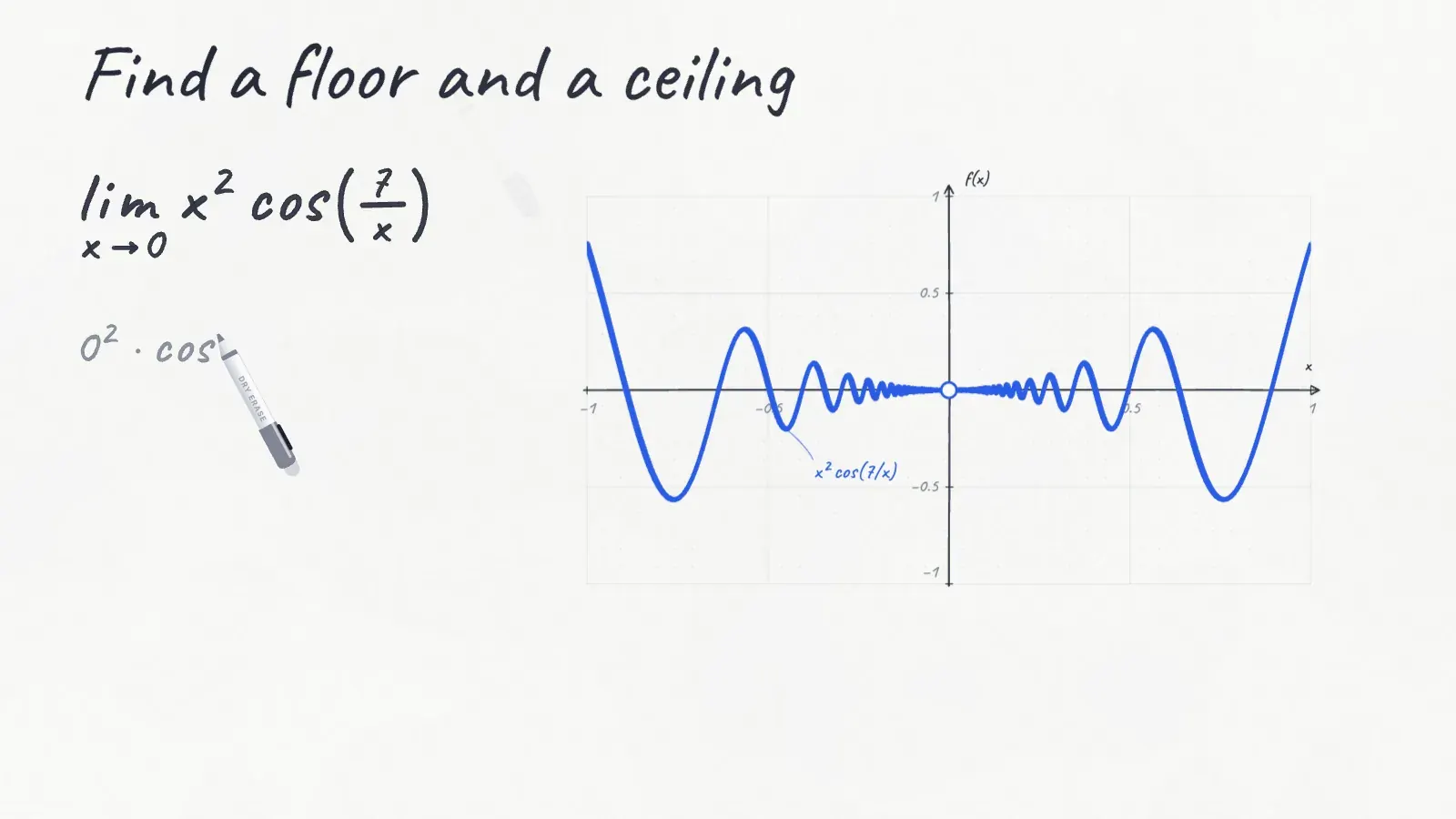
- If g(x) ≤ f(x) ≤ h(x) for all x near c (except possibly at c), and g and h have the same limit L as x → c, then the limit of f(x) as x → c is also L.
- bounding functions (floor and ceiling)
- Two functions that stay below and above the function you care about near the point and share one limit there; for a two-sided limit they must hold on both sides of c, for a one-sided limit only on the side approached.
- the two conditions to check
- 1. The inequality holds for every x near c (on both sides for a two-sided limit, on the approached side for a one-sided limit; c itself may be left out). 2. Both bounding functions have the same limit.
- bounds that disagree
- If the bounding functions have different limits, the Squeeze Theorem gives no conclusion; the middle function may or may not have a limit.
- lim sin x / x = 1
- As x → 0 (x in radians), sin x / x → 1, proved by trapping it between cos x and 1.
- lim (1 − cos x) / x = 0
- As x → 0, (1 − cos x)/x → 0: multiply by (1 + cos x)/(1 + cos x) and use sin x / x → 1.
- radians
- On a circle of radius 1, an angle of θ radians cuts an arc exactly θ long; the limit sin θ / θ = 1 needs θ in radians (in degrees it is π/180).
- indeterminate form 0/0
- What substitution gives when it can't decide the limit: a signal to look closer (factor, conjugate, match a sine, squeeze), never an answer.
- selecting a procedure
- Plug in first. A number: done if the function is continuous there. 0/0: factor, conjugate, or match a sine. A bounded wiggle times something going to 0: squeeze. |x| or a split rule: check each side.
- a table is evidence, not proof
- A table checks only the inputs it lists; it can suggest a limit, but justifying one needs an argument that covers every x near the point.
Transcript
225 words · 1 parts
The last second of a spin
This is a heavy steel disk spinning on a mirror, and if you’ve ever spun a coin on a kitchen table, you already know what it’s about to do. Listen to it settle. The wobble keeps speeding up, and in the last second it’s whirring around more than fifteen times every second.
Physicists have argued about how this toy stops in the journal Nature, and in the most famous model, the wobble’s speed grows without any limit as it closes in on one exact instant. Then, it just stops.
Let’s watch that last second again, twenty times slower. In real time, that blue dot on the rim was bobbing up and down so fast that nobody could have told you where it was at any instant.
I can still tell you exactly where it ends up, though, and I can prove it. By the end of this lesson, you’ll be able to prove exactly where something is heading, even when it’s moving way too fast for anybody to follow. We’ll use the very same trick to crack the most famous limit in this unit, the one most people are just told to memorize.
We don’t have a formula for the dot’s height to plug into or factor, so we’re going to need a brand-new tool. Let’s start with that dot, one second before the end.