
Topic 6.13 key terms
- improper integral
- An integral with one or both limits infinite, or with an integrand that is unbounded somewhere on the interval of integration.
- limit of definite integrals
- How an improper integral is evaluated: replace the trouble spot with a finite cutoff b (or a), integrate as usual, then take the limit as the cutoff approaches infinity or the bad point: ∫ₐ^∞ f(x) dx = lim_{b→∞} ∫ₐᵇ f(x) dx.
- converges
- An improper integral converges when the limit of the definite integrals exists and is a finite number; that number is its value.
- diverges
- An improper integral diverges when the limit of the definite integrals is infinite or does not exist.
- p-integrals
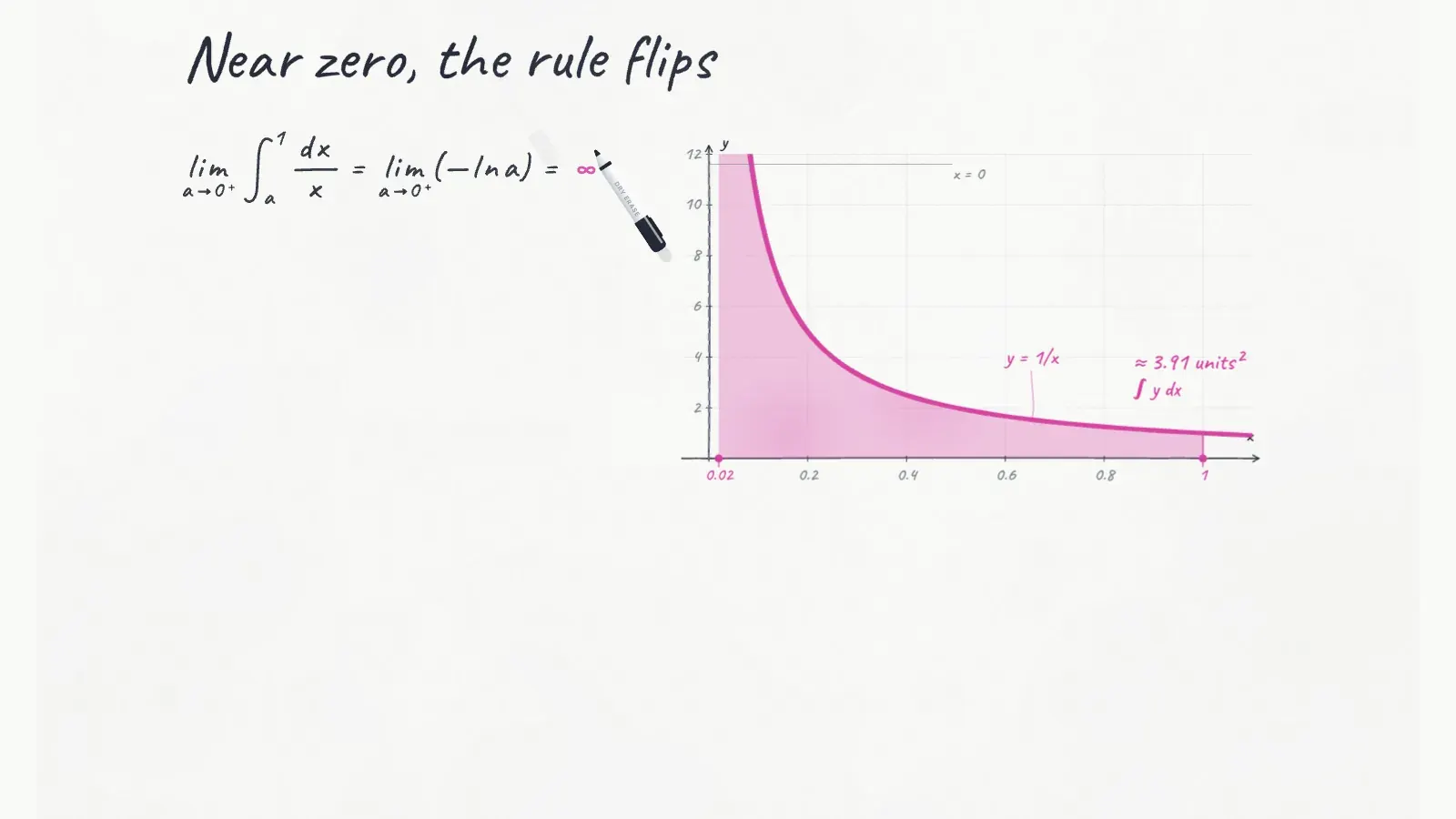
- ∫₁^∞ dx/xᵖ converges (to 1/(p − 1)) when p > 1 and diverges when p ≤ 1; near zero the rule flips: ∫₀¹ dx/xᵖ converges when p < 1.
- unbounded integrand
- The second kind of improper integral: the function blows up at an endpoint or inside [a, b] (a vertical asymptote). Split there and use a one-sided limit for each piece; if any piece diverges, the integral diverges.
- escape speed
- The launch speed whose kinetic energy, ½v², equals the work to escape, ∫_R^∞ GM/r² dr = GM/R per kilogram: about 11.2 km/s from Earth's surface (ideal model: Earth alone, no air).
- Gabriel's horn
- The solid made by spinning y = 1/x, x ≥ 1, around the x-axis: finite volume π∫₁^∞ dx/x² = π, but infinite surface area (at least 2π∫₁^∞ dx/x).
Transcript
2,445 words · 9 parts
Gravity never switches off
Right now, Earth is pulling on you, and it’s still pulling on New Horizons, the probe that flew past Pluto, more than nine billion kilometers away, because gravity never switches off. It gets weaker the farther out you go, but it never actually drops to zero. This glass is a graph of the fight to get away, and the higher you climb its wall, the more energy you’ve paid to escape Earth’s pull.
You’d think an endless fight would cost an endless amount of energy, so let’s launch a probe and watch the bill. One Earth radius above the ground it has paid thirty-one million joules for every kilogram, then forty-seven, and the counter keeps on rolling. It climbs forever, and it keeps paying as long as it climbs. But the total creeps up slower and slower, as if there’s a ceiling up there it can never quite touch.
By the end of this lesson, you’ll be able to add up a force that never switches off, get a finite answer, and turn it into the exact speed you’d need to leave Earth for good. To do that we need an integral that runs all the way out to infinity, so let’s put Earth’s pull on the board.
Infinitely long, but how big?
We’ll measure distance from Earth’s center in Earth radii. That puts the ground at x equals one. Gravity goes in g’s, so it’s one on the ground. Gravity weakens with the square of the distance, so two Earth radii out the pull is a quarter, and in general it’s one over x squared.
Work is force times distance. When the force keeps changing, the work is the area under the force graph, just as distance is the area under a speed graph. That makes Earth’s whole energy bill this area, from one all the way out to infinity. This region stretches out forever, so before we measure anything, I want your gut feeling about how big its area is.
We can’t add all the way to infinity in one step, but we can always stop at a finite cutoff. Let’s call it b, find the area from one to b, and then let b grow. For any finite b this is an ordinary integral. The antiderivative of x to the negative two is negative one over x. From one to b that’s negative one over b minus negative one, which is one minus one over b.
At b equals two the area is a half, at four it’s three quarters, at ten it’s nine tenths, and at a thousand Earth radii it’s point nine nine nine. It keeps growing, but it never gets past one, because there’s always one over b left to go, and that leftover shrinks to zero. The area out to infinity is the limit of one minus one over b as b goes to infinity, and that limit is exactly one.
When an integral runs out to infinity, we call it an improper integral. We define its value just this way, as the limit of ordinary integrals with a finite cutoff. If that limit is a finite number, the integral converges, and if it isn’t, the integral diverges. Ours converges, to one.
It’s tempting to plug infinity straight in and write one minus one over infinity. Infinity isn’t a number, though, and on the exam that line costs points. Keep the limit and the b in every line until the very last step. We measured all of this in Earth units, so one square unit here is worth sixty-two point six million joules for every kilogram. Let’s go back to the well and see that bill.
Earth’s bill
The amber curtain is Earth’s pull, strongest at the ground, and the glass below it shows what you’ve paid so far. As the probe climbs out to two Earth radii from the center, the area under the curtain fills in. The probe rises up the wall by exactly that much, thirty-one million joules for every kilogram. That makes the wall of this funnel the area function from the board, sculpted in glass.
Let’s pay one doubling at a time. One Earth radius to two costs thirty-one million joules, two to four costs half of that, four to eight half again, and every doubling costs half of the one before. Each payment closes half the gap that’s left, so the bar creeps toward sixty-two point six and never gets there. The dim tail beyond the probe is the part we haven’t paid yet, and it matches how far the wall still sits below the rim.
Now you take the probe. Drag it out to wherever you think ninety-five percent of the bill is paid, and keep adjusting until you land on it.
Now write it the way the exam wants. Newton’s law says Earth’s force on the probe is G M m over r squared. Little r is your distance from Earth’s center. Capital M is Earth’s mass, small m is the probe’s, and G is gravity’s constant. The work to escape is the integral of that force from capital R, Earth’s radius, all the way out to infinity.
We trade infinity for a cutoff b and take the limit. The antiderivative is negative G M m over little r, so from capital R to b we get G M m over capital R minus G M m over b. As b grows, that second piece shrinks to zero.
Earth’s G times M is three point nine eight six times ten to the fourteenth, and its radius is about six point four million meters. For one kilogram, that gives about sixty-two point six million joules. That’s twice the first doubling, and it’s the ceiling the ledger kept creeping toward.
Then finish with the sentence that earns the point. Because the limit of the integrals from R to b is a finite number, the improper integral converges. The work to escape is sixty-two point six million joules for each kilogram.
Flatland
Our gravity fades like one over x squared. One over x fades more slowly, but it also heads down to zero. Both curves sink toward zero. Make a prediction about the area under one over x, from one all the way out to infinity.
Under one over x squared, the strip from one to two has area a half, then a quarter, then an eighth, then a sixteenth. Each strip is half the last, and together they add up to one.
Under one over x, every doubling strip has the same area. Take the strip from a to two a. Its area is the natural log of two a minus the natural log of a, the log of two a over a. That’s the natural log of two, about point seven, however far out you go.
Endless equal strips add up to infinity, and the algebra agrees, because the integral from one to b is the natural log of b, which grows without bound. This integral diverges.
What would that mean for gravity? If space had only two dimensions, a planet’s pull would spread around a circle instead of a sphere, so it would fade like one over r. In that flat universe the well loses its rim, every doubling costs the same forty-three million joules, and the bill never stops growing.
No launch speed would ever be enough, so nothing could escape anything, and every planet would be a prison. In our three-dimensional universe, gravity fades like one over r squared, which is fast enough to give the bill a ceiling. Now you set the law. Drag the dial and find the law of gravity whose escape bill is exactly twice ours.
Now any power p. The border sits at p equals one. For other powers, the antiderivative is x to the one minus p, over one minus p. If p is bigger than one, that exponent is negative. Then b to that power shrinks to zero.
What’s left is one over p minus one, so your p of one and a half gives two, the doubled bill you found. For p of one or less, it grows forever, and the integral diverges.
Your turn at infinity
Let’s do one together that the exam loves, six e to the negative three x, from zero to infinity. I’ll set it up with a cutoff, and you finish it. Find the antiderivative, evaluate it from zero to b, and let b run off to infinity. What do you get?
Try this one yourself, and look for a substitution that turns the denominator into a simple power. Find the integral from one to infinity of x, over the quantity x squared plus one, squared.
Now both ends run to infinity, like one over one plus x squared across the whole number line. We split this hill at zero and give each half its own limit. From zero to b, the area is arctangent of b, and arctangent levels off at pi over two. The left half gives pi over two as well, because arctangent of a heads to negative pi over two, so the whole hill holds pi.
This next one fools a lot of people. Take the line y equals x, from negative four to four. The left half is negative, the right half is positive, and with matching cutoffs they cancel to exactly zero.
The definition gives each half its own cutoff. Keep the left one at negative four, and drag the right cutoff out until the integral reaches twenty-four.
From zero to b, the integral of x is b squared over two, and that runs off to infinity. That half already diverges, so the whole integral diverges, because infinity minus infinity isn’t a number.
Infinitely tall
An integral can also be improper on a finite interval, when the function shoots up without bound somewhere in it. One over the square root of x, from zero to one, does that as x gets close to zero. We use the same trick from the other side, starting at a small number a, finding the area from a to one, and sliding a toward zero.
The antiderivative is two root x, so the area is two minus two root a. At a quarter that’s one, at a sixteenth one and a half, and at a hundredth one point eight. As a slides down to zero from the right, two root a disappears and the area is exactly two. The spike is infinitely tall, but it’s so thin that it holds a finite area.
One over x doesn’t make it. Its area from a to one is negative natural log of a, and that blows up as a goes to zero. Near zero the rule flips, so a power converges there only when p is less than one. One over x sits right on the border, so it fails both times. Find the integral from zero to eight of x to the negative one third, and set it up with a limit before you compute anything.
This next solution looks completely routine. A student integrates one over x minus one, squared, from zero to two, plugs in the bounds, and gets negative two. We’re adding up a positive function here, so a negative answer should make us suspicious. Where does the calculation go wrong?
The graph gives it away, because the function is positive everywhere. The fundamental theorem needs the function to be continuous on the whole interval, and this one blows up at x equals one, so that negative two is meaningless.
The fix is to split at the asymptote. The left piece is a limit as b comes up to one from the left. Then b minus one is a tiny negative number, so negative one over b minus one is huge and positive, and it blows up to infinity.
Because that one piece diverges, the whole integral diverges, and that’s the sentence to write on the exam. Before you use the fundamental theorem, always scan the interval for a spot where the function blows up.
Gabriel’s horn
Let’s put one over x on a lathe, from x equals one out forever, and spin it. We get a horn that keeps narrowing forever, a shape mathematicians call Gabriel’s horn, after the angel’s trumpet. Every slice is a thin disc, d x thick, with radius one over x, so each one has an area of pi over x squared.
Stacking the discs gives pi times the integral from one to infinity of one over x squared, the very integral we started with, which comes out to one. So the whole infinite horn holds exactly pi, and as it stretches, the paint creeps up toward pi and never gets past it.
Now the skin. Cut it into thin bands, one over each slice. A band goes once around, two pi over x. Its edge slants, so it’s at least d x wide. Add up the bands, and the skin is at least two pi times Flatland’s integral, and that one diverges.
The horn’s inside is Earth’s integral, and even a lower bound on its skin is Flatland’s. Pi cubic units of paint would fill it completely, but coating its skin with an even layer of paint, however thin, would take an endless supply.
Eleven point two
Back to our probe. A moving object carries kinetic energy, one half m v squared. A one-kilogram probe that leaves the ground with the whole bill, about sixty-two point five six million joules of it, can pay its way out. Use the calculator for this one. Solve for the speed v, and give it in kilometers per second.
Let’s see whether it really works, and this time you’re the one at the controls. Set any launch speed and fire. Try one that falls short first if you’re curious, and then find the smallest speed that leaves Earth for good.
A finite bill for an endless road
New Horizons left Earth in 2006 at about sixteen kilometers per second, well over the eleven point two you found, and that’s why it’s still sailing away today. Every improper integral works the same way. Swap the trouble spot for a cutoff, do an ordinary integral, and take the limit, whether the trouble is out at infinity or hiding in a spike. Before you trust the fundamental theorem, always look for that spike.
On the exam, write the limit in every line, and finish with a sentence that says whether the integral converges or diverges, and why. You took a force that never switches off and added it up to a finite sixty-two point six million joules. Then you turned it into the eleven point two kilometers per second a probe would need to leave Earth for good.