
Topic 6.7 key terms
- antiderivative
- A function whose derivative is : . For , is one, and so is .
- Fundamental Theorem of Calculus (evaluation part)
- If is continuous on and , then . Some books call it Part 2, some Part 1.
- bracket notation
- means : plug in the top limit, plug in the bottom limit, subtract.
- accumulation function
- for continuous : an antiderivative of with (lesson 6.4).
- indefinite integral
- , where and is any constant: the whole family of antiderivatives.
- constant of integration,
- Differentiating erases a constant, so undoing a derivative leaves one unknown constant. One known value (a starting height, a starting reading) fixes it.
- reverse power rule
- for ; for , .
- no closed-form antiderivative
- Many continuous functions, like , have antiderivatives (their accumulation functions) that no elementary formula can write; definite integrals of them are found numerically.
Transcript
1,011 words · 3 parts
Thirty-six frames
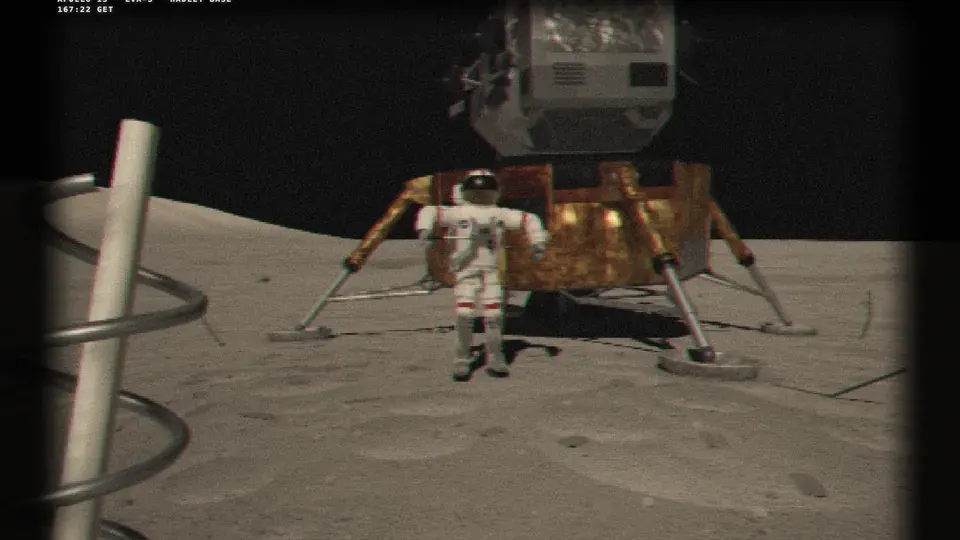
On the second of August, 1971, at the end of the last moonwalk of Apollo 15, David Scott stood in front of a TV camera holding a hammer in one hand and a falcon feather in the other. He let go of both at once. With no air on the Moon to slow the feather, they hit the dust together. But that clip hides a number. We can work it out from the film: how high the hammer was when he let go.
The camera recorded thirty pictures a second. If you go through the footage frame by frame, you count about thirty-six frames from the release to the landing, so the fall lasts about one point two seconds. The first official science report from the mission says he dropped them from about one point six meters up, and NASA’s summary still gives that height. Can those thirty-six frames tell us whether it fits?
By the end of this lesson, you’ll be able to take one number, the Moon’s gravity, add those thirty-six frames, work out how high that hammer started, and check that report yourself. To get there, we need a fast way to go from how quickly something moves to how far it goes. That shortcut is the Fundamental Theorem of Calculus, and the car whose camera is filming him is the best place to see it.
Read it twice
Apollo 15 was the first mission to bring a car for astronauts to drive, the Lunar Roving Vehicle, and Scott and Jim Irwin drove it almost twenty-eight kilometers around Hadley. Among the dials on its dashboard were a speed needle showing how fast they were going right now, and a distance counter adding up how far they’d gone.
Let’s watch five minutes of a drive like theirs, sped up fifteen times. The blue graph records the speed needle, and you can see it dip whenever they slow down for a crater. You could find this distance with rectangles, the way we did in the last few lessons, but look at the counter instead. Two minutes in, it reads four point three kilometers, and at seven minutes it reads five point one.
How far did the rover drive between those two moments? That’s the integral of v from one hundred twenty to four hundred twenty seconds, two minutes to seven, and I’d like the answer in kilometers.
Each minute’s distance is the counter at the end of that minute minus the counter at its start. When we add up all five minutes, every reading in the middle shows up twice, once with a plus and once with a minus. They cancel in pairs, and only the very first and the very last readings survive. It doesn’t even matter what the counter said when they set out, because a counter that started at zero gives different readings but exactly the same difference.
Now you drive. Stop, floor it, crawl, whatever you like, then drag the two pins and try to make the area and the counter disagree. That counter is really a function, D of t, whose derivative is the speed, and that one fact is what turns an area into a subtraction.
Written as math, the integral of v from a to b is D of b minus D of a, and it works because D prime is v. In precalc, you took a rocket’s altitudes and found how fast it was climbing. Today we’re running that backward, from a speed to a distance.
Build the counter
With a formula for the speed, we have to build the counter ourselves, so let’s take a simple one, v of t equals two t meters per second. We need a function whose derivative is two t, and you already know one, because the derivative of t squared is two t. We call a function like that an antiderivative. F is an antiderivative of f when F prime equals f, so t squared is the counter for two t.
Let’s use it. The distance from zero to three seconds is the integral of two t from zero to three, three squared minus zero squared, nine meters. The area under this line is a triangle with base three and height six, and half of three times six is nine, so it matches. If we start the clock at one second instead, it’s three squared minus one squared, which is eight meters, and the trapezoid agrees, two times the average of two and six.
Notice that this time the lower limit doesn’t give zero. Dropping that minus one is one of the easiest mistakes to make on the exam, so watch for it. If we’d picked t squared plus five instead, its derivative is still two t, and fourteen minus six is still eight, because the five cancels, just like the rover’s starting reading.
This is the Fundamental Theorem of Calculus, the part we use to evaluate integrals. If f is continuous on the interval from a to b and F is any antiderivative of f, then the integral from a to b of f of x, d x, is F of b minus F of a.
The shorthand is F in square brackets with a and b beside it, which means plug in b, plug in a, and subtract, so our eight meters is t squared in brackets from one to three. Why does that work for every continuous function? Last lesson’s accumulation function, A of x, the area from a up to x, has derivative f, so it’s an antiderivative too, a counter that starts at zero.
Two functions with the same derivative differ by a constant, because their difference has a zero derivative and never changes. Any antiderivative F is A plus some constant C. When we subtract, the C’s cancel, A of a is zero because no area has piled up yet, and what’s left is A of b, the whole area from a to b. Let’s see you use it. With t squared as the antiderivative, what’s the integral of two t from two to five?