
Topic 6.6 key terms
- Riemann sum
- A sum of products f(xᵢ*)·Δxᵢ over a partition of [a, b]: each slice's height (the function at a point in the slice) times its width.
- sigma notation
- Σᵢ₌₁ⁿ aᵢ means a₁ + a₂ + … + aₙ: add up the terms as the counter i runs from 1 to n.
- definite integral
- For f continuous on [a, b], ∫ₐᵇ f(x) dx is the limit of Riemann sums as the widest slice shrinks to 0 (with equal slices, as n → ∞). It is one exact number.
- integrand
- The function being integrated: f(x) in ∫ₐᵇ f(x) dx.
- limits of integration
- The bounds a (lower) and b (upper) in ∫ₐᵇ f(x) dx: where the slicing starts and where it stops.
- signed area
- For a < b, a definite integral counts area between the graph and the x-axis as positive where f > 0 and negative where f < 0, then adds.
- reversing the limits
- ∫ᵦᵃ f(x) dx = −∫ₐᵇ f(x) dx: going from b back to a makes every Δx negative.
- adjacent intervals
- ∫ₐᵇ f(x) dx + ∫ᵦᶜ f(x) dx = ∫ₐᶜ f(x) dx.
- constant multiple and sum rules
- ∫ₐᵇ k·f(x) dx = k∫ₐᵇ f(x) dx and ∫ₐᵇ (f(x) ± g(x)) dx = ∫ₐᵇ f(x) dx ± ∫ₐᵇ g(x) dx. There is no such rule for products.
- removable and jump discontinuities
- A bounded function with finitely many holes, moved points or jumps on [a, b] still has a definite integral; changing one point never changes its value.
Transcript
1,672 words · 5 parts
Pushes that point down
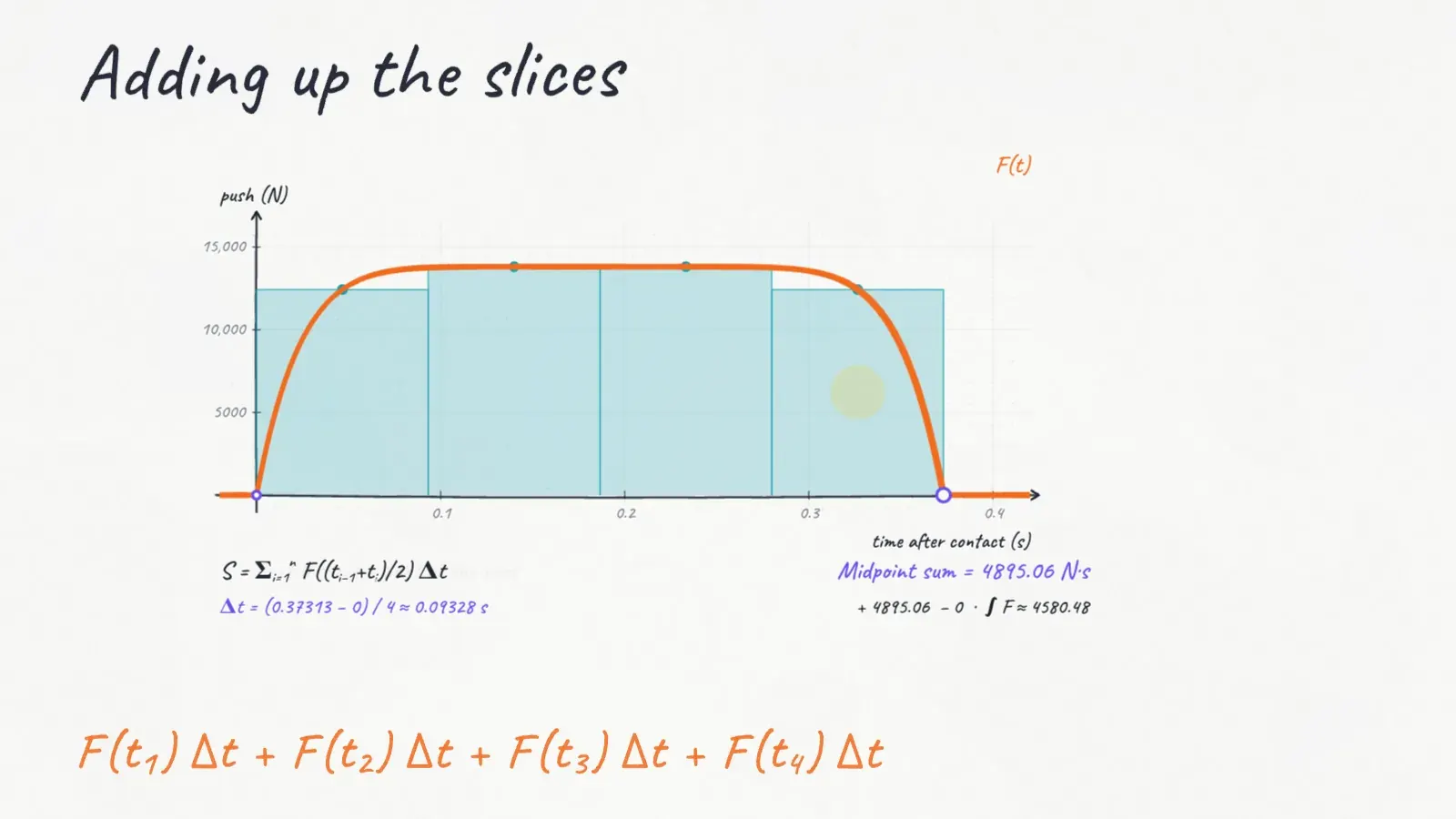
Let’s go back to the catch, where the net pushed for about forty-five hundred eighty newton-seconds. The whole time the net pushes him up, gravity pulls him down with about seven hundred eighty-four newtons if he’s eighty kilograms. Since up is positive, on the graph his weight sits below the time axis. That’s a rectangle below the axis, seven hundred eighty-four newtons for point three seven three seconds. It points down, so it counts as negative, about minus two hundred ninety-two and a half newton-seconds.
The total push on him is the net’s push plus his weight. Add the two areas and the total comes out to exactly forty-two eighty-eight newton-seconds. That’s his mass, eighty kilograms, times the speed he has to lose, fifty-three point six meters per second. A push in newton-seconds changes mass times speed by exactly that much. The net had to cover both, forty-two eighty-eight to stop him and about two hundred ninety-two and a half to fight gravity.
The weight showed us a rule for every integral read from left to right. Area above the axis counts plus, and area below counts minus, and the integral adds them up. We added the two forces’ areas to get the total, so the integral of a sum is the sum of the integrals. That’s our first property.
Now you try one. The graph of f is a triangle above the axis from zero to two that peaks at six, then a triangle below it from two to four that dips to negative two. Find the integral of f from zero to four.
Cut and fill
Road builders live on signed area. Every new road has to cross ground that refuses to be flat, like this granite knob and the dry wash beside it. Let’s slice the ground open along the middle of the new road, so we can see its profile, how high the ground is at every point along the way.
The green laser marks where the road has to go. We dig out the ground above it, which engineers call cut, and we fill the space below it with dirt, which they call fill. When the cut exactly fills the holes, the road balances and no truck has to bring dirt in or haul any away. That’s why the engineers want this signed area to come out to zero. Let’s put this profile on the board exactly the way the AP exam would draw it.
The graph of h, the height of the ground above the road, is a semicircle, a straight segment, and two flat pieces, with a jump where the retaining wall is. The knob is a semicircle of radius twenty, so its area is half of pi times twenty squared, two hundred pi. That’s about six hundred twenty-eight square meters, and it counts as plus because it’s above the road.
Below the road, the bank is a triangle, half of ten times ten, fifty. The wash floor is a rectangle thirty long and ten deep, three hundred, and both of those count as negative. Past the wall, the ledge is another rectangle above the road, twenty by ten, plus two hundred.
Adding the signed pieces, the integral of h from zero to a hundred is two hundred pi minus a hundred fifty, about four hundred seventy-eight square meters. This road has way more cut than fill. That passes the eye test, since the knob by itself is bigger than the bank and the wash put together.
Before you touch the laser, make a prediction. If we raise the whole road by one meter, what happens to the signed area of the profile? Now you’re the engineer, so grab the laser and move the road up or down until the cut and the fill balance.
Watch where the dirt goes. All the dirt cut from the knob and the ledge fills the holes, and the road comes out dead level without a single load hauled in or out.
We’ve been using the rules of integrals all along without naming them. A road with zero length moves no dirt, so the integral from a to a is always zero. If you walk the road backward, from b to a, every step dx is negative, so every slice flips its sign. That’s why reversing the limits flips the sign of the integral.
Two crews, one grading from zero to fifty and one from fifty to a hundred, move exactly the dirt of the whole road, so integrals over touching intervals add. Say the road is twelve meters wide, with the same ground all the way across. Every slab is twelve times its slice, so a constant like that twelve comes straight out of the integral.
Just like the net’s push and his weight, the integral of a sum is the sum of the integrals, and the same goes for a difference. Be careful not to invent a rule for products, though. The integral of f times g is not the integral of f times the integral of g.
Let’s use them on a function we can’t even see. The integral of f from zero to two is nine, and from zero to five it’s four, so what’s the integral of f from two to five? Let’s use the same function again and find the integral from five to two of the quantity three f of x minus two, d x.
One stake, one wall
Back at the road, a surveyor drove a stake into the wash, but somebody typed its reading wrong. Now the profile says that one spot is thirty meters up instead of ten meters down.
What do you think that one bad reading does to the integral from zero to a hundred? The readouts don’t even flicker, and it isn’t rounding. Whatever height you give one point, it covers zero area.
Let’s see the same thing on a simpler graph, where f equals twenty from zero to three, except at x equals one, where somebody set it to a hundred. The only rectangle that can feel that point is the one slice it sits in. As that slice shrinks to zero width, its extra area shrinks to zero with it, so the integral stays sixty.
Give that change some width instead, say a hundred all the way from one to one point one. Now it’s a real rectangle, eighty tall and a tenth wide, and the integral jumps from sixty to sixty-eight. Remember the holes from precalc, the removable discontinuities? You can fill a hole, move its point, or leave it empty, and the integral never notices.
The retaining wall is a different kind of break, a jump discontinuity, and the integral handles it fine. We just split the road at the wall, so from fifty to a hundred it’s negative three hundred plus two hundred, negative one hundred. That works for any graph with a few holes or jumps, as long as it doesn’t shoot off to infinity. The integral still exists, and you find it by splitting at the breaks.
Build the catch
Now it’s time to keep the promise. He’s falling at fifty-three point six meters per second, and you’re going to design the push that stops him. Your push is a triangle. Drag its top to set how hard the net pushes at its peak, and drag its end to set how long the catch lasts, while his weight keeps pulling the whole time.
When you press drop, he falls into your push, and the physics follows your graph exactly. If your total comes out right, he stops, and if it doesn’t, you’ll see what happens. Design a push that stops him, and if the first try doesn’t work, figure out why and try again.
Watch the peak slide to an earlier time, and to a later one. The push’s area doesn’t change, because a triangle’s area depends only on its base and its height. A whole family of catches stops him.
Now find a gentler catch, one that still stops him but never pushes harder than eleven thousand newtons. The total stays locked at forty-two eighty-eight, so you’re only choosing its shape, and the net only has about thirty meters to give.
A short, hard catch and a long, gentle one can both stop him, but the short one peaks more than twice as high. The same total can put very different forces on him, so engineers stretch the catch as long as the net allows.
On the exam they’ll often ask you what an integral means in context, and the full-credit answer names the amount, the time interval, and the units. For our net, the integral from zero to point three seven three of F of t dt is the total push of the net on him during the first point three seven three seconds after he touches it. That’s about forty-five eighty newton-seconds.
To justify that this catch stops him, show why its total push leaves his momentum at zero. He’s falling and up is positive, so his momentum starts at minus forty-two eighty-eight. The total push adds back forty-two eighty-eight, so it ends at zero.
Every instant, added up
A Riemann sum adds up heights times widths, and the definite integral is the number those sums settle on. From left to right, it counts area above the axis as positive and below as negative. When we reverse the limits, the sign flips, and when two intervals meet, their integrals add. A constant factor comes outside the integral, a sum splits into separate integrals, and a single point or a jump can’t stop an integral.
Remember the puzzle we started with, where every single instant of the catch pushed for no time at all? We never had to add up zero-width instants. We added pushes over thin slices of real time, made every slice thinner, and watched the totals close in on one exact number, and that number is what stopped him. Next time we’ll let the end of the interval slide, and watch the integral itself turn into a function.