
Topic 6.14 key terms
- long division before integrating
- When the top's degree is at least the bottom's, divide: . Integrate the quotient and the remainder piece separately; the remainder never gets dropped.
- completing the square
- Rewrite as : half of , squared, is the corner that completes the square.
- Witch of Agnesi
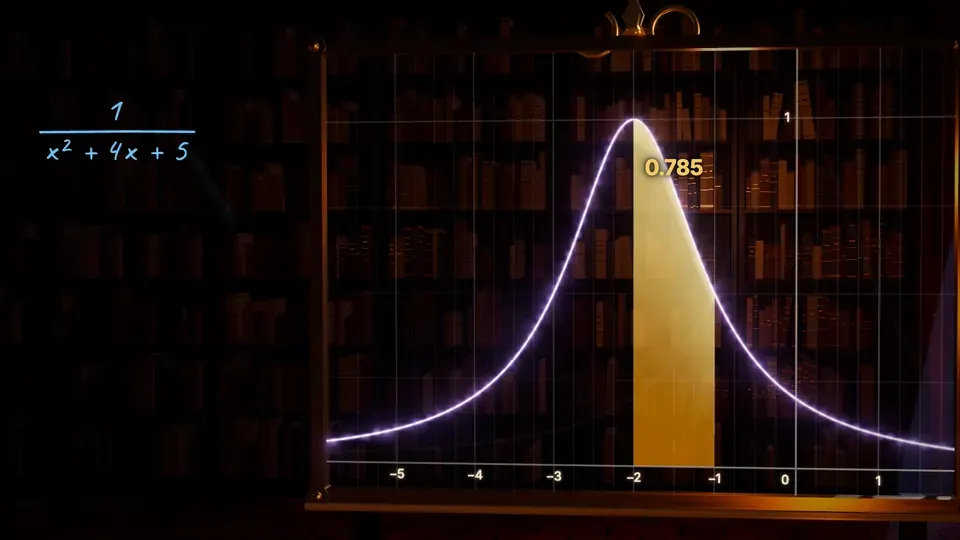
- The curve , from Maria Gaetana Agnesi's 1748 calculus textbook. The area under it from to is .
- arctan form
- for ; the comes from the stretch.
- choosing a technique
- Ask in order: a basic rule? an inside function with its derivative (u-substitution)? a top-heavy fraction (divide)? a quadratic bottom that won't factor (complete the square)? Then differentiate to check.
Transcript
580 words · 2 parts
Which move?
Here are three integrals with the same bottom, x squared plus four, and a one, a two x and an x squared on top, and each one needs a different first move. With one on top, we can use our arctan rule with a equal to two. That gives one half arctan of x over two, plus C.
For the second, look at the top first, because two x is exactly the derivative of x squared plus four, so u-substitution gives the natural log of x squared plus four, and no bars are needed, since x squared plus four is always positive. Try the third one yourself, x squared over x squared plus four.
When you meet an integral you don’t recognize, ask a few questions in order. Can I simplify it or use a basic rule? Is there an inside function with its derivative sitting next to it? Then it’s u-substitution.
Is the top’s degree at least as big as the bottom’s? Then divide. Is the bottom a quadratic that won’t factor, with nothing useful on top? Then complete the square and look for an arctan. Whatever you choose, differentiate at the end, because that’s the check that never lies.
On the AP exam any correct method earns the credit, even if it isn’t the shortest. This next one has a trap built into it. What’s the best first move for the integral of x plus two, over x squared plus four x plus five? BC students add two more tools in the next lesson, integration by parts and partial fractions, and for AB, this is the whole menu.
The boss
Let’s finish with an AP-style problem that’s all yours. During a cloudburst, rain runs into a barrel at r of t equals t squared minus two t plus three, over t squared minus two t plus two, liters per minute, for two minutes. The total is the integral of the rate from zero to two, because liters per minute times minutes is liters.
Exactly how many liters flow into the barrel during those two minutes? That blue sentence is how you show the Fundamental Theorem did the work, and stating your reasons like that earns the point when a question says justify. It fits, too, since a rate between one and a half and two liters a minute for two minutes gives between three and four liters.
Back on the glass, the rate is one plus the witch, an amber slab two wide and one tall with the witch sitting on top at t equals one. That makes two liters of water from the slab. For the witch, the machine rides up onto the slab.
This last quarter turn is yours. The rain runs from one unit left of the peak to one unit right, and arctan of minus one and one are minus and plus forty-five degrees. Swing the arm across that quarter turn and collect the witch’s area.
Look for a u-substitution first, divide when the top’s degree is at least the bottom’s, complete the square when a quadratic bottom won’t factor, and differentiate to check. At the start I promised you’d find areas like that gold piece exactly, by hand, and you just did. You found the hidden curve and its circle, and then you used both to solve the rain-barrel problem yourself. Maria Agnesi wrote her book so that young people could learn this, and almost three hundred years later, here you are, doing exactly that.