
Topic 4.2 key terms
- planar motion as a parametric function
- An object moving in a plane has a position f(t) = (x(t), y(t)) at each time t: the same t goes into both coordinate functions and gives one point.
- horizontal and vertical extrema
- The farthest left and right the object goes are the minimum and maximum values of x(t); the lowest and highest are the minimum and maximum values of y(t). They can happen at different times, and the ends of the time interval count.
- time, value and point
- "When is it highest?" asks for a time, "how high?" for a value of y(t), and "where?" for the point (x(t), y(t)) at that time. Say which one you are giving.
- y-intercept from a zero of x(t)
- When x(t) = 0 the object is on the y-axis, so a real zero of x(t) gives a y-intercept: the point (0, y(t)) at that time.
- x-intercept from a zero of y(t)
- When y(t) = 0 the object is on the x-axis, so a real zero of y(t) gives an x-intercept: the point (x(t), 0) at that time.
- at the origin
- The object is at the origin only at a time when x(t) = 0 and y(t) = 0 together. Find the zeros of each, and look for times on both lists.
Transcript
2,589 words · 6 parts
Let go
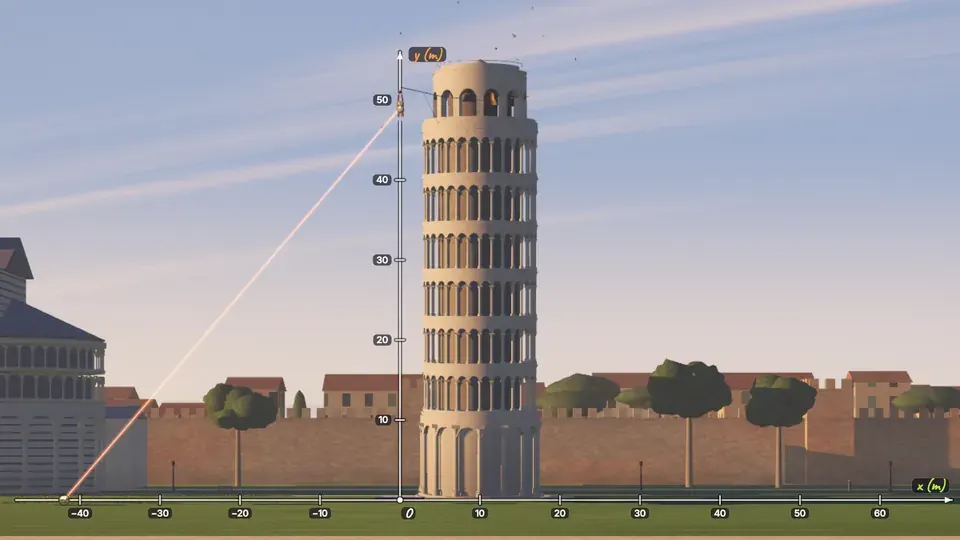
This is the Leaning Tower of Pisa, a little before sunset, and the story goes that Galileo once dropped balls off the top of it to show that heavy things and light things fall together. So let’s do an experiment up there that I think he would’ve loved. That’s a toy monkey, hanging from a magnet forty-nine meters above the lawn.
And over here, forty-two meters away across the grass, there’s a launcher, aimed dead straight at the monkey along that laser. First, let’s keep the monkey right where it is, and fire. It misses, and by a lot, because the ball starts falling the moment it leaves the launcher, so by the time it gets across, it’s way below where we aimed.
Now let’s take the same shot again, with the same aim and the same speed, except this time the magnet lets go of the monkey at the exact instant the ball leaves the launcher. Before we fire, think about what that should do. We aimed at the monkey, and now the monkey is falling away from our aim, so it ought to miss by even more, right? Here it goes.
And it’s a hit… right in the middle of the drop. Physics teachers have been doing this with a stuffed monkey for decades. And it works at any speed, as long as the monkey hasn’t hit the ground yet.
By the end of this lesson, you’ll be able to explain exactly why letting go makes the shot work, and you’ll predict when and where the ball and the monkey meet, for a launch you’ve never seen before. To get there, we need a way to say where something is at every single moment, and Galileo already had it, because he saw that a thrown ball is doing two motions at once, one sideways and one up and down, on the same clock.
One clock, two numbers
Let’s put some numbers on the piazza. We’ll measure in meters from the spot on the lawn right under the monkey, with x running along the grass and y going straight up the line the monkey falls along.
So the launcher sits at negative forty-two, zero, and the monkey hangs at zero, forty-nine. Now let’s watch the first shot again in slow motion, with two markers following the ball. The one on the grass tracks how far across the ball is, and the one on the monkey’s line tracks how high it is.
The marker on the grass moves at a perfectly steady pace, while the one on the monkey’s line climbs fast, slows down, and comes back, just like the cannonball in Lesson 1.3, steady sideways and a parabola up and down. Each marker has its own formula. Across, the ball’s position is x of t equals twenty-one t minus forty-two, and up, it’s y of t equals twenty-four point five t minus four point nine t squared, where t is the time in seconds since launch.
Those numbers come from how hard and at what angle we launched, and today I’m just giving them to you. The minus four point nine t squared is gravity, and hold onto it, because it’s going to explain the catch. Let’s freeze the clock at three seconds. The sideways formula gives twenty-one times three minus forty-two, which is twenty-one, so the ball is twenty-one meters right of the monkey’s line, but on its own, that only says it’s somewhere on this vertical line.
The height formula at three seconds gives twenty-nine point four meters, and on its own, that only puts the ball somewhere along this horizontal line. Put the two together, from the same moment, and there’s only one place the ball can be, right where the lines cross, at the point twenty-one, twenty-nine point four.
So that’s what a position is in this lesson. One time goes into both formulas, and the two answers together make one point. Now you try one. Where is the ball one second after launch? Let’s take that picture onto the board and write it the way mathematicians do.
We can wrap both formulas into one function of t, f of t equals the pair x of t, y of t, so one input, the time, gives you one output, and that output is a whole point. So f of one means putting one into both halves, and that gives the point you just found, negative twenty-one, nineteen point six.
Doing the same for every second gives a table, and I’ll start with x. Every second the ball moves twenty-one meters to the right, so x climbs from negative forty-two at launch to sixty-three when it lands. The heights climb to twenty-nine point four, the same at two seconds and at three, and fall back to zero at five, when the ball lands.
Notice the table never shows the very top, which comes somewhere between two and three seconds, and we’ll find it exactly in a minute. Each row is one point of the picture, so let’s plot them with their times beside them, because time isn’t an axis of this graph, and the labels are the only place you can still see it. Joined in order of time, they make the very path we watched over the piazza.
Highest is not farthest
Let’s watch the whole flight again, with the monkey held, and this time, keep your eye on the height marker. Watch it climb, slow down and turn around, and then fall all the way back to the grass.
Now you take the clock. Drag the time until the ball is at its very highest. Now the marker on the grass. It never turns around, so the ball keeps moving right the whole time, and its farthest-right point is the end of the flight, the landing, at sixty-three meters.
The other two directions work the same way. The ball is farthest left at the start, and lowest at both ends, when it’s down at lawn level. Those four extremes make a box around the whole flight, and each side of the box comes from just one of the two formulas, the top and bottom from y and the left and right from x.
Now look at the top-right corner of that box. The ball never goes there, because it’s highest at two and a half seconds and farthest right at five, so the biggest x and the biggest y don’t happen at the same time. Now, let’s work out that top exactly.
If we factor the height formula, we get four point nine t times five minus t, so the height is zero at t equals zero and at t equals five. A parabola’s peak sits exactly halfway between its two zeros, so the top comes at two and a half seconds. Putting two and a half into both formulas, the height is thirty point six two five meters, and x is ten and a half.
For the farthest right we don’t need any algebra, because x of t grows by twenty-one every second, so it’s biggest when the clock runs out, at t equals five, at the point sixty-three, zero. So an extreme can sit right at the end of the time interval, not only where the motion turns around.
This is the part people mix up, so let’s be careful with the top. If the question is when it’s highest, the answer is a time, two and a half seconds. If it’s how high, the answer is a height, about thirty point six meters, and if it’s where the ball is, the answer is a point, ten and a half across and about thirty point six up.
Those are three different answers, and a good solution says which one it’s giving. When you explain it, tie it back to the formula, and say the ball is highest at two and a half seconds because y of t reaches its maximum there.
Here’s a motion where both coordinates turn around. A particle moves with x of t equals four minus the quantity t minus two squared, and y of t equals four minus the quantity t minus three squared, for t from zero to five.
Watch the cursor run through the time. The x graph tops out at four when t is two, and the y graph tops out at four when t is three, each at the moment its squared part is zero. So someone in a hurry might say the particle reaches the point four, four. Let’s test that. Where is the particle when it’s farthest to the right?
And if we run the clock all the way through, the pin at four, four never lights up, because the particle is at four, three when it’s farthest right and at three, four when it’s highest, a whole second later. The rest of the box works the same way. The leftmost point comes at the very end, negative five, zero, and the lowest at the very start, zero, negative five, so two of the extremes are at the ends and two are in the middle.
Crossing the lines
Back on the piazza, let’s watch the sideways marker as the clock runs toward two seconds. Its bar is the ball’s distance from the monkey’s line, and at two seconds it’s gone. x equals zero means no sideways distance at all, so the ball has to be on the y-axis, and the height formula says where, twenty-nine point four meters up. That crossing is the path’s y-intercept.
That’s why a zero of x gives you a y-intercept, which sounds backwards at first, until you remember that the y-axis is exactly the line where x equals zero. Now the height marker. Its bar goes to zero twice, at launch and at landing, and both times the ball is sitting on the x-axis, the grass, at negative forty-two, zero and at sixty-three, zero. Those are the x-intercepts.
Is the ball ever at the origin, the spot right under the monkey? Its x is zero only at two seconds and its height only at zero and five, so they never happen together, and it never goes there.
On paper, an intercept takes two steps, first when and then where. For the y-intercept, set x of t to zero, so twenty-one t minus forty-two is zero and t is two. Then put that two into the other formula, and y of two is twenty-nine point four, so the y-intercept is zero, twenty-nine point four.
For the x-intercepts, set y of t to zero instead. Factored, four point nine t times five minus t is zero at t equals zero and at t equals five, and x at those times gives negative forty-two, zero and sixty-three, zero. If you keep one picture from this part, make it the ball sitting on the monkey’s line. When x is zero you’re on the y-axis, and when y is zero you’re on the x-axis.
Now go back to the particle with the corner it never visits. Which points are the x-intercepts of its path? This particle never reaches the origin either, since it’s on the y-axis at zero and four seconds and on the x-axis at one and five. To be at the origin, x and y have to be zero at the same time.
Here’s a different particle. Its x of t is zero only at t equals one, three, and four, and its y of t is zero only at t equals two, four, and six. When is this particle at the origin?
Why letting go works
Now for the monkey. Once the magnet lets go, the monkey has its own position function. It never moves sideways, so its x is always zero, and its height is forty-nine minus four point nine t squared.
And we already know when the ball gets to the monkey’s line, because that’s the y-intercept we just found, at two seconds and twenty-nine point four meters up. At two seconds, the monkey’s height is forty-nine minus four point nine times four, which is also twenty-nine point four, so at the same moment, they’re at the same point. That’s the catch. In those two seconds the monkey fell nineteen point six meters, exactly the amount the first shot missed by.
To see why it always works, picture the shot with no gravity at all. The ghost ball flies straight along the laser to the monkey’s starting spot in two seconds, while the ghost monkey just hangs there.
Gravity pulls each real object below its ghost by four point nine t squared, the same amount for both at every instant, four point nine meters after one second and nineteen point six after two, so the ball stays lined up with the monkey. Now, let’s see the same thing… in the formulas.
Subtract the ball’s height from the monkey’s height, and that’s the vertical gap between them. Subtracting the ball’s minus four point nine t squared turns it into a plus, and the two gravity terms cancel, so the gap is just forty-nine minus twenty-four point five t, and gravity is gone from it completely.
That gap closes at exactly two seconds, the same moment the ball reaches the monkey’s line, and that’s because we aimed straight at the monkey. The ghost ball climbs twenty-four point five meters for every twenty-one across, exactly the slope from the launcher up to the monkey, forty-nine over forty-two.
Launch it faster or slower and both gaps, across and up, close faster or slower together, so at any speed the ball reaches the monkey’s line at the very moment the height gap closes, and that’s why they meet. Let’s double the launch speed and keep the same aim. With these formulas, when and where does the ball catch the monkey?
Let’s watch it. The catch comes after one second, much higher up the tower, at forty-four point one meters. Now let’s go the other way. Let’s launch at half the speed. At half the speed, with the same aim, does the ball still catch the monkey?
So any speed works, but only as long as the meeting comes before the ground ends the flight, which is why the time interval matters just as much as the formulas do. And that’s the whole trick. The ball and the monkey fall by exactly the same amount, so if you aim straight at it and it lets go the moment you fire, gravity drops out of the gap between them, and the ball arrives right where the monkey is. It’s the same reason astronauts float inside the space station, because they and the station are falling around the Earth together, so between them, gravity cancels out.
What to remember
The position at time t is the point x of t, y of t, with the same t going into both formulas. The highest and lowest points come from y of t, and the farthest left and right from x of t, and they can happen at different times, including at the ends. When x of t is zero, the object is on the y-axis, and when y of t is zero it’s on the x-axis, so you find when first, and then where.
And it’s at the origin only if both are zero at the same moment. Next time, in 4.3, we’ll use x of t and y of t to tell which way something is heading. In AP Physics this is called projectile motion, and in Calculus BC you’ll use position functions like these to find exactly how fast things move.