
Topic 4.6 key terms
- conic section
- A curve you get by slicing a double cone with a flat plane: a circle, an ellipse, a parabola or a hyperbola. A light's cone on a flat floor shows all four.
- circle (standard form)
- : center , radius . Every point is from the center (Pythagoras). A circle is an ellipse with .
- ellipse (standard form)
- : center , horizontal radius (with ), vertical radius (with ). It reaches from to across and from to up and down.
- completing the square
- Rewriting as ; done for and for it turns an expanded conic equation into standard form.
- parabola (vertex forms)
- opens up () or down (); opens right () or left (). Vertex , . If is squared it opens up or down; if is squared it opens left or right; the sign of picks the side.
- hyperbola (standard forms)
- opens left and right; opens up and down. The positive term decides the opening, not the larger denominator.
- vertices of a hyperbola
- The points where each branch turns: for a hyperbola opening left and right, for one opening up and down.
- asymptotes of a hyperbola
- , the lines through the center and the corners of the -by- rectangle, for both orientations. Far from the center the branches hug them.
Transcript
2,652 words · 7 parts
Throw it hard enough
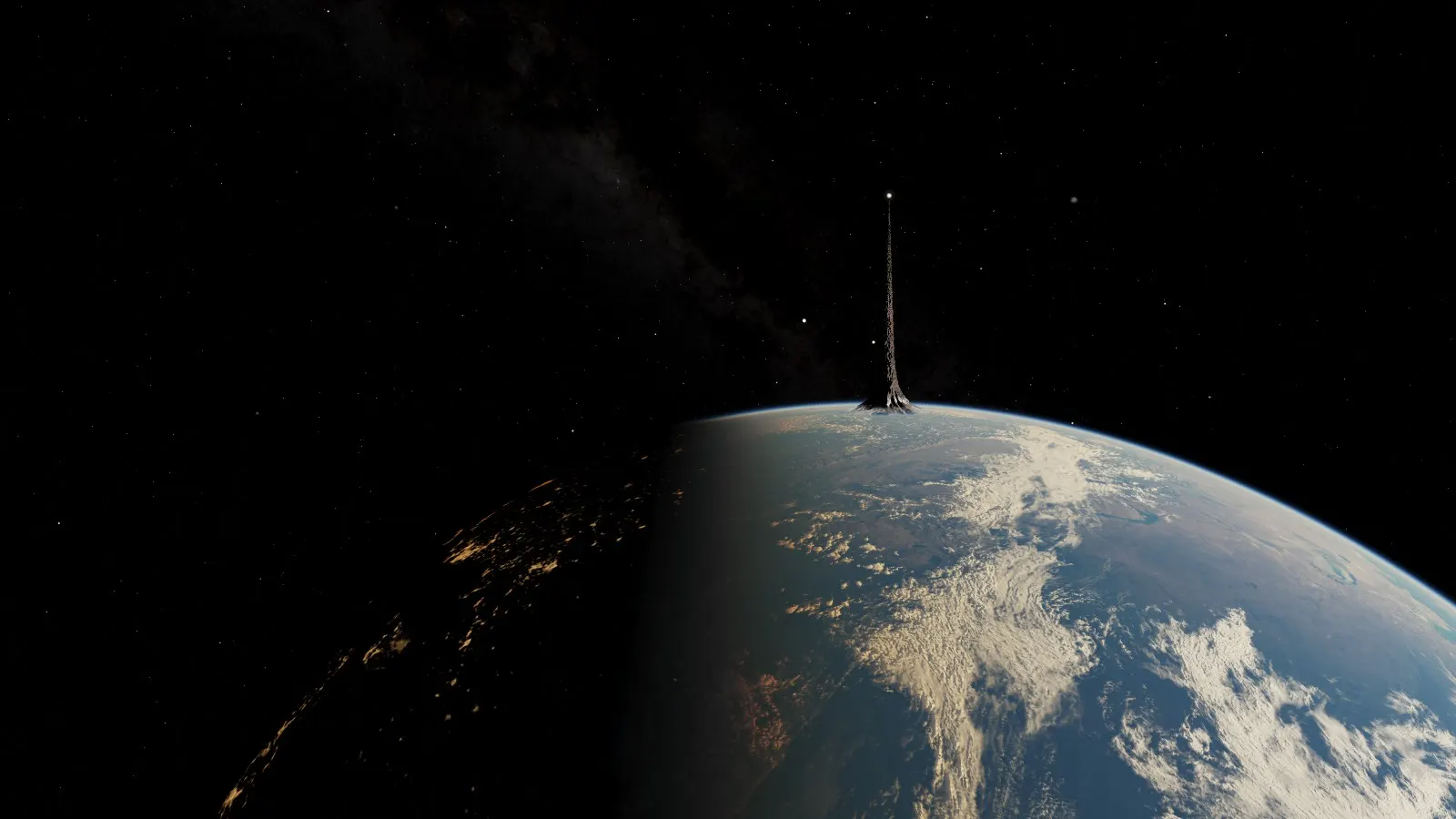
In the 1680s, Isaac Newton asked a question you might have wondered about yourself. Could you throw something so hard that it never comes back down? He imagined a cannon on top of a very high mountain, with no air in the way to slow the ball down. Then he worked out what would happen when you fire it.
Fire it gently, in total silence because there’s no air up there, and the ball curves down and falls back to Earth. Fire it faster and it lands farther away, because the ground curves away underneath it.
And at about seven kilometers a second, something amazing happens. The ball falls all the way around the planet without ever reaching the ground, and two hours later it’s back at the mountain, going round forever. That’s an orbit. Fire it faster still and the circle stretches into an oval, swinging far out into space before it comes back around.
And at about ten kilometers a second, the path breaks open, and the ball never comes back. Faster still, and it leaves in an almost straight line. Every path a cannonball, a moon or a comet can take around a planet or a star is one of these four curves. And the strangest part is that Greek mathematicians had already found these exact curves, and named them, about two thousand years before Newton.
By the end of this lesson, you’ll read any of these paths from its equation, and draw it. One single sign in that equation tells you whether the cannonball is ever coming back. Those mathematicians didn’t get these curves from cannons, though. They got them by slicing a cone, and you can do that with a light.
Slice a cone of light
This is an arena, an hour before the doors open. The haze machines are running, and one stage light is switched on. The haze lets you see the light itself. It comes out of the lamp as a cone.
Pointing straight down, the cone meets the floor in a circle, because the beam spreads out evenly in every direction. But watch what happens when we tilt it. The circle stretches into an oval, an ellipse, and the more we tilt, the farther its far end runs away down the floor. Right now its far end is twenty-seven meters away, and a few more degrees push it past sixty meters.
Now I want you to take the light. There’s one exact tilt where the edge of the light stops closing up into a loop, so tilt it and see if you can find it.
Tilt it past that and the curve opens up even wider, into one branch of a hyperbola, so let’s take it all the way to level. A hyperbola comes in two pieces, and one light can only make one, so let’s switch on a second light, back to back with the first. And there’s the other piece.
Together the two beams make a double cone, and every one of these curves is where the flat floor slices through it, which is why they’re called conic sections. Apollonius named them more than two thousand years ago. Let’s put the simplest one on the board. First we point the light straight down again. Then we measure the floor in meters, starting from the spot right under the light.
The edge of the light is a circle, and its radius is two meters. So every point on it is exactly two meters from the center. Pick any point on the edge and call it x, y. Going x across and y up makes a right triangle with the radius, so Pythagoras says x squared plus y squared equals two squared, which is four. Now slide the light three meters to the right and two meters up, so the center moves to three, two.
Every point is still two meters from the center, but now the distances across and up are x minus three and y minus two, so the equation becomes x minus three, squared, plus y minus two, squared, equals four. Notice that the center at positive three shows up as x minus three, just like in transformations. So any circle with center h, k and radius r is x minus h, squared, plus y minus k, squared, equals r squared.
Stretch the circle
Let’s start with the unit circle you know from trig. It has radius one and sits at the origin, so x squared plus y squared equals one. Now let’s stretch it sideways so it reaches three units out on each side, and up and down so it reaches two units above and below.
To get its equation, imagine measuring with two different rulers. Across, every three units count as one, so we use x over three, and up and down every two units count as one, so we use y over two.
Try it at the point three, zero, where it reaches across. There, x over three is one and y over two is zero, and one squared plus zero squared is one, so the point fits. Measured with those rulers it’s still a circle of radius one, and squaring the fractions gives x squared over nine plus y squared over four equals one. That’s an ellipse.
Notice that the nine isn’t how far it reaches. The reach is three, and nine is three squared, which trips up almost everybody at first. Slide it so its center is at h, k, and the ellipse is x minus h, squared, over a squared, plus y minus k, squared, over b squared, equals one. Here a is how far it reaches across. And b is how far it reaches up and down.
So let’s read one: x minus one, squared, over nine, plus y plus two, squared, over four, equals one. Start with the center. x minus one means h is one, and y plus two means k is negative two, so the center is one, negative two. Under the x part there’s a nine, so a is three, and it reaches three left and right of the center, to negative two and four. Under the y part there’s a four, so b is two, and it reaches up to zero and down to negative four.
Those four points are all you need, so draw a smooth oval through them, and that’s the whole ellipse. Swap the nine and the four and the ellipse stands on end, reaching two across and three up and down. If a and b are equal, both denominators are four. The two rulers match, and the ellipse is a circle again.
Back on Newton’s mountain, the cannonball that swung far out on that oval was on an ellipse, and this is its equation, measured in thousands of kilometers from the center of the Earth. x plus five puts its center at negative five, zero, so the Earth isn’t at the center at all. It sits at a special point called a focus, which you’ll meet in physics.
A hundred sixty-nine is thirteen squared, so it reaches thirteen thousand kilometers left and right of its center, and a hundred forty-four is twelve squared, so it reaches twelve thousand up and down. So where’s the farthest the ball ever gets from the Earth? Drag the flag to that spot, and the cannon will fire to check.
The circle hiding in a mess
Sometimes the equation doesn’t come in this nice form. Here’s one that looks like a mess, x squared plus y squared minus six x plus four y minus three equals zero. It’s a circle in disguise. To find its center and radius, we’ll complete the square, once for the x’s and once for the y’s. First, group the x’s together and the y’s together, and move the three to the other side.
For the x’s, take half of negative six, which is negative three, and square it to get nine, and add nine to both sides so the equation stays balanced. For the y’s, half of four is two, and two squared is four, so we add four to both sides as well.
Now each group is a perfect square of the half we found, so the negative three gives x minus three, squared, the two gives y plus two, squared, and on the right, three plus nine plus four is sixteen. So the center is three, negative two, and the radius is four, because sixteen is four squared. This is a classic SAT question, by the way. Now I want you to try one, so where’s the center of this circle, and what’s its radius?
Parabolas, both ways
You already know the parabola. Written as y minus k equals a times x minus h, squared, its vertex is h, k, and a tells you which way it opens and how wide. Take y minus three equals negative one half times x plus one, squared. The vertex is negative one, three, and because a is negative, it opens downward.
What’s new is what happens when we swap x and y. The parabola flips over the diagonal line y equals x, just like the graph of an inverse function, and ends up lying on its side. Every point trades its coordinates, so the vertex at negative one, three lands at three, negative one. So a sideways parabola is x minus h equals a times y minus k, squared, with its vertex still at h, k. The squared variable tells you which way it lies, and the sign of a tells you which side it opens to.
Let’s read the one we just made, x minus three equals negative one half times y plus one, squared. y is squared, so it lies on its side, with its vertex at three, negative one. Which way does it open? y plus one, squared, is never negative. Multiply by negative one half, and the right side is never positive. That means x never gets past three, and the parabola opens to the left.
A negative a flips it left, just as it flips an ordinary parabola upside down. To draw it, try y equals one. Then x minus three is negative one half of four, which is negative two, so x is one. The same happens at y equals negative three, so the curve goes through one, one and one, negative three.
Here’s the arena floor from straight above, with the light tilted to the exact angle where its edge stopped closing. The edge of the light is a sideways parabola. Its vertex is three meters in front of the spot under the light. And it opens to the right, away from the light, the same way the beam points. It also passes through the point four, two. Which equation describes this parabola?
One sign changes everything
Back to an ellipse, x squared over four plus y squared over nine equals one, so a is two and b is three, and it reaches two across and three up and down. Now change just one thing. Make the plus a minus, x squared over four minus y squared over nine equals one. What does that do? Move the y part across and x squared over four equals one plus y squared over nine, which is at least one, because y squared can’t be negative.
So x squared is at least four, which means x is at least two or at most negative two, and nothing on the curve sits in the strip in between. At y equals zero, x is two or negative two, and those are its vertices, and from there it opens outward in two separate pieces. This is a hyperbola.
The two and the three still matter. Stretch the rectangle’s diagonals into full lines. Those lines are the hyperbola’s asymptotes. Far from the center the curve hugs those lines, getting closer and closer without ever touching.
The box is four wide and six tall. What are the slopes of its diagonals? Three is b and two is a. Every hyperbola’s asymptotes have slopes plus or minus b over a: up b for every a across.
Now put the minus on the other term: y squared over nine, minus x squared over four, equals one. The rectangle and the asymptotes stay the same. But now the y part must be at least one. The curve opens up and down, with vertices at zero, three and zero, negative three.
The positive term decides which way a hyperbola opens, not the bigger number. The nine is bigger in both. One opens sideways and the other up and down. Let’s check that. Which way does this hyperbola open, and what are its asymptotes?
A hyperbola slides just like a circle. Move this one’s center to one, negative two. Now x becomes x minus one, and y becomes y plus two. The asymptotes slide too. They still cross at the center, with slopes plus or minus three halves.
Any center h, k works the same way, just like the circle. The asymptotes become y minus k equals plus or minus b over a, times x minus h. Here’s a hyperbola in the arena, made by the two lights back to back and level, and the edge of their light on the floor is x squared over sixty-four minus y squared over sixteen equals one.
So a is eight. That’s how far ahead the beam first touches the floor. And b is four, which is exactly the height of the lights above the floor. And look at the asymptotes, the lines through the corners of the rectangle. They’re the edges of the beams, seen from above.
Now back to the fastest cannonball, the one that left in an almost straight line. Its path is a hyperbola, and this is its equation. x minus twenty puts its center at twenty, zero, out in empty space. A hundred forty-four is twelve squared and two hundred fifty-six is sixteen squared, so a is twelve and b is sixteen. And the cannonball rides the left branch, around the Earth and away.
So which way will this cannonball be heading forever, once it’s far from the Earth? Turn the arrow to point that way.
The shot right on the edge follows a parabola, x minus eight equals negative one over thirty-two, times y squared. Its vertex sits at the cannon. The minus sign opens it to the left. The ball swings around behind the Earth and never comes back.
Which ones come back?
So let’s finish the way we started, on top of Newton’s mountain. Here are four shots, and all you get is their equations. Which ones will come back? Mark each shot, then fire them all and see if you were right.
Newton showed that every one of these paths is a conic section. Whether a cannonball, a moon or a comet ever comes back depends on whether its path closes up, and now you can read that straight from its equation.
So here are all four. Add two squared terms and you get an ellipse, or a circle when a equals b. Subtract them and you get a hyperbola, which opens toward its positive term, sideways when the x term is positive, or up and down when the y term is.
And just one squared term makes a parabola. If x is squared it opens up or down, and if y is squared it opens left or right. In every one, h and k tell you where the curve sits. In an ellipse, a and b tell you how far it reaches. In a hyperbola, they build the box that gives you its vertices and its asymptotes, and that’s everything you need to draw it.
So the next time you see a beam of light on a floor, or hear about a comet from another star, you’ll know its shape has an equation. And you’ll know exactly how to read it. You’ll even know whether it’s ever coming back.