
Topic 4.5 key terms
- graph of an equation in two variables
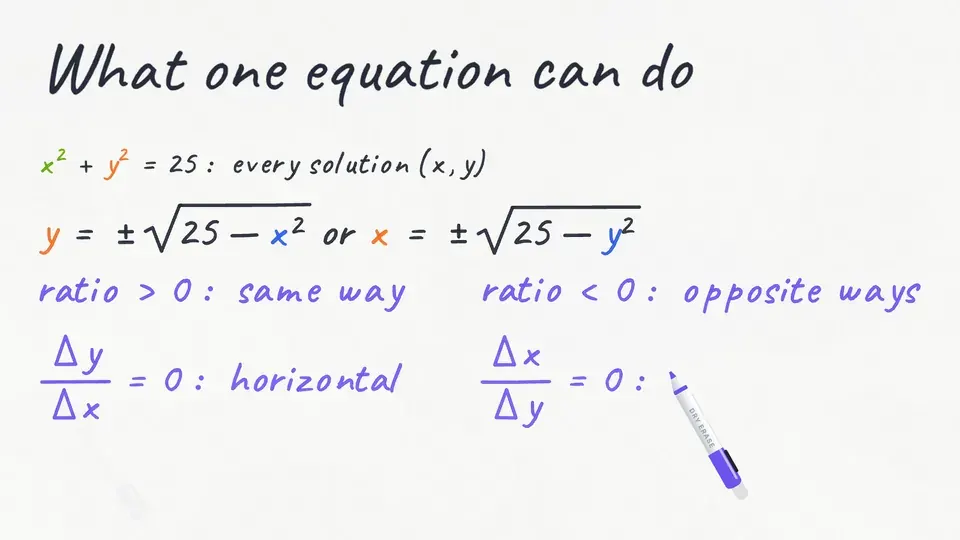
- Every point (x, y) that makes the equation true. You can build it by choosing a value of one variable and solving for every value of the other: each choice can give two points, one, or none.
- implicitly defined
- An equation such as x² + y² = 25 relates x and y without being solved for either one. It can implicitly describe one or more functions.
- solving for one variable
- Solving an equation for y (or for x) defines a function whose graph is part or all of the equation's graph, and makes the other variable the input. x² + y² = 25 gives y = ±√(25 − x²): two functions, the top and bottom halves.
- ratio of changes between nearby points
- For nearby points on the graph, Δy/Δx positive means x and y increase together or decrease together; negative means one increases while the other decreases. Reversing the points doesn't change the ratio.
- zero rate: horizontal or vertical
- Δy/Δx = 0 on a stretch means y isn't changing: the graph is horizontal there. Δx/Δy = 0 means x isn't changing: the graph is vertical there (and Δy/Δx doesn't exist).
Transcript
2,492 words · 8 parts
Lost in the fog
It’s five in the morning, and fog has rolled in over the mouth of this harbor, so thick that nobody on shore can see past the breakwaters. This little robot boat is heading out through that gap to map the seabed. It’s going straight into the fog. Ten minutes later its motor is off, its camera sees nothing but gray, and the harbor has lost it.
Its radio can still answer one question, though, and that’s how far away it is. So the beacon on the west breakwater asks, and the answer comes back five hundred meters. That sounds like progress, until you realize that every point on this ring is exactly five hundred meters from the beacon, so the boat could be anywhere on it. So the east beacon asks too, and it also says five hundred meters.
Now the two rings cross in just two places, one inside the harbor and one out there in the fog. Two perfect readings, and still two places the boat could be. By the end of this lesson, you’ll be able to find this boat with one more reading, and you’ll know exactly why two readings left two answers, because both of them were hiding in a single equation.
It’s the same idea your phone uses to find you, with satellites instead of beacons. And it all starts with that first ring, so let’s go back to one beacon and one number.
A whole ring of places
Let’s look down on the harbor from straight above, like a map, with a grid on the water and the west beacon right at the origin, zero, zero. We’ll measure east with x and north with y, and one unit on this grid is a hundred meters, so five hundred meters is five units.
Here’s one place the boat could be, four units east and three units north. Its distance from the beacon is the long side of this right triangle, and four squared plus three squared is sixteen plus nine, twenty-five, which is exactly five squared. Here’s another, four east and three south, where the same triangle just flips over, so it’s five units away too.
But four east and four north is too far, because sixteen plus sixteen is thirty-two, not twenty-five, which puts it about five hundred sixty-six meters away. So for any point x, y on the ring, the same triangle works, and the reading becomes one equation, x squared plus y squared equals twenty-five. Every place the boat could be makes that equation true, and every place it can’t be makes it false.
So here’s the reading as an equation. I want you to notice something about it. It doesn’t say y equals anything, and it doesn’t say x equals anything either. It just states a fact that x and y have to make true together, and that’s what we call an implicit equation, one that ties two variables together without solving for either of them. To test a point, you plug in both coordinates at once, so four and three give sixteen plus nine, twenty-five, and that point belongs.
Four and negative three works too, because negative three squared is still nine, but four and four gives thirty-two, so that point is off the ring. So the graph of this equation is every point that makes it true, and together they make the whole ring, every place the boat could be. Here are four more places. One of them can’t be where the boat is, so which one is it?
Graphing from solutions
Now suppose all you had was the equation, and no ring on the water at all. How would you draw it? The way you’ve always graphed, by picking a value of x and solving for y, except now we need every y that works. Let’s stand a gate across the water at x equals four. The equation becomes sixteen plus y squared equals twenty-five, so y squared is nine, and y is three or negative three.
Don’t throw away the negative one, because negative three squared is nine too, and four, negative three is a real place, three hundred meters out past the harbor mouth. At x equals five, y squared is zero, so there’s only one answer, and the gate just touches the ring. At x equals six, y squared would have to be negative eleven, so there’s no real y and the gate finds nothing, which makes sense, because nowhere six hundred meters east of the beacon is five hundred meters from it.
Now let the gate sweep across the harbor, solving at every stop, and watch the ring build itself out of solutions. You can scan the other way too, and a gate along y equals three gives x squared equals sixteen, so x is four or negative four. Now the gate is yours. Drag it until it finds exactly one place the boat could be.
On paper, that gate is a table with room for two values of y in every row. At x equals negative five, y can only be zero, and at negative four, at zero and at three, there’s a pair, one positive and one negative. Then come the gates we tried, two points at four, one at five, and none at six.
Join the points and the ring comes back. A table only suggests the shape, but the equation guarantees every point in between. Here’s a stranger one, the absolute value of x plus the absolute value of y equals four, so let’s find out what it looks like the same way.
At x equals zero, y is four or negative four, at two it’s two or negative two, at four it’s just zero, and at five there’s nothing, because an absolute value can’t be negative. Connect them and the equation draws a diamond, with its corners on the axes. At x equals negative one, which values of y make this equation true?
A function is a choice
Over at the quay, the harbor’s tender, a small workboat, is warming up, and its autopilot steers by a rule that turns each east position into one north position. Could a rule like that trace our ring? At x equals four it would have to give three and negative three at once, and a rule like that can only give one answer.
But if we keep just the half inside the harbor, every x from negative five to five gets exactly one y, and now there’s a rule the autopilot can use. We didn’t change the ring at all. We just made a choice. And that choice turned part of the ring into a function.
Here’s that choice in algebra. Starting from x squared plus y squared equals twenty-five, move the x squared across, and y squared equals twenty-five minus x squared. Then take the square root, and that’s exactly where the choice comes from, because a positive number has two square roots, one positive and one negative.
So one equation gives two functions, the top half, y equals the square root of twenty-five minus x squared, and the bottom half, its negative, both for every x from negative five to five. Functions like these, hiding inside an equation that never says y equals, are what we call implicitly defined functions. And look at x. Once we solved it for y, x became the input, the value you choose, and y became the output that depends on it.
We could just as well have solved for x instead, and x equals plus or minus the square root of twenty-five minus y squared gives a right half and a left half, with y as the input. The ring never moved. All that changed is which variable we put in charge. Some equations give one function for the whole graph, like x times y equals twelve, which is y equals twelve over x everywhere except x equals zero.
Others only work one way round. In x equals y squared, x is a function of y, but x equals four comes from y equals two and from y equals negative two, so y isn’t a function of x.
So whenever solving means undoing a square, keep both signs, because each one is its own function. Which of these equations gives you y as a function of x for its entire graph?
Moving together
Now let’s see how x and y change together as you move along the ring, sliding over the top from the west end to the east end and leaving footprints at a few exact points. On the way up, from negative four, three to negative three, four, x goes up by one and y goes up by one, so the ratio of the changes, change in y over change in x, the same ratio as an average rate of change, is one over one, which is positive.
And over the top? From four, three to four point eight, one point four, x still goes up, by eight tenths, but y drops by one point six, so the ratio flips to negative two. So a positive ratio means x and y move the same way, and a negative one means opposite ways, and you can usually see which before dividing anything.
Now I want you to find one yourself. Drag the two points to a stretch of the ring where x and y increase together. Let’s put the upper-right footprints on paper and look at all of their changes at once.
Here are six of them, from the top down to the east end, and each one really is on the ring, for instance, one point four squared plus four point eight squared is exactly twenty-five. Take the first step, from zero, five down to one point four, four point eight. x goes from zero to one point four, so it changes by one point four, and y goes from five to four point eight, a change of negative two tenths.
So the ratio of the changes is negative two tenths over one point four, which is negative one seventh. Step by step, x goes up and y goes down, so every ratio comes out negative. From four, three to four point eight, one point four, that’s the negative two we found on the water, and the whole column runs from negative one seventh down to negative seven.
And the order doesn’t matter. Going backwards from four, three to three, four flips both changes, but the ratio is still negative one. So for nearby points on a graph, a positive ratio of changes means the two variables increase together or decrease together, and a negative ratio means one increases while the other decreases.
When one stops changing
Look at the ends of that column. Near the top the ratio is only negative one seventh, because the ring is almost flat there, and near the east end it’s negative seven, because it’s almost straight up and down.
Points even closer to the top give about negative one hundredth, but stepping down from the top like this, the ratio never becomes exactly zero, because no piece of a ring is perfectly flat. So where does a ratio of changes stay exactly zero? On a perfectly straight stretch, like the one the tender’s about to take.
The tender’s running due east along the quay now. x climbs from one to four, but y stays at exactly six the whole way. So the change in y is zero, and the ratio, zero over three, is exactly zero, which is what a horizontal stretch looks like in numbers.
On paper, change in y over change in x is zero over three, so the path is horizontal. Turn it upside down, though, and you’d be dividing three by zero, which doesn’t exist. Now picture a path down the channel line, x equals four, from six to negative three. x never changes, so change in x over change in y is zero over negative nine, which is zero. The path is vertical, and this time it’s the upside-down ratio that doesn’t exist.
So a zero ratio means the variable on top isn’t changing at all. Zero for y over x means horizontal, and zero for x over y means vertical. And on the line x equals four, y isn’t a function of x at all, but x is a perfectly good function of y, since x is four for every y. Two nearby points on a graph are three, seven and three, nine. Which statement is true about the segment joining them?
The third ring
Now let’s bring back the second reading, from the east beacon, eight hundred meters from the first. Both beacons said five hundred meters, so the boat is just as far from one as from the other, which puts it on the line halfway between them, x equals four, and that line happens to be the harbor’s channel.
On that line the first ring says sixteen plus y squared equals twenty-five, so y is three or negative three, the very same row we wrote in the table, with both of its signs. If we’d kept only the positive square root, we’d be searching inside the harbor right now, and nobody would look outside. So here’s the third reading, from the fairway buoy out at four, negative six, and it says three hundred meters.
You’ve got everything you need. Tap the place that fits all three readings. The buoy’s ring passes right through four, negative three, and nowhere near the other place. The tender runs straight down the channel line, past the empty place inside the harbor and out through the mouth, and its readout keeps x at exactly four the whole way, a vertical path.
So this time the route is x as a function of y, four for every y. And there it is, sitting in the fog at four, negative three, on the bottom half you’d have thrown away if you forgot the minus sign. When your phone uses GPS to find you, it does the same thing, except that its beacons are satellites and its rings are really spheres, with one extra satellite to keep its clock honest.
What one equation can do
An equation in x and y has a graph made of every pair that makes it true, and you find those pairs by choosing a value and solving. Solving for one variable picks out functions whose graphs are part of that graph, or all of it, and you choose which variable is the input. Between nearby points, a positive ratio of changes means the variables move the same way, and a negative one means opposite ways.
And a ratio that stays at zero means a straight stretch, horizontal when y over x is zero, vertical when x over y is. In calculus, you’ll slide two nearby points together to find a curve’s exact direction at a single point. But today, you found a boat in the fog with three distances and both signs of a square root.