
Topic 4.7 key terms
- parametrization of an implicitly defined curve
- A pair of rules such that substituting and into the curve's equation makes it true for every in the domain. You prove it with an identity; checking a few values of can catch a wrong pair but never proves a right one.
- parametrizing a function
- is traced by , with in the domain of . A curve that is a function of , like , is traced by : .
- parametrizing an inverse
- If is one-to-one on an interval, swapping the rules, on that interval, traces the inverse function : traces . needs to give .
- parametric ellipse
- is traced by , , , because . and are the radii, not their squares; swapping and changes where the trace starts and which way it goes, not the ellipse.
- parametric hyperbola
- Opening left and right, is traced by ; opening up and down, by . It works because . On , leave out and , where .
- trammel (ellipsograph)
- Two sliders in perpendicular straight grooves joined by a bar of length ; a pen a distance from the horizontal-groove slider draws , an ellipse with radii and (a circle when the pen is in the middle).
Transcript
2,787 words · 8 parts
Straight bars, curved tower
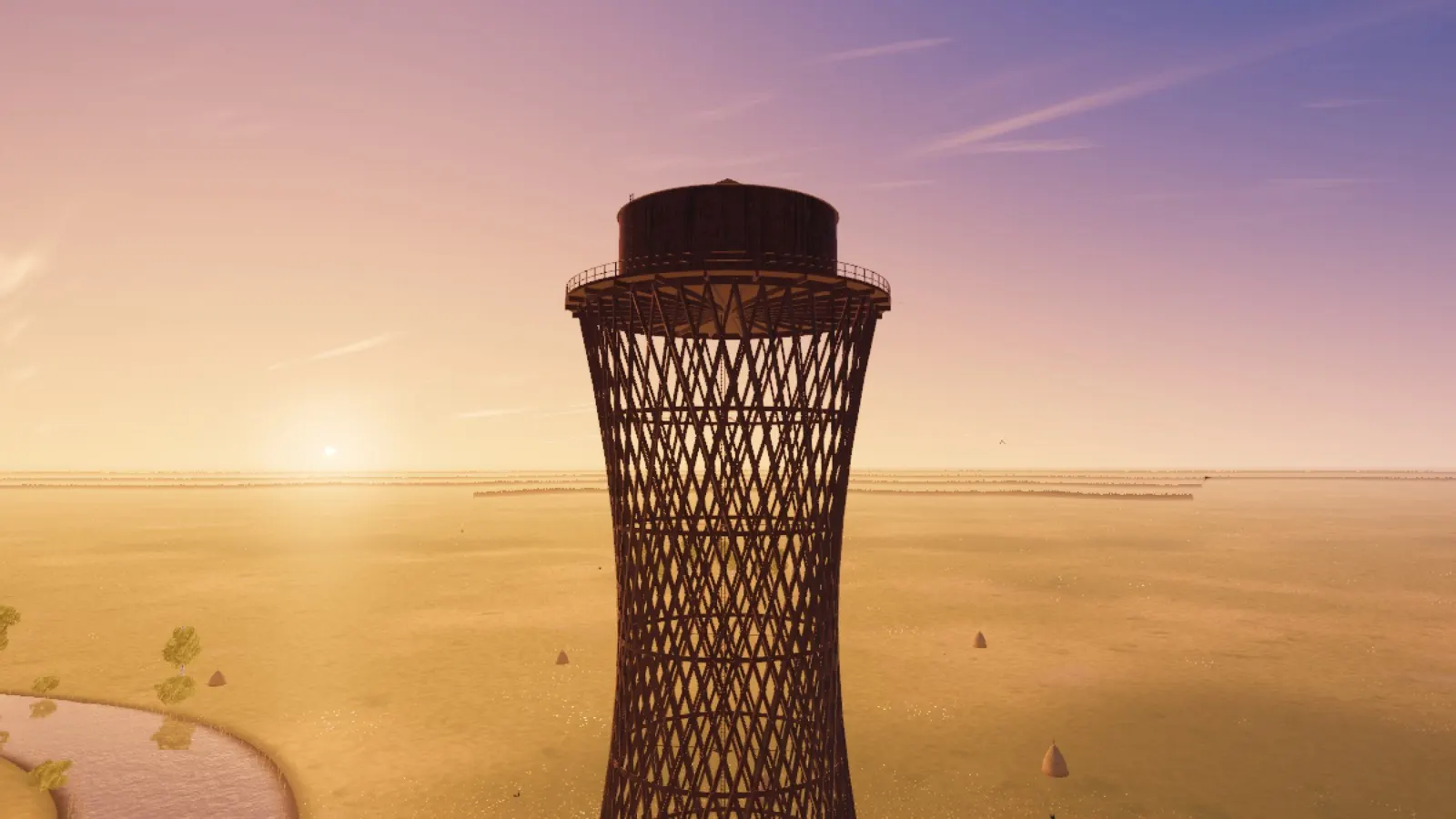
Every bar in this tower is perfectly straight. Not one of them is bent. Not even a little, from the ground all the way up to the top. And yet, look at the shape they make together. The tower pinches in at the waist and flares out again, in a curve so smooth you’d swear somebody bent the steel.
An engineer named Vladimir Shukhov built the first tower like this in 1896, to hold up a water tank, and people kept on building them, because a curved tower made of straight pieces is easy to put together and surprisingly strong. And that curve isn’t just any curve. It’s a hyperbola, one of the conic sections from last lesson, and it’s exact.
By the end of this lesson, you’ll be able to write down the instructions that trace this tower’s curve, point by point, and prove that this tower’s straight bars have to make exactly this curve. To get there, let’s start with a much smaller machine. It pulls off the same kind of trick.
The machine that does nothing
This machine is called a trammel. Draftsmen once used them to draw ellipses, and today people buy little ones as desk toys nicknamed the do-nothing machine. Each brass slider runs in a perfectly straight groove, one side to side and one up and down, and yet the pen on the bar draws a perfect ellipse.
We already know this ellipse’s equation, x squared over nine plus y squared over four equals one. But an equation is just a test, which tells you whether a point you give it is on the curve.
What it can’t do is move a pen. For that, the pen needs instructions, one input that keeps changing and two rules that turn it into an x and a y. Here the input is the angle of the bar, and we’ll call it t. The pen splits the bar into two pieces, three units long on one side and two on the other.
The three-unit piece reaches from the pen to the slider on the y-axis, so the pen’s x is how far that piece reaches sideways, three cosine t. And the two-unit piece reaches from the slider on the x-axis up to the pen, so the pen’s y is how high it reaches, two sine t. So the machine is quietly following two instructions, x equals three cosine t and y equals two sine t, and the only thing that ever changes is t.
Let’s see if you can make it draw a circle instead. Slide the pen to wherever you think it should go. Then let go, and the machine will draw. Put our ellipse on the board. There’s a question we haven’t answered yet.
True for every t
This is the curve the machine drew, with its equation, and the pen’s two instructions, which we call a parameterization of the curve. So does every single point the pen draws really pass the test? Let’s put the instructions straight into the equation, three cosine t for x and two sine t for y.
Squaring gives nine cosine squared t over nine, plus four sine squared t over four, and once the nines and the fours cancel, we’re left with cosine squared t plus sine squared t. That’s the Pythagorean identity, so it equals one for every value of t there is. Wherever the handle is, the pen is on the ellipse.
A pair of rules can only parameterize a curve when this happens, when substituting them into the curve’s equation makes it true for every t in the domain. Why bother with algebra, when we could just check a point? Let’s try that on a pen that’s programmed wrong, with x equals three cosine t but y equals two sine of two t.
At t equals zero, both pens sit at three comma zero, and the wrong one passes the test there perfectly, because nine over nine plus zero is one. But at t equals pi over four the wrong pen is at about two point one two comma two, and the test gives one half plus one, which is three halves, not one.
So checking points can catch a wrong pen, but it can never prove a right one, because there are always more values of t than you could ever check. Only the identity covers all of them at once. Let’s put that to work. Which of these pairs makes x squared plus y squared equal twenty-five for every value of t?
Let one variable drive
The easiest parameterizations of all come from curves that are already functions. Take y equals x squared plus one. Since y is a function of x, let x be the input, so x equals t and y equals t squared plus one. At t equals negative one, x is negative one. And y is one plus one, which is two.
The other rows fill in the same way, one point for each value of t. And as t runs from negative two to two, the pen sweeps across the parabola from left to right. So any function y equals f of x is t comma f of t, and the check is just t squared plus one equals t squared plus one.
Now try x equals y squared minus three, a parabola lying on its side, which isn’t a function of x, because a vertical line can hit it twice. Solving for y gives plus or minus the square root of x plus three, two separate pieces that have to meet at the vertex.
But x is already a function of y, so let y be the input instead, y equals t, and then x equals t squared minus three. At t equals negative two the pen is at one comma negative two, at zero it’s at the vertex, and at two it’s at one comma two, so one pair of rules draws both halves. So how would you parameterize the whole parabola x equals y squared plus two?
Now let’s swap the two rules. Start with two to the x, drawn as t comma two to the t, for t from zero to three. Swap them, so x equals two to the t and y equals t. Every point trades its coordinates, three comma eight becomes eight comma three, and the whole curve folds across the line y equals x.
That’s the graph of the inverse, log base two of x, and we drew it without ever writing a logarithm. The input still runs from zero to three, so now it’s x that runs from one to eight.
So the graph of f is t comma f of t, and its inverse is f of t comma t, but squaring shows there’s a catch. Swap t comma t squared, and you get t squared comma t. At t equals negative two and two, that’s four comma negative two and four comma two, one point right above the other.
That isn’t a function of x, so it can’t be an inverse function. The fix is to keep t at least zero, where squaring is one-to-one, and then the swap traces y equals the square root of x. The function f of x equals x cubed plus one is one-to-one. Which pair of rules traces its inverse?
Any ellipse you want
Now let’s write instructions for any ellipse at all. Any center, and any size. An ellipse centered at h comma k, with radius a across and radius b up, has the equation x minus h, squared, over a squared, plus y minus k, squared, over b squared, equals one. Each of those fractions is really one square, because x minus h, squared, over a squared is the same as x minus h over a, all squared, and the y part works the same way.
That’s two squares adding up to one, just like cosine squared t plus sine squared t, so let x minus h over a be cosine t, and y minus k over b be sine t. Solving gives x equals h plus a cosine t and y equals k plus b sine t, with t from zero to two pi for one full lap.
Let’s try x minus one, squared, over nine, plus y plus two, squared, over four, equals one. The center is one comma negative two, and the radii are three and two, the square roots of nine and four.
So x equals one plus three cosine t, and y equals negative two plus two sine t. It’s the three and the two that go in front, not the nine and the four, because a and b are radii.
Substitute, and the minus one and the plus two cancel the shifts, leaving cosine squared plus sine squared, which is one. The pen starts at the right end, four comma negative two, reaches the top at pi over two, the left end at pi, and the bottom at three pi over two.
On the machine, h and k just move the place where the grooves cross, and the same bar draws the new ellipse through its four target points. The domain matters too. Turn the grooves into a floor and a wall, and the bar becomes a ladder sliding down the wall.
A dot two units up the ladder follows our first rules, three cosine t and two sine t, but a ladder only goes from upright to flat, so t runs from pi over two to zero, and the dot paints a quarter of the ellipse. So the rules decide which curve you’re on. The domain decides how much of it you draw.
For a full lap, t has to cover a whole two pi, say from zero to two pi. Swap sine and cosine. Now the pen starts at the top and runs the other way. But it’s still the very same ellipse.
So let’s give you a commission. Move the crossing and slide the pen until this machine draws x plus two, squared, over sixteen, plus y minus one, squared, over nine, equals one.
Two squares that always differ by one
Now for the tower’s kind of curve, the hyperbola. Take x squared over four minus y squared over nine equals one, which looks almost like an ellipse’s equation, except for the minus sign in the middle. Cosine and sine can’t help here, because their squares always add up to one, and we need two squares whose difference is always one.
So let’s divide every term of cosine squared plus sine squared equals one by cosine squared t, which is fine as long as cosine t isn’t zero. Cosine squared over cosine squared is one, sine squared over cosine squared is tangent squared, and one over cosine squared is secant squared, so one plus tangent squared t equals secant squared t.
Move the tangent squared across, and there it is, secant squared t minus tangent squared t equals one, every time. That’s exactly the shape we need, so let x over two be secant t and y over three be tangent t, which means x equals two secant t and y equals three tangent t.
Substitute, and the four and the nine cancel just like before, leaving secant squared minus tangent squared, which is one. At t equals zero the point starts at two comma zero, and as t grows, secant and tangent both grow, so the point climbs out along the asymptote. By t equals one point five it’s about twenty-eight units to the right, and by one point five seven it’s past two thousand.
At pi over two, cosine t is zero, so secant t and tangent t don’t exist at all. There’s no point there, and the pen has to lift. Just past pi over two, secant is a huge negative number, so the pen reappears far away on the other side, comes in through negative two comma zero at t equals pi, and runs off again near three pi over two.
Then it comes back in along the lower right. It finishes at two comma zero. So on zero to two pi we leave out pi over two and three pi over two, and the curve comes in two branches.
If the hyperbola opens up and down instead, like y squared over nine minus x squared over four equals one, then y has the positive square, so y gets the secant, and x equals two tangent t while y equals three secant t. So whichever variable has the positive square gets the secant, and the other one gets the tangent. And a center at h comma k just adds h and k, exactly as it did for the ellipse. Now see if you can parameterize this one, y squared over sixteen minus x squared over twenty-five equals one.
Straight lines, exact curve
Back to the tower. Why do straight bars make this curve? You have every tool you need to answer that now. Follow just one bar. It touches the narrowest ring, the waist, ten meters from the center.
It climbs three meters for every meter it runs sideways. Look from straight above. Every bar’s shadow is a straight line. Each one just touches the waist ring. It meets the radius at a right angle.
Put a bead on the bar. Watch it slide out, away from the touching point. Measure the angle t at the center. It opens from the touching point to the bead. That makes a right triangle.
The ten-meter radius is the side next to t. The bead’s distance from the center is the hypotenuse. Cosine t is ten over that distance. That makes the distance ten over cosine t: ten secant t.
The other leg is the bead’s run along the shadow. Tangent t is that run over ten, so the run is ten tangent t. Look from the side. The touching point faces us. It sits straight in front of the center. Put the x and y axes at the waist.
Spin the bead around the axis. It sweeps out a hoop at the bead’s height. The hoop meets the outline, so the outline’s x is the bead’s distance from the center: ten secant t.
The bead’s height above the waist comes from its run along the shadow. It climbs three meters for every meter it runs. Your turn to keep the promise. Which pair of instructions traces the tower’s outline?
Slide the bead from the bottom ring up to the top. Its hoop traces the whole right side. That right side is the hyperbola x squared over ten squared, minus y squared over thirty squared, equals one. Ten is the waist. Thirty is three times ten, from the bars’ climb.
Substitute the instructions. Ten secant t, squared, over ten squared, minus thirty tangent t, squared, over thirty squared, is secant squared minus tangent squared, which is one. Underneath, that’s the Pythagorean theorem in the triangle from above. The bead’s distance squared, minus its run squared, is always ten squared. That’s the real reason straight bars make a hyperbola.
Push the bead past the top. It climbs faster and faster, up a bar that would have to go on forever. It never reaches pi over two, which is why that input is left out. And the other side of the tower is the other branch, where secant t is negative. At the same height on the left, t is five pi over four.
Even the asymptotes stand right here. The bar we followed lies on y equals three x. Its partner lies on y equals negative three x. So this tower, built from nothing but straight lines, has to curve exactly like this, and you just wrote its instructions and proved it.
What to remember
Let’s put the whole lesson into four lines. A pair of rules that parameterizes a curve makes its equation true for every t when you substitute them, and you prove that with an identity, not with a few points.
A function y equals f of x is t comma f of t, and swapping the rules to f of t comma t gives its inverse where f is one-to-one, or any curve where x is a function of y, like a parabola on its side. An ellipse is h plus a cosine t comma k plus b sine t, from zero to two pi, because cosine squared plus sine squared is one.
And a hyperbola puts secant on the positive square and tangent on the other, because secant squared minus tangent squared is one, leaving out pi over two and three pi over two. So the next time you see a tower like that one, look for the straight bars. They’re hiding in the curve. And now you know exactly why they make it.