
Topic 4.9 key terms
- vector-valued function
- A function whose input is a number (here the time t) and whose output is a vector. A planar motion f(t) = (x(t), y(t)) can be written p(t) = ⟨x(t), y(t)⟩ = x(t)î + y(t)ĵ.
- position vector
- The vector p(t) from the origin to the object at time t. Its components are the object's coordinates, so its tip is the object.
- magnitude of the position vector
- |p(t)| = √(x(t)² + y(t)²): the object's straight-line distance from the origin at time t. It is not the distance traveled and not the distance from the starting point.
- velocity vector
- The vector v(t) on the object, pointing the way it is moving at time t. Its first component says right (positive) or left (negative); its second says up (positive) or down (negative).
- speed
- The magnitude of the velocity vector: square its two components, add them and take the square root. Never negative. One zero component does not mean stopped; only v = ⟨0, 0⟩ does.
Transcript
2,250 words · 8 parts
Let go
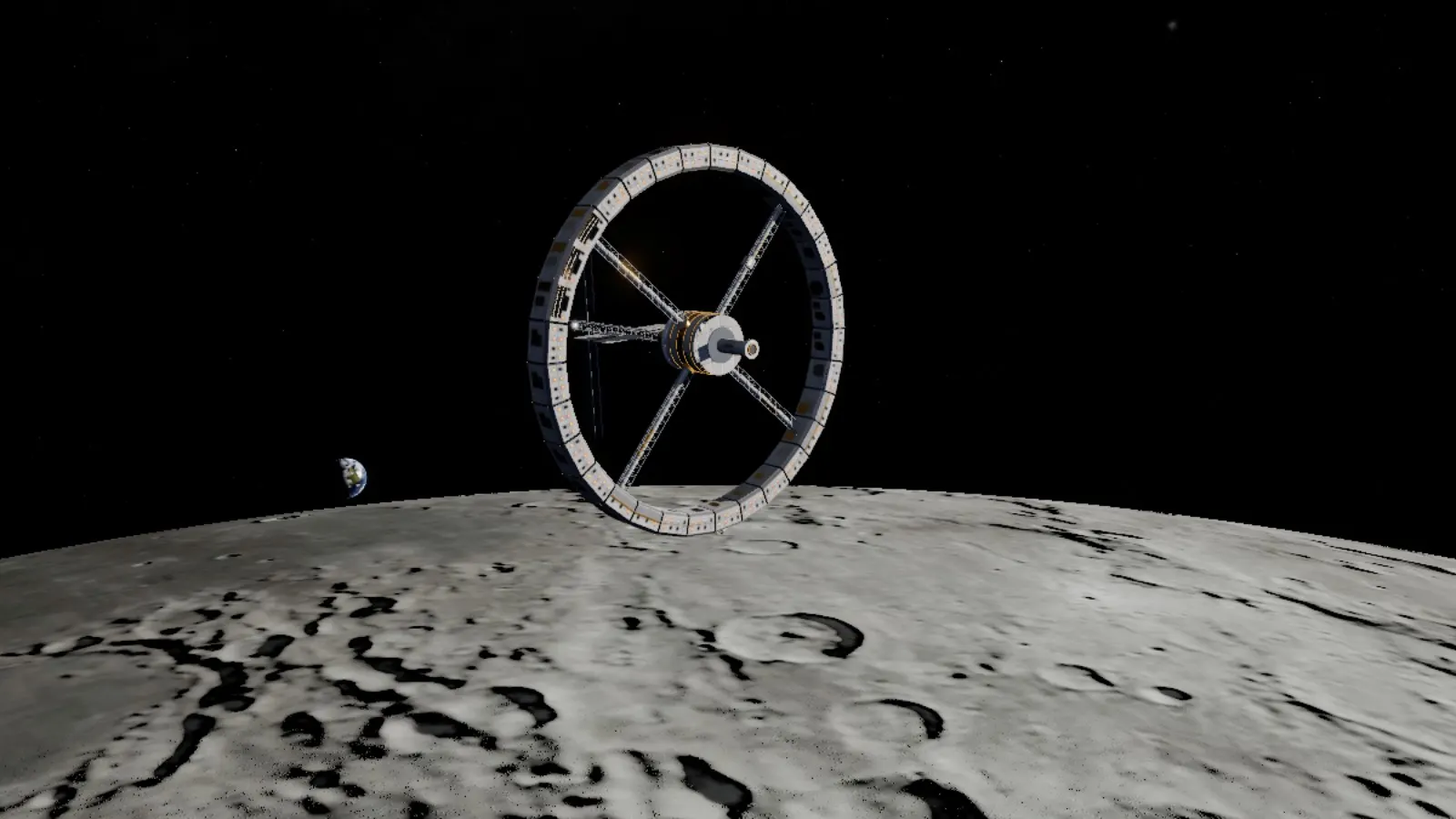
Picture yourself in orbit a hundred kilometers above the Moon, with the Earth just coming up over the horizon. That wheel is a space station two hundred meters across, and it turns all the way around once every twenty-one seconds. That slow spin is the whole reason the people inside can stand on the floor instead of floating.
This cargo pod rides the rim at highway speed. The station has to send it over to that ship, and the strange part is that the pod has no engine, so the station is simply going to let go of it. The clamp’s light just turned amber, which means it’s about to open, so let’s stop time right here, a split second before it does. People usually picture one of these four paths when they imagine what happens next, and only one of them can be right.
So… when that clamp lets go, which path do you think the pod will take? By the end of this lesson, you’ll be able to tell this station exactly when to let go, so the pod sails straight into that ship… and how fast it’ll be going when it gets there.
To do that, we need two arrows on this pod. One says where it is. The other says where it’s going. You’d think they point the same way. They don’t.
An arrow from the hub
Let’s start with where the pod is. To say that with numbers, we need somewhere to measure from, so let’s put the origin right at the hub, with x to the right and y up.
In space there’s no real up, so up just means the top of your screen, and this grid stays put while the station turns under it. Right now the pod is sixty meters to the right of the hub and eighty meters up, so let’s draw an arrow that starts at the hub and ends right on the pod.
That’s the pod’s position vector, p, and its components are the sixty and the eighty, so we write it as sixty, eighty, in meters. Now let the station turn. The arrow sweeps around like a clock hand, its tail stuck to the hub and its tip riding the pod, so every moment gets exactly one arrow. So the position is a function of time, with one number in and a whole arrow out.
On paper the pod sits at the point sixty, eighty, and its position vector is the arrow from the origin out to that point. With the unit vectors from last lesson it’s sixty i hat plus eighty j hat, and either way the arrow starts at the origin, so its tip lands exactly on the pod.
In general, if an object’s coordinates at time t are x of t and y of t, its position vector is x of t, y of t, or x of t i hat plus y of t j hat. A function like this, with a number going in and a whole vector coming out, is what we call a vector-valued function.
For our station, x of t is a hundred cosine of point three t and y of t is a hundred sine of point three t, a parametric circle with a radius of a hundred meters. At t equals zero that gives one hundred, zero, a hundred meters straight to the right of the hub.
Here’s the real station again, frozen at t equals zero. Turn the station until the pod’s position vector is negative sixty i hat plus eighty j hat.
How far is it?
The length of that arrow has a meaning of its own… and it’s the pod’s straight-line distance from the hub. Let’s mark where the pod is now and watch three distances during one full turn, its distance from the hub, its straight-line distance from where it started, and how far it has traveled around the ring. After one full turn, when the pod is back on its start mark, which of these three distances do you think will be zero?
As the station turns, the first gauge, the distance from the hub, doesn’t budge from a hundred meters. The second one climbs as the pod moves away from its start mark, and halfway around it reaches two hundred meters, as far as it can get. And now the pod is back on its mark, so that distance is zero, while the distance traveled has grown to about six hundred twenty-eight meters.
To get the length of a position vector, we use Pythagoras, because the two components and the arrow make a right triangle. The square root of sixty squared plus eighty squared is the square root of ten thousand, which is a hundred meters.
And it’s a hundred at every moment. Square both components, add them, and pull the hundred out of the square root, and what’s left inside is cosine squared plus sine squared, which is always one. The magnitude of the position vector tells you how far the object is from the origin right now. It has nothing to do with how far it has traveled.
Where is it going?
The position vector tells us where the pod is, but it can’t tell us which way the pod is heading, and for that we need a second arrow. We’ll find it with the rocket trick from lesson one point two. Two seconds from now the pod will be over here, so in those two seconds its position changes by this arrow.
Divide that change by the two seconds, and you get its average velocity, about negative twenty-eight, ten, in meters per second. Now shrink the window to one second, then half a second, then a fiftieth of a second, and watch the arrow swing up until it lies right along the ring, while its numbers settle on negative twenty-four, eighteen.
The change in position shrinks toward nothing, but we divide it by a time that shrinks just as fast, so the arrow doesn’t shrink away, and it settles on one length and one direction. That’s the pod’s velocity at this instant, v. It sits on the pod instead of at the hub, and it points exactly the way the pod is moving right now.
Its first component, negative twenty-four, says the pod is moving left at twenty-four meters per second, and its second, positive eighteen, says it’s moving up at eighteen meters per second. When the station turns, both arrows turn with it, but they never point the same way, because one says where the pod is and the other says where it’s going.
The station’s computer has a formula for the velocity too. v of t equals negative thirty sine of point three t, thirty cosine of point three t, in meters per second. In calculus you’ll learn to get this from p of t, so today we’ll just use it. Its components are v sub x and v sub y, so we don’t mix them up with x and y, which say where the pod is. At our freeze-frame, t equals three point one, it gives negative twenty-four, eighteen: the very same arrow the shrinking window found.
The sign of each component tells you the direction. A negative first component means moving left and a positive one means right, and a positive second component means up, a negative one down. So right now the pod is to the right of the hub and above it, because p is sixty, eighty, but it’s moving left and up, because v is negative twenty-four, eighteen. The signs of p tell you where it is. And the signs of v tell you where it’s going.
Here’s the station again, with both arrows on and the velocity’s numbers in the corner. Turn the station until you find a moment… when the pod is moving left and down.
Opening the clamp
Now that we have both arrows, let’s go back to the moment from the very beginning. Before we open the clamp, think about which arrow the pod is going to follow. So let’s open the clamp.
It flies off in a perfectly straight line, right along its velocity arrow, which is path C. Once the clamp lets go, nothing pushes it sideways, so it keeps the velocity it had at that instant. Watch the two arrows as it goes. The velocity arrow rides along unchanged, while the position arrow stretches as the pod gets farther from the hub. And twenty seconds after the clamp opened, the ship’s bay swallows it, right where path C was headed.
Look at the spot where the clamp opened. The position arrow and the velocity arrow meet there at a right angle. The pod flies straight along v, so the hub, the release point and the pod always form a right triangle. You can check that with the dot product from last lesson, because sixty times negative twenty-four plus eighty times eighteen comes out to exactly zero.
And that’s why the pod’s distance from the hub never changed while it rode the ring, because its velocity never pointed toward the hub or away from it, only sideways. Ten seconds after the clamp opened, the pod was at negative one hundred eighty, two hundred sixty. How far was it from the hub?
How fast?
Where does the thirty meters per second on the speed gauge come from? A speed is the length of the velocity arrow. Watch the speed gauge while the station turns. The velocity arrow keeps turning, but its length never changes, so the speed stays at thirty meters per second the whole way around.
Here are four moments a quarter turn apart, where the velocity points straight up, then straight left, then straight down, and then straight right. That’s the same speed every time, with four completely different velocities.
To find a speed, take the magnitude of the velocity vector, the square root of v sub x squared plus v sub y squared. At our freeze-frame that’s the square root of negative twenty-four squared plus eighteen squared, which is the square root of nine hundred, thirty meters per second.
Squaring makes the negative sign disappear, and that makes sense, because a speed is a length, and a length is never negative. A velocity like negative thirty, zero has a zero in it, but the pod is moving left at thirty meters per second. Only zero, zero means stopped. The speed only says how fast. The velocity says how fast and which way.
Not every path is a circle
On the ring the speed never changed, but most motion isn’t that tidy. Here’s a little probe hopping between two docks, with position three t i hat plus four t minus t squared, all times j hat, in meters.
We also know its velocity, three i hat plus four minus two t, all times j hat, in meters per second, for t from zero to four seconds. At t equals zero the probe is at the origin, so its position vector is the zero vector, but its velocity is three, four, so it’s already moving right and up at five meters per second. At t equals one it’s at three, three, and its velocity is three, two, so it’s still moving right and up, but slower.
At t equals two, the probe is at the very top of its hop. How fast is it moving there? Here’s the whole hop in one table, one row for each second. Every number comes from those two formulas.
Row zero is the launch, at the origin. One second in, it’s still climbing. At t equals two it reaches the top, and then it comes back down. The distance column is just Pythagoras on the position, so at t equals one it’s the square root of three squared plus three squared, root eighteen, about four point two. The speed column does the same with the velocity, so at t equals one it’s the square root of three squared plus two squared, root thirteen, about three point six.
At t equals three, three numbers are easy to mix up. Nine point five meters is its distance from the origin. Negative two meters per second is its vertical velocity, so it’s heading down. Three point six meters per second is its speed. And at t equals four it lands at twelve, zero, moving at five meters per second again, the same speed it started with.
Tell it when
Let’s go back to the station for one last job. The ship has moved, and now it’s waiting down here, below the station and off to the right. The station keeps turning, and only one moment in each turn will send the pod straight into that bay. You get to choose it. Turn the station to the moment you think is right… and then press let go.
So a vector-valued function gives you an arrow for every t. The position vector runs from the origin to the object, and its length is the distance from the origin. The velocity vector v of t sits on the object, and the signs of its components say right or left and up or down, and its length is the speed.
Calculus shows you how to get v from p. Physics shows what keeps the velocity arrow turning. The floor pushes the crew toward the hub, and they feel that push as gravity. The clamp pushed the pod the same way, until it let go. The ship is heading home with its cargo now, and the station keeps on turning, once every twenty-one seconds.