
Topic 4.3 key terms
- direction of motion (parametric)
- As t increases, x(t) increasing means moving right and decreasing means moving left; y(t) increasing means moving up and decreasing means moving down. Read each coordinate separately, from how it changes, not from its sign.
- repeated point
- A parametric path can pass through the same point at different values of t. The direction of motion there may be different on each visit, or the same.
- parametrization
- A parametric function that traces a curve. The same curve can be traced by different parametric functions, faster or slower, from a different start, or in the opposite direction, usually with a different domain.
- average rate of change of x(t) and of y(t)
- Over [t₁, t₂], Δx/Δt and Δy/Δt, each computed on its own from the two positions.
- slope between two points of a parametric curve
- (Δy/Δt) ÷ (Δx/Δt) = Δy/Δx, the slope of the line segment joining the points at t₁ and t₂, as long as Δx ≠ 0. If Δx = 0 and Δy ≠ 0 the segment is vertical (slope undefined); if both are 0 the two points coincide.
Transcript
2,418 words · 7 parts
One smoke trail
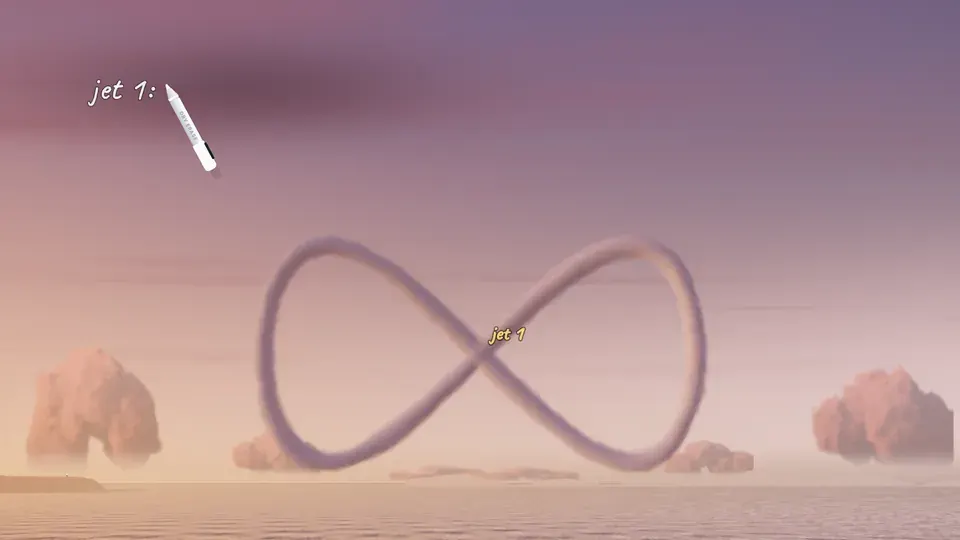
This is a Cuban eight, one of the classic stunts in any air show. The jet flies two giant loops side by side, and it dives straight through the middle between them, first one way and then the other.
It got its name because the pilot who first flew it, back in 1936, happened to be flying for Cuba’s air force at the time. Now look at what it leaves behind. The jet went through this one point in the middle twice, heading a different way each time.
But the smoke can’t show you which way the jet went around, or which of the two passes came first. Now watch. A second jet is about to fly the same eight, the other way around.
They meet head-on, right in the middle of the sky. Two different flights, one smoke trail. The smoke can’t show where each jet was at each second, or which way it was heading. What’s missing is time.
By the end of this lesson, you’ll be able to take the two streams of numbers that track a jet like this, and say exactly which way it’s flying at any moment. Even at the spot it flies through twice. And then you’ll pick the flight plan for the second jet yourself. The two of them will meet head-on, right in the middle of the sky. So let’s slow everything down and follow just one jet, one second at a time.
Two records
To keep track of the jet, we need just two numbers at every moment. One is how far it is to the right of show center, which we’ll call x, and the other is how high it is above the sea, which we’ll call y. Both numbers change as the jet flies, so each one is a function of time. These two cards record them while the jet flies the eight again. Watch x go negative over the left loop.
Here’s a smooth model of this eight. x swings six hundred meters to each side of center, and y swings three hundred meters above and below four hundred, over the thirty-two seconds of the eight. You won’t need to calculate with these today, because the records tell us everything. Let’s stop the clock at ten seconds. The jet is five hundred fifty-four meters to the right of center, so x is positive, and yet it’s flying to the left.
So the sign of x can’t tell you which way the jet is going. What matters is whether x is getting bigger or smaller, and right now it’s shrinking, because the jet is heading back toward the center. Let’s put the two records on the board, side by side. Then we can read them properly.
On the top record, x of t rises whenever the jet moves to the right, because its distance to the right of center is growing, and it falls whenever the jet moves left. And y of t, on the bottom, rises when the jet climbs and falls when it dives, which is just what a height should do.
So let’s read the first four seconds. On the top record x is rising, so the jet moves right, and on the bottom record y is falling, so it’s moving down, and put together, that’s down and to the right. If you write that as one sentence, the jet is moving down and to the right from t equals zero to t equals four, because x of t is increasing and y of t is decreasing on that interval.
Every time one of the records turns around, the direction changes, so let’s run the whole eight and let the arrows fill in. The mistake almost everyone makes at first is reading the signs. From eight seconds until it gets back to the center at sixteen, the jet is on the right side, with x positive, and it’s flying left the whole way. It’s the same with y, which stays positive for the entire flight because the jet never goes underwater, and it still dives half the time.
I’ve got a challenge for you. Let’s see if you can do it. And this time, you can’t look at the jet. I’ve frosted over the sky, so all you have are the two records. Drag the time to a moment when the jet is moving left and up, and let go to see where it really was.
Here are the two records of a particle moving in the plane. Which way is it moving between t equals one and t equals two? So reading the direction always comes down to two separate questions, one for each record.
The point it passes twice
Now let’s go back to the middle of the eight, the one point the jet passes twice. At t equals zero it’s right here, at zero, four hundred. The records say that x is rising and y is falling at that moment, so on this first pass the jet is diving down and to the right. Sixteen seconds later the jet is back at the very same point, zero, four hundred, but look at what the records are doing now.
Using the records at t equals sixteen, which way is the jet heading on its second pass through the center? So one point in the plane can come with two completely different directions, because the jet was there at two different times.
On the board, that’s the point zero, four hundred. At t equals zero the jet leaves it down and to the right, and at t equals sixteen it leaves it down and to the left.
But a second visit doesn’t always mean a new direction. If the jet starts another eight, it comes through the middle again at thirty-two seconds, and this time it heads down and to the right, exactly the way it did at zero. So the direction at a point can change from one visit to the next, or it can stay the same. The records are how you tell.
One smoke trail, many flights
Display teams love mirror tricks like this next one. A mirror jet flies the same eight, but it starts on the other pass. While the first jet takes the right loop, the mirror jet takes the left. They’re mirror images of each other, and every sixteen seconds they cross in the middle like the blades of a pair of scissors. Together they paint one smoke trail.
If the first jet’s flight is p of t, the mirror jet’s flight is p of t plus sixteen. At every moment, it’s where the first jet will be sixteen seconds from now. At t equals zero, the mirror jet is already at p of sixteen. That’s the first jet’s second pass through the middle. It’s diving down and to the left.
Let’s check that. When the first jet is four seconds into its eight, where is the mirror jet? Or take the recording of the first jet and play it back twice as fast, so the replay paints the very same eight in sixteen seconds instead of thirty-two.
It reaches the bottom of the right loop at two seconds instead of four, so if we call the replay q, then q of two is p of four, and in general q of t is p of two t. That’s because the replay reaches every point in half the time the jet took, so it gets to the top of the right loop at six seconds instead of twelve.
That’s one curve with three different functions behind it. The original jet runs for thirty-two seconds, and so does the mirror jet, because after p of thirty-two the eight starts over. The fast replay needs only sixteen seconds, so its domain is cut in half. The smoke is identical in all three, and what’s different is when each one gets to each point.
Running a path backwards is just as easy, so let’s try it on a straight segment. Say A of t equals one plus two t, three plus t. It starts at one, three when t is zero and reaches nine, seven when t is four. Which of these runs along exactly the same segment, but backwards, from nine, seven to one, three?
There’s a neat way to build a backwards plan. You run the clock backwards, so A of four minus t starts where A of t ends and finishes where it started, because as t counts up to four, four minus t counts down to zero. Hold on to that idea. The second jet is going to need it.
Two readings, one slope
How steep is the jet’s dive through the middle? Let’s build the tool on something slower first. Say a camera drone filming the show is tracked the same way, and we know where it is at one, two and three seconds. Between t equals one and t equals three, two seconds go by. x drops from six to two, so it changes by negative four, and y climbs from two to ten, which is a change of eight.
On average, x changes by negative two meters every second, and y changes by four meters every second. Those are the average rates of change of x and of y. Now divide the rate of y by the rate of x, four over negative two, and you get negative two. And that’s exactly the slope of the straight line between the point six, two and the point two, ten, because y went up eight while x went back four.
That’s no accident. The two seconds sit under both rates, so when you divide one rate by the other they cancel, and you’re left with the change in y over the change in x, in meters up per meter across. One thing to watch out for is that the slope comes from the changes, never from the coordinates themselves. Dividing the second point’s coordinates, ten over two, gives five, but the real slope is negative two, because the drone moved up and to the left.
Try this one yourself. A particle has x of t equals ten minus two t and y of t equals t squared plus t. What’s the slope of the line between its positions at t equals one and t equals four?
Let’s go back up into the sky. Between zero and four seconds, the jet goes from show center down to the bottom of the right loop. Its x changes by about four hundred twenty-four meters and its y by negative three hundred, so the average rates are about a hundred six meters per second sideways and negative seventy-five meters per second vertically.
Divide them and the slope is about negative zero point seven. That’s the slope of this straight line from where the jet was to where it ended up, which we call a chord. It cuts right across the loop.
Notice that the line isn’t the path. The jet curved down and around, and the chord only joins the two ends. Now stretch the interval to eight seconds. The jet ends up level with where it started, so the change in y is zero and the chord is flat, even though the jet dove three hundred meters and climbed back up in between.
See if you can find two moments where the chord between them is perfectly vertical, by dragging the two times and watching the readout. The strangest case of all is zero to sixteen seconds. The jet flies the entire right loop and comes back to the exact same point, so both changes are zero.
Both average rates are zero, and that doesn’t mean the jet stood still, because it flew a whole loop. It means the two ends are the same point, so there’s no line between them at all. So divide the average rate of y by the average rate of x. That gives you the slope between the two points, as long as x actually changed.
The opposing pass
The sun’s going down. So let’s give the crowd the finale I promised you at the start. Jet one flies p of t, the eight we’ve been studying all along. Your job is to pick a flight plan for jet two, so that it flies the same smoke trail and meets jet one head-on, right at show center. Pick a plan and watch what happens, and keep trying until the two jets meet head-on.
Here they come, one diving in from the upper left and one climbing in from the lower right. Look at the moment they meet. Jet one’s x is rising and its y is falling, so it dives down and to the right. Jet two’s x falls and its y rises, so it climbs up and to the left, straight at jet one.
Jet two is always exactly opposite jet one, on the other side of the center, so the only place they ever meet is right in the middle, every sixteen seconds, and every time it’s head-on. In a real show the pilots keep a safe gap toward or away from the crowd, which our flat picture can’t show, so from the beach they seem to fly straight through each other.
Before they go, let’s squeeze that straight line around jet one’s pass through the center at sixteen seconds. Watch its slope climb from about zero point nine eight, to zero point nine nine five, and then to zero point nine nine nine eight.
It’s heading for one. A slope of one is a forty-five degree line, because the tangent of forty-five degrees is one. Real pilots dive through the middle of a Cuban eight at that angle. In calculus you’ll find that slope exactly, as the rate of y over the rate of x at a single instant.
What the smoke can’t show
So the smoke shows you the curve. The two records show you the flight. x of t tells you left or right and y of t tells you up or down, from whether each one is increasing or decreasing, never from its sign. The same point can be passed at different times heading different ways, and the same curve can be flown by different functions, at a different speed or even backwards.
And between any two moments, the average rate of y divided by the average rate of x is the slope of the line joining the two points, as long as x changed. That’s the whole story. Now you know what the smoke never tells the crowd.