
The four questions at a glance
Section II of the AP Physics 1 exam has four free-response questions, one of each type. You read them in the Bluebook app and write your answers by hand in a paper booklet, and only what is in the booklet gets scored. The reference sheet and your calculator are available the whole time.
| Question | Type | Points | Suggested time | What you do |
|---|---|---|---|---|
| 1 | Mathematical Routines | 10 | 20–25 min | Sketch a graph or draw a diagram, derive expressions in symbols, sometimes calculate a number, then make a claim about a changed situation and justify it. |
| 2 | Translation Between Representations | 12 | 25–30 min | Draw a representation such as an energy bar chart, derive an equation, sketch a graph, then show that two of your answers agree or predict what changes. |
| 3 | Experimental Design and Analysis | 10 | 25–30 min | Design a procedure with the equipment you’re given, then plot real data, draw a best-fit line and use its slope to find an unknown. |
| 4 | Qualitative/Quantitative Translation | 8 | 15–20 min | Make a claim and justify it in words, derive an equation, then show that the equation says the same thing as your words. |
The section counts for half of your AP score, the same as the 42 multiple-choice questions. For May 2027 it runs 95 minutes, five fewer than in 2025 and 2026.
Older practice papers look different. Through 2024 the section had five questions in 90 minutes, and one of them, worth 7 points, asked for an argument written as a paragraph. That question is gone, but the writing isn’t. Questions 1, 2, and 4 all end with a claim you have to justify in sentences, and those sentences hold some of the points students miss most.
Where students lost points in 2025
Each year the Chief Reader, the college professor who leads the scoring, publishes a report on how students did. The 2025 report, the latest one for AP Physics 1, gives the average score for every single point on every question.
| Question | Type | Average | Out of | Share earned |
|---|---|---|---|---|
| 1 | Mathematical Routines | 4.74 | 10 | 47% |
| 2 | Translation Between Representations | 6.09 | 12 | 51% |
| 3 | Experimental Design and Analysis | 4.93 | 10 | 49% |
| 4 | Qualitative/Quantitative Translation | 4.65 | 8 | 58% |
| All four | 20.41 | 40 | 51% |
So the average student earned about half of the free-response points. The per-point averages show which half. These are the eight points the fewest students earned:
| Question and point | What it asked for | Earned by |
|---|---|---|
| Q1, part B (B2) | Say why friction between the sliding block and the cart can’t change the system’s momentum: it is internal to the system. | 10% |
| Q2, part B (B4) | Finish the derivation with a correct expression for the spring constant. | 17% |
| Q3, part B (B2) | Say how the slope of the graph gives the block’s mass. | 20% |
| Q1, part B (B3) | Connect that to momentum: equal and opposite impulses, or no net external force, so no change. | 22% |
| Q2, part D (D2) | Justify a change in speed using both potential energies on your graph. | 22% |
| Q3, part D (D1) | Relate the slope of the best-fit line to the meterstick’s mass. | 28% |
| Q3, part D (D2) | Get a mass inside the accepted range. | 28% |
| Q4, part A (A2) | Say that the block has the same weight in both liquids. | 32% |
What these points have in common is where they sit: at the end of a line of reasoning that most students had already started. In Question 2, 64% of students began with conservation of energy, but only 17% finished with a correct spring constant. In Question 4, 73% picked the right comparison of accelerations, and only 32% said the block weighs the same in both tanks, which is half of why the comparison is true. In Question 3, most students tried to calculate a slope, and 28% connected it to the mass.
The cheapest points to win back come from one habit: write the last link. Say what the principle means for this system, and say what the slope equals. The worked examples below show that link on every question.
Habits that earn points on every question
The four question types test different skills, but the rubrics reward the same habits. Each one below comes from the 2025 and 2026 scoring guidelines or the 2025 Chief Reader report.
Write the principle first
Every derivation on the 2025 and 2026 exams says, nearly word for word, to begin with “a fundamental physics principle or an equation from the reference information.” Take it literally. In six of those eight derivations, the scoring guidelines say a correct final answer written on its own earns every point but one, and the point it misses is the one for a multistep derivation that starts from the principle. Writing or as your first line takes five seconds.
Some prompts name the principle for you: conservation of energy in 2025 Question 2, Newton’s second law in 2025 Question 4. Start there. In 2025 some students began the buoyancy derivation with Bernoulli’s equation anyway.
Answer in the letters they give you
“In terms of , , , and physical constants” means your final line contains only those symbols. counts as a physical constant. In 2025 Question 1, part A(iii), many students left in their kinetic-energy answer instead of replacing it with the expression they had just derived, and lost the last point.
Copy equations from the sheet
The reference sheet is open for the whole exam, so copy from it instead of from memory. The 2025 Chief Reader saw derivations go wrong from a missing square, and from written as instead of .
Justify in sentences, one link per point
The course framework defines “justify” as reasoning in words that goes beyond the math, so pointing at your equation is not enough. On the 2025 and 2026 exams a justification after a claim was usually worth two points, and each point was one link in the chain. In 2026 Question 1, part B, one point was for saying a smaller nozzle makes the water leave faster, and the other for saying faster water rises higher. Write every link, including the one that feels too obvious to say.
Use the exact physics words
The 2025 Chief Reader saw students use “conservation of energy” and “conservation of momentum” as if they meant the same thing, and read the density symbol as , for pressure or momentum. Say system, internal force, external force, net force. A reader can’t give credit for an idea they have to guess at.
Make one claim, and check it
Mark one choice. In 2025 a few students wrote a justification that argued for the opposite of the inequality they had picked, probably by misreading > and <. Read your choice again after you finish the justification.
Draw as if it will be measured
Use a straightedge for straight lines and one color of ink or pencil, and label every line or curve you sketch. In 2025 Question 2 the total-energy line and the potential-energy line each needed a label to earn its point.
A wrong early answer doesn’t sink the later parts
Points are scored one at a time, and later parts are usually judged against what you wrote earlier. In 2025 the speed comparison in Question 2, part D, was scored against your own graph from part C. A Question 3 response that chose the wrong quantity to plot still earned the points for its axis scale, its plotted points and its line. Never leave a part blank because the part before it went badly.
What the task verbs ask for
Each part starts with a bold verb, and the verb tells you how much to write. These are the 14 the course framework lists, in plain words.
| Verb | What it wants | How much to write |
|---|---|---|
| Calculate | Work through the math to an answer: the equation, the numbers substituted in, the result with units. | A few lines |
| Compare | Say how two things are alike or different. | A sentence or two |
| Derive | Start from a fundamental law or an equation on the sheet and work step by step to the result. | Several lines of algebra, in the given symbols |
| Describe | Give the features that matter. | Sentences or short steps |
| Determine | Reach a conclusion by reasoning, observation or calculation. | Whatever it takes, shown |
| Draw | Make a diagram: arrows, bars, a free-body diagram. Label it when asked. | A careful figure |
| Estimate | Give a rough value, a sign, or a greater-than or less-than, from data or evidence. Steps aren’t required. | A value or a comparison |
| Indicate | State the answer without explaining it. | A word, a checked box, a quantity |
| Justify | Give the physical reasoning, in words, that supports your claim. Equations alone don’t count. | Two to four sentences |
| Label | Name the units, the scale or the parts of a graph or diagram. | Words on the figure |
| Plot | Put data points on a graph with a scale and units. | Points, placed accurately |
| Rank | Put quantities in order, usually by size. | A list, with ties marked |
| Sketch | Draw a graph or picture that shows the shape of a relationship and agrees with your other answers. | The shape, key values, labels |
| Verify | Show a law’s conditions are met, or use data to confirm a hypothesis. | Sentences with evidence |
Question 1: Mathematical Routines (10 points)
What it looks like
One physical situation, asked about in a few parts. You sketch a graph or draw a diagram, derive one or two expressions in symbols (the second one often built on the first), and sometimes calculate a number. The last part changes something about the situation and asks what happens, with a justification. In 2025 it was a block dropped onto a moving cart. In 2026 it was a water droplet leaving a fountain nozzle, which mixed projectile motion with the volume flow rate from the fluids unit.
How the points split
Both released versions split the 10 points the same way: 2 for the graph, 5 for the derivations, 1 for the claim and 2 for the justification. Inside a derivation, expect one point for starting from the right principle and the rest for the key substitutions that lead to the answer. The graph points go to specific features: in 2025, a flat momentum line, then a flat line with no break at the collision; in 2026, a constant horizontal velocity, and a vertical velocity that falls steadily through zero.
Worked example: 2025 Question 1
Read the prompt and figures in College Board’s 2025 questions (PDF). The response is written for this page, and the 2025 scoring guidelines give the complete point breakdown.
Open the 2025 released question, Question 1 for the prompt and diagrams. Our worked solution follows; the official scoring guidelines give the complete rubric.
A(i) [Sketch: one horizontal line at height , unbroken from through and and on past .]
A(ii) Nothing outside the block-cart system pushes it horizontally, so its horizontal momentum is conserved: .
, so .
A(iii)
B: Remains constant. The friction forces between the new block and the cart are internal to the block-cart system. The cart pushes the block forward exactly as hard as the block pushes the cart backward, for the same time, so they get equal and opposite impulses: whatever horizontal momentum the block gains, the cart loses. With no net external horizontal force on the system, its horizontal momentum can’t change.
Why it works
- The graph is about the system, not the block or the cart. A collision inside the system can’t change the system’s momentum, so the line runs straight through it.
- Part (iii) punishes anyone who reaches for conservation of energy. Kinetic energy is not conserved when objects stick together; the answer is negative, because the system ends with only five-sixths of the kinetic energy it started with.
- Part B has two justification points on purpose: one for naming the friction as internal, one for connecting that to momentum. Many students wrote “momentum is conserved” and stopped, which earns neither.
Where students lost points
- Drawing momentum as a rising line, or as two flat lines with a drop at the collision.
- Starting the derivation from energy instead of momentum.
- Slips in fraction algebra. The Chief Reader called these out in both derivations.
- Trying to find the energy lost in the collision.
- Putting the combined mass on both sides of the equation.
- In part B, calling friction internal without saying what that does to the system’s momentum, or quoting “conservation of momentum” without applying it to the sliding block.
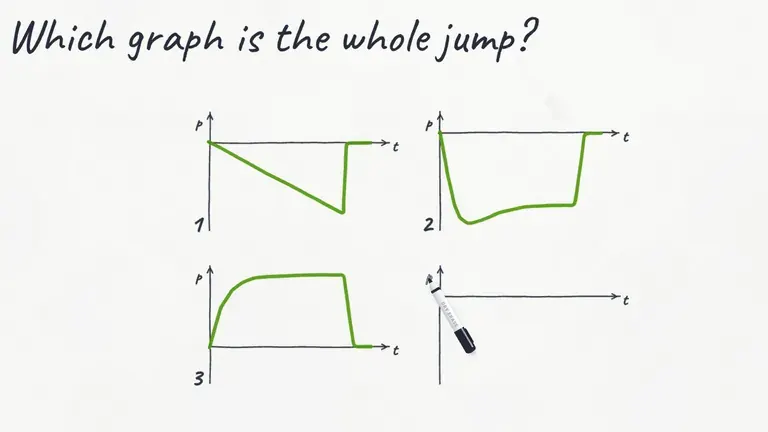
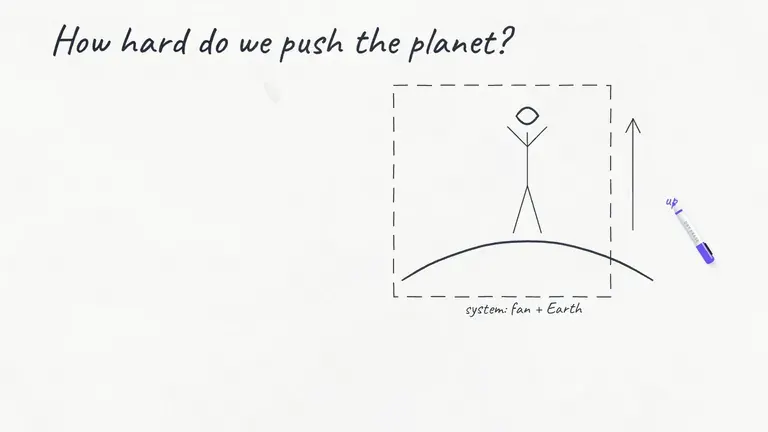

Question 2: Translation Between Representations (12 points)
What it looks like
The longest question. One situation, shown three or four ways: a drawing such as an energy bar chart or momentum arrows, a derivation, a graph, and then a part that asks whether two of them agree or what would change. In 2025 it followed a block sliding down a ramp into a spring. In 2026 it followed two disks colliding on a track, with momentum arrows, a derivation of one disk’s kinetic energy, and position-time lines for both disks and their center of mass.
How the points split
Both years: 3 for the drawing, 4 for the derivation, 3 for the graph and 2 for the final claim and its justification. The drawing points reward the right bars or arrows in the right places before they reward exact sizes, so first get right which quantities are zero and which way each arrow points.
Worked example: 2025 Question 2
The full question is in the 2025 PDF. Our worked response follows; use College Board’s scoring guidelines for the full point breakdown.
Open the 2025 released question, Question 2 for the prompt and diagrams. Our worked solution follows; the official scoring guidelines give the complete rubric.
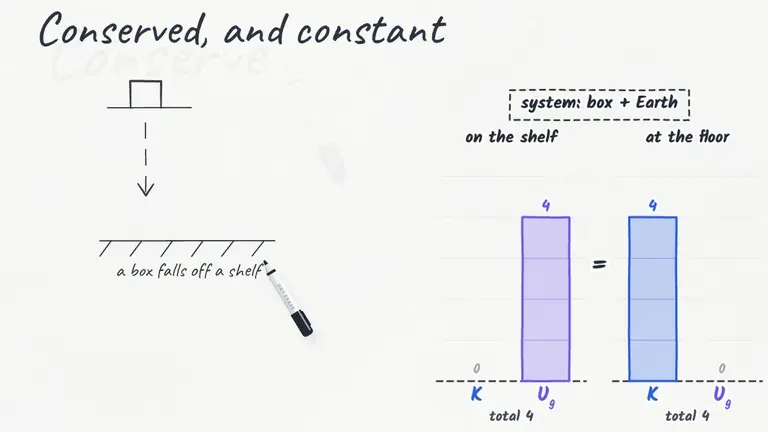
A: The total at is , and with no friction it stays . At : one bar, ; and are drawn as flat marks on the zero line. At : and ; is a flat mark on zero, since the spring hasn’t been touched.
B: . At release nothing moves and the spring is relaxed; at nothing moves and . So all the gravitational energy ends up in the spring: .
, where the drop is (the is measured along the ramp) and the compression is .
, so .
C: [Sketch: is a horizontal line at from to , labeled . is a straight line falling from at to zero at , labeled .]
D: . From to my line drops by , from to , while the curve rises by less than . So is smaller at than at . The total is constant, so is larger at , and the block is moving faster there even though it has started to squeeze the spring.
Why it works
- Where does come from? The block loses the same height for every it slides, and the full is worth , so drops by per . At there are of ramp left: .
- Touching the spring doesn’t mean slowing down. Just after contact the spring barely pushes back, and the pull of gravity along the ramp is still larger, so the block keeps speeding up for a while. The Chief Reader named the belief that touching a spring always slows a block as a common misconception.
- If you write a kinetic-energy term at a point where nothing moves, set it to zero in the next line. Correct responses that kept the term did exactly that.
Where students lost points
- Writing as .
- Using the distance along the ramp as the change in height instead of .
- Drawing total energy as a sloped line, when nothing removes energy from the system.
- Drawing as a curve, or as a mirror image of the curve, when height falls in proportion to distance along the ramp.
- Justifying the speed change with one energy instead of comparing the change in both.
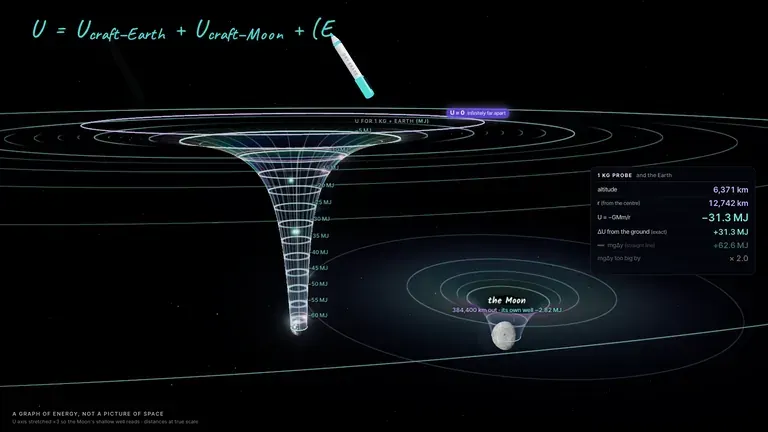
Question 3: Experimental Design and Analysis (10 points)
What it looks like
Two experiments on the same theme. In the first half you design one. You’re told what equipment you have and what to find, and you describe what to measure, how to reduce the uncertainty, what to graph and how the graph gives the answer. In the second half someone has already run a related experiment. You get their data and the equation that fits it, and you plot the data, draw a best-fit line and calculate the unknown from its slope. In 2025 the theme was balancing a meterstick, which is torque. In 2026 it was friction.
How the points split
Both years: 4 for the design (two for the procedure, two for the graph you would make), 4 for the graph you actually draw, and 2 for the slope and the final value. The final value only has to land inside an accepted range, so your line doesn’t need to be perfect. It does need to be your line, used correctly.
Worked example: 2026 Question 3
The full question is in College Board’s 2026 questions (PDF), scored by the 2026 scoring guidelines. The 2026 Chief Reader report hasn’t been published yet, so this one has no per-point averages.
Open the 2026 released question, Question 3 for the prompt and diagrams. Our worked solution follows; the official scoring guidelines give the complete rubric.
A(i): Measure the release height of the block above the horizontal surface, and the distance it slides along the horizontal surface before it stops. Both with the meterstick.
A(ii): Release the block from at least five different heights, and repeat each height three times, averaging the sliding distances.
B(i): Graph on the vertical axis against on the horizontal axis.
B(ii): The ramp has no friction, so the block reaches the flat with all of its energy , and friction removes all of it over the distance : , so . The slope of the line is .
C(i): Vertical axis: (m²/s²).
C(ii): [Points plotted at = 0.084, 0.144, 0.168, 0.240 and 0.270 m²/s², on a vertical scale from 0 to 0.30 m²/s² in steps of 0.05.]
C(iii): [One straight line drawn with a ruler through the middle of the points, passing near (0.20 m, 0.088 m²/s²) and (0.60 m, 0.275 m²/s²).]
D: Slope from two points on my line: m/s². The equation says slope , so .
Why it works
- The mass cancels in part B, which is why a meterstick alone is enough. When a design question gives you very little equipment, that is a hint that something cancels.
- Part C is linear without any tricks: against , because everything else in the equation is constant. The work is in part D, where you solve the slope for .
- The slope comes from two points on the line, far apart, not from two data points.
Where students lost points
The 2025 version (a meterstick balanced with a spring scale) has a full Chief Reader report, and its lessons hold for any year. The weakest points were saying how the slope gives the unknown (20%), relating the best-fit slope to the mass (28%) and landing in the accepted range (28%). Students also gave an axis a label without a unit or a unit without a label, joined the dots instead of drawing a best-fit line, plotted a reciprocal that made the graph curve, treated the spring scale reading as the block’s weight, and mixed up two distances with similar names.
The experimental design guide covers this question in depth: what each piece of lab equipment measures, how to linearize the equations on the reference sheet, and a worked solution to the 2025 question, with the official rubric linked.
Question 4: Qualitative/Quantitative Translation (8 points)
What it looks like
The shortest question. You make a claim about a situation and justify it in words, derive an equation for the same situation, and then show whether the equation agrees with your words. The course framework says a diagram can help you think here but earns no points of its own. In 2025 a block was let go underwater in fresh water and in salt water. In 2026 two toys with different rotational inertias were spun up by the same force pulling the same length of string.
How the points split
Both years: 1 for the claim, 2 for the justification, 3 for the derivation and 2 for showing that the two agree. The last two points are about functional dependence. One is for describing how the quantity in your equation depends on the variable in question, in words like “increases with,” “proportional to” or “in the denominator.” The other is for using that correctly to support your claim. The first of those is earned even if the use goes wrong, so always say how the variables depend on each other.
Worked example: 2025 Question 4
Full question: 2025 questions (PDF). The response is written for this page.
Open the 2025 released question, Question 4 for the prompt and diagrams. Our worked solution follows; the official scoring guidelines give the complete rubric.
A: . Two forces act on the block in each tank: its weight, pulling down, and the buoyant force, pushing up. The weight is the same in both tanks because it’s the same block. The buoyant force equals the weight of the water the block pushes aside. The block displaces the same volume in each tank, but salt water is denser, so the buoyant force is bigger in salt water. Same weight, bigger upward push: the net upward force is larger in salt water, and so is the acceleration.
B: . Taking up as positive: .
With : , so .
C: Consistent. In my expression goes up as goes up: is in the numerator of the first term, and the second term, , doesn’t depend on . Salt water has the larger , so it gives the larger acceleration, which is what I claimed in part A.
Why it works
- A2 is the point most students skipped. Acceleration depends on the net force, and the net force has two parts. Saying the buoyant force is bigger is only half the comparison until you say the weight stayed the same.
- In part B the two forces point opposite ways, so they subtract. Some students added them, and some treated the buoyant force as the only force.
- The symbol in is the Greek letter rho, density. It is not for momentum or for pressure.
Where students lost points
- Treating the buoyant force as the only force on the block.
- Saying a denser fluid slows the block more, without recognizing that it also pushes up harder.
- Reading as pressure or momentum, in both the words and the algebra.
- Starting from Bernoulli’s equation when the prompt said to start from Newton’s second law.
- Treating pressure as if it were a force.
- Drawing the buoyant force and gravity in the same direction.
The 2026 version asked which toy spins faster after the same force pulls the same length of string off each one. The same force over the same length of string does the same work on each toy, so the toy with the smaller rotational inertia ends up spinning faster. The derivation, from Newton’s second law in rotational form or from work and kinetic energy, gives , which shows falling as rises.
Spending the 95 minutes
In May 2027 you get 95 minutes for 40 points, a little under two and a half minutes a point. The course framework suggests a range for each question. The ranges add up to 85–105 minutes, so you can’t take the top of every range; decide on a plan before exam day.
| Question | Points | Suggested range | Plan |
|---|---|---|---|
| 1 Mathematical Routines | 10 | 20–25 min | 22 min |
| 2 Translation Between Representations | 12 | 25–30 min | 27 min |
| 3 Experimental Design and Analysis | 10 | 25–30 min | 25 min |
| 4 Qualitative/Quantitative Translation | 8 | 15–20 min | 16 min |
| Checking | 5 min |
- You can move between the four questions at any time during the section, so one stuck derivation doesn’t have to cost you the rest.
- In 2025 and 2026 the clock in Bluebook turned red with 5 minutes left, and proctors gave no time warnings. Set your own checkpoints: about 22, 49 and 74 minutes in.
- When a derivation stalls, go on to the next part. Claims, graphs and justifications are scored on their own.
- Spend the last five minutes on cheap points: a label on an axis or a sketched line, a missing unit, a final answer that still holds a symbol it shouldn’t, a claim you forgot to mark.
Practice with real questions
Only two exams in this format have been released, 2025 and 2026, so all eight questions are worth doing properly. Take one at a time with a timer, score it against the scoring guidelines one point at a time, and for a 2025 question, read the Chief Reader’s comments on it afterward.
| Exam | Type | What it’s about | Lessons |
|---|---|---|---|
| 2025 Q1 | Mathematical Routines | A block dropped onto a moving cart: momentum and kinetic energy when objects stick | 4.3, 4.4 |
| 2025 Q2 | Translation Between Representations | A block slides down a ramp into a spring: bar charts, the spring constant, energy against position | 3.3, 3.4 |
| 2025 Q3 | Experimental Design and Analysis | A meterstick balanced with a spring scale: a block’s mass, then the meterstick’s | 5.3, 5.5 |
| 2025 Q4 | Qualitative/Quantitative Translation | A block let go underwater in fresh and salt water: buoyancy and acceleration | 8.1, 8.3 |
| 2026 Q1 | Mathematical Routines | A droplet from a fountain: velocity graphs, launch speed from maximum height, volume flow rate, a smaller nozzle | 1.5, 8.4 |
| 2026 Q2 | Translation Between Representations | Two disks collide on a track: momentum arrows, kinetic energy, position-time lines with the center of mass | 2.1, 4.3 |
| 2026 Q3 | Experimental Design and Analysis | Friction twice: sliding distance against release height, then speed through a photogate on a rough ramp | 2.7, 3.4 |
| 2026 Q4 | Qualitative/Quantitative Translation | Two toys spun up by pulling string: the same force, different rotational inertias | 5.6, 6.2 |
The official files: 2026 questions and scoring guidelines; 2025 questions, scoring guidelines and Chief Reader report. The reference sheet is the one you get on exam day, so practice with it next to you.
For the equations and ideas behind all eight questions in one place, use the AP Physics 1 cheat sheets. For the whole exam, multiple choice included, see the AP Physics 1 exam guide, and to turn a practice score into an estimated AP score, use the score calculator.
Sources
- AP Physics 1: Algebra-Based Course and Exam Description: exam format, free-response types, suggested times and task verbs (PDF)
- AP Physics 1 Course and Exam Description Clarifications and Corrections, fall 2026: May 2027 timing (PDF)
- AP Physics 1: Algebra-Based exam page, AP Central: exam date, format and hybrid digital delivery
- 2026 AP Physics 1 Free-Response Questions (PDF)
- 2026 AP Physics 1 Scoring Guidelines (PDF)
- 2025 AP Physics 1 Free-Response Questions (PDF)
- 2025 AP Physics 1 Scoring Guidelines (PDF)
- 2025 AP Physics 1 Chief Reader Report: per-point averages and common errors (PDF)
- 2025 AP Physics 1 Scoring Statistics (PDF)
- 2025 AP Physics 1 Question 3 sample responses and scoring commentary (PDF)
- 2024 AP Physics 1 Free-Response Questions: the old five-question format (PDF)
- AP Physics 1 past exam questions, AP Central
- AP Physics 1 reference sheet, mechanics and fluids (PDF)