
The official AP Physics 1 reference table
College Board’s name for it is the Table of Information, and the PDF is titled AP Physics 1 Exam Reference Information. Students call the same document the reference table, the formula sheet or the equation sheet. The version for the May 5, 2027 exam is this PDF on AP Central: a cover, a page of constants and math, and a page of 48 equations headed Mechanics and Fluids. It’s the sheet AP Central links for exam day, dated 2025, and the same one printed at the back of the current Course and Exam Description.
If the copy you’re studying from has an Electricity table, , or the mass of a proton, it’s out of date. Search engines still serve a 2020 sheet with circuits and waves on it, and the sheet printed in the May 2024 exam had density but none of the other fluids lines. What changed lists the differences.
Page 2 is the one you’ll use most. Its 48 equations sit in one box, in two columns, with no headings. The left column runs from kinematics through forces, energy and momentum. The right column covers rotation, then oscillations, then fluids. Each column has its own key to the symbols, and the two keys disagree about one letter: means power on the left and pressure on the right.
One number needs a note the sheet doesn’t give. The sheet prints m/s², but the course framework says that when a question needs a number for , it uses 10 m/s², and correct work with 9.8 or 9.81 isn’t penalized. The examples below use m/s².
Constants, prefixes, units and trig values
The top of page 1 is reference data: three constants, the metric prefixes, the unit symbols and a table of trig values.
Universal gravitational constant
sets the strength of gravity between any two masses, anywhere. The two units are the same thing written two ways, because a newton is a kg·m/s². You need only with the two-body equations, and : planets, moons, satellites, and a planet’s field strength, .
Don’t mix up and . never changes. is the field strength at one place, and it shrinks as you move away from a planet.
Two 1,000 kg spheres with centers 2 m apart attract each other with N, which is why you never notice gravity between everyday objects.
One atmosphere
The sheet’s rounded value for one atmosphere, in pascals (newtons per square meter); actual air pressure varies. It is the in when a liquid is open to the air.
Air presses on both sides of most things, so it often cancels. Add it when a question asks for absolute pressure. Leave it out for gauge pressure, and for the net force on a wall that has air on its other side.
Ten meters under fresh water, the pressure is Pa, about two atmospheres.
The two meanings of g
The sheet lists twice on purpose. As 9.8 m/s² it is the acceleration of anything in free fall near Earth’s surface. As 9.8 N/kg it is the gravitational field strength, the force of gravity on each kilogram. A newton per kilogram is the same unit as a meter per second squared, so the number doesn’t change, and the second meaning is the one behind weight, .
is a positive magnitude. The direction comes from your axes: with up as positive, a falling object has . Put that minus sign in once; adding a second one by habit flips your answer.
A 2 kg bag weighs N, and once dropped it gains 10 m/s of downward speed every second.
Prefixes and unit symbols
The prefixes run from tera () down to pico (). The unit symbols are hertz (Hz), joule (J), kilogram (kg), meter (m), newton (N), pascal (Pa), second (s) and watt (W). The sheet doesn’t spell out how they relate: 1 N = 1 kg·m/s², 1 J = 1 N·m, 1 W = 1 J/s, 1 Pa = 1 N/m² and 1 Hz = 1/s.
Squared and cubed units square and cube the prefix too. A centimeter is m, but a square centimeter is m² and a cubic centimeter is m³, and fluids questions depend on it. One more: torque is measured in N·m and never written in joules, even though the units match.
A 250 cm³ rock has a volume of m³.
Trig values for common angles
The table gives sine, cosine and tangent at 0°, 30°, 37°, 45°, 53°, 60° and 90°. The unusual ones, 37° and 53°, are rounded angles of a 3-4-5 right triangle, so and . They let you work with those angles without a calculator.
The 3-4-5 values are rounded: the true sine of 37° is about 0.602, so a calculator answer can differ from a table answer in the third digit. The table is also a quick check that your calculator is in degree mode. If doesn’t come out as 0.5, it’s in radians.
A ball launched at 10 m/s at 37° above the horizontal starts with m/s and m/s.
The four conventions
A box on page 1 lists what every question assumes unless it says otherwise. Each assumption deletes something from the problem, and a question that switches one off is telling you where the physics is.
- The frame of reference is inertial. Measure from the ground, or from anything moving at constant velocity, and Newton’s laws work as written. There is no centrifugal force to draw on a free-body diagram.
- Air resistance is negligible. A projectile has no horizontal acceleration and a vertical acceleration of downward, and mechanical energy is conserved in free fall. When a question includes drag, the acceleration generally changes as the speed does, and the course asks you to reason about that motion in words and sketches, not to calculate it.
- Springs and strings are ideal. An ideal spring has no mass and follows Hooke’s law exactly. An ideal string has no mass and doesn’t stretch, so a taut string constrains the connected objects’ motion. In the usual setup with a fixed pulley, their speeds match; a moving pulley can give a different speed ratio. Tension is uniform along a free massless segment. That changes when the string runs over a pulley with rotational inertia that is speeding up or slowing down: the tensions on its two sides differ, because the difference between them exerts the net torque that changes the pulley’s spin.
- Fluids are ideal and pipes are full. An ideal fluid is incompressible and has no viscosity, which is what lets you use continuity and Bernoulli’s equation. A full pipe means the same volume passes every point each second.
Geometry and trigonometry
The bottom of page 1 holds area, volume and right-triangle formulas, with a circle that defines arc length. In physics they mostly do three jobs: finding the area under a graph, finding the volume an object takes up, and splitting a vector into components.
Rectangle and triangle
is the base and the height. In AP Physics 1 these are mostly for areas under graphs: the area under a velocity–time graph is the displacement, under a force–time graph the impulse, and under a graph of the force along the motion against position, the work.
Area below the time axis counts as negative. A cart that rolls forward and then back has a smaller displacement than the two areas added together.
A car that speeds up steadily from 0 to 20 m/s in 10 s covers the triangle’s area, m.
Circle and arc length
is the area of a circle of radius , its circumference, and the length of the arc swept by an angle . You need for the cross-section of a pipe or piston, and for one trip around a circle. is the root of every link between turning and moving, including and rolling.
works only with in radians. One revolution is rad, not 360.
A wheel of radius 0.3 m that turns twice sweeps rad, so a point on its rim travels m.
Solids
Volumes () and surface areas () of a box, a cylinder and a sphere. Volume is the one you’ll use: it turns density into mass () and gives the volume of fluid an object pushes aside.
Don’t mix up a radius and a diameter, and convert centimeters to meters before you cube them.
A ball of radius 0.1 m held under water displaces m³, so the water pushes up on it with about 42 N.
Right triangle
is the hypotenuse, the side opposite the angle , and the side next to it, as the small diagram on the sheet shows. You use these to split a vector into components and to put components back together.
“The part goes with cosine” is a habit, not a rule; it depends on which angle you’re given. On a ramp tilted at , gravity’s component down the slope is and its component into the slope is .
A 5 kg box on a frictionless 30° ramp is pulled down the slope by N, so it accelerates at 5 m/s².
Kinematics, forces and circular motion
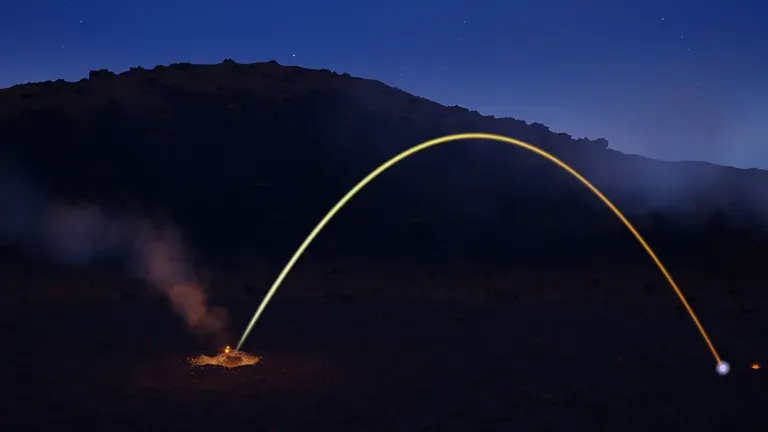
The left column of page 2 opens with motion at constant acceleration and then the forces of Unit 2. The three kinematics equations are written for the direction; for vertical motion, use the same equations with , and with up as positive, .
Velocity at constant acceleration
is the velocity at time , the velocity at , and the acceleration, all along one axis and all with signs. It holds only while the acceleration is constant, as in free fall or for a cart rolling down a ramp.
The mistake is using it when the acceleration changes, as it does for a mass on a spring or anything slowed by drag. If the acceleration isn’t constant, none of the three kinematics equations is the tool; oscillations have their own lines in the right column.
A ball thrown straight up at 15 m/s has , so it stops rising at s.
Position at constant acceleration
is the position at time and the position at . Use it when the question gives you a time or asks for one.
is a displacement, not a distance. A ball thrown up and caught at the same height has , however far it traveled. Copy the ½ and the square on from the sheet; they’re the parts that go missing when you write it from memory.
A cart starting from rest with m/s² moves m in 3 s.
Velocity and displacement, without time
The same motion with time taken out. Reach for it when the question never mentions time.
Signs matter twice: the displacement and the acceleration both carry them, and the square root at the end gives a speed, so you choose the direction from the physics. For a projectile, work with components. At the top of its path , but hasn’t changed.
The first free-response question in 2026 began with a fountain droplet rising to a height . At the top, , so : for m, that’s 6 m/s.
Center of mass
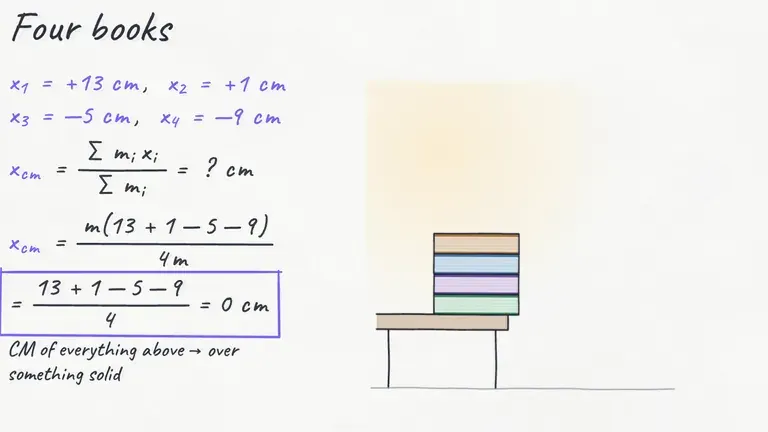
The center of mass is the mass-weighted average position of a system’s parts. is each part’s mass and its position, measured from one origin you choose. In two dimensions, do and separately. The course asks you to calculate it for up to five particles, or for shapes symmetric enough that you can see where it is.
A plain average of the positions ignores the masses and puts the center in the wrong place. With two objects, the center of mass always sits closer to the heavier one.
A 2 kg mass at and a 6 kg mass at m have m.
Newton’s second law for a system
The acceleration of a system’s center of mass is the net external force divided by the system’s total mass. Forces between parts of the system cancel in pairs (Newton’s third law), so you can draw the system boundary to make them disappear. Apply it one axis at a time.
is not a force. Never draw it on a free-body diagram, and never add a force for “motion” or “inertia.” Only real pushes and pulls go into .
A 10 N pull on a 3 kg block that tows a 2 kg block across a frictionless floor gives both m/s², and the string pulls the 2 kg block with N.
Universal gravitation
The size of the gravitational pull between masses and whose centers are a distance apart. Each pulls the other with the same size of force. Use it for planets, moons and satellites; near Earth’s surface it comes down to .
runs from center to center, so a satellite at height above a planet of radius has . And it’s an inverse square: doubling cuts the force to a quarter, not a half.
A satellite at twice Earth’s radius from Earth’s center feels a quarter of the gravitational force it would feel on the ground.
Friction
Friction can be as large as the coefficient of friction times the normal force , but no larger. The “less than or equal to” is about static friction, which takes whatever value stops the surfaces slipping, up to . Sliding (kinetic) friction is fixed at , a line the sheet doesn’t write out for you.
Two mistakes to avoid. One is setting static friction equal to when nothing is about to slip. The other is assuming : on a ramp it’s , and a push or pull at an angle changes it again.
A 5 kg box on a level floor with can be held by up to N of static friction. Push it with 12 N and it stays put, with a friction force of 12 N.
Spring force (Hooke’s law)
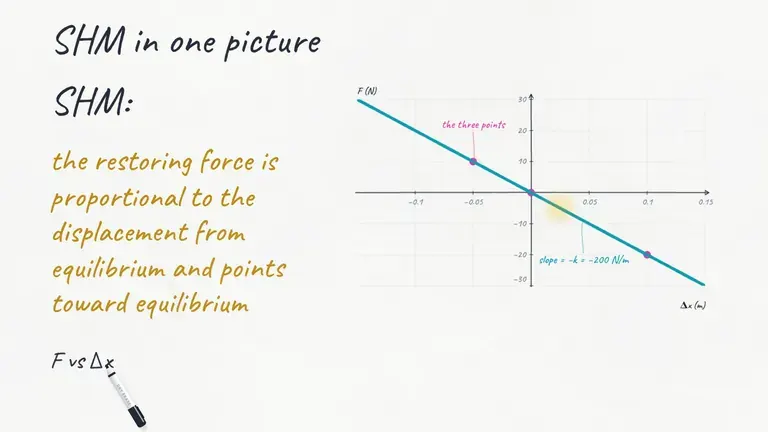
An ideal spring pushes or pulls with a force proportional to how far it is stretched or compressed, , measured from its relaxed length. is the spring constant in N/m; a stiffer spring has a bigger . The minus sign says the force points back toward the relaxed length.
is the change from the spring’s natural length, not its total length and not the distance from some other marked point.
A spring with N/m holding a 1 kg mass at rest is stretched m.
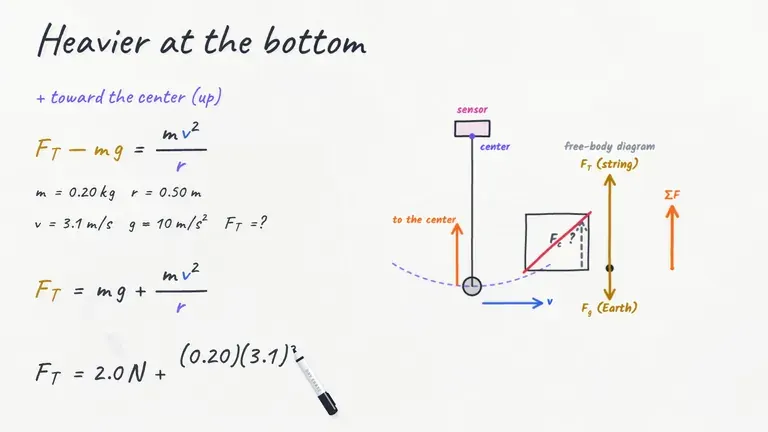
Centripetal acceleration
Anything moving on a circle of radius at speed accelerates toward the center at , even at constant speed, because its direction keeps changing.
There is no separate centripetal force. On a free-body diagram, draw only the real forces (tension, gravity, normal, friction), then set the part of the net force that points to the center equal to . That step, , isn’t printed on the sheet.
A car rounding a flat curve of radius 50 m at 20 m/s needs m/s², which friction can supply only if is at least 0.8.

Energy, power and momentum
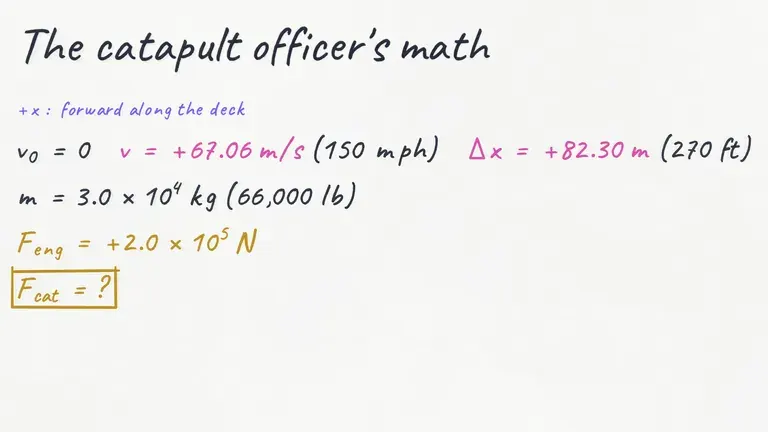
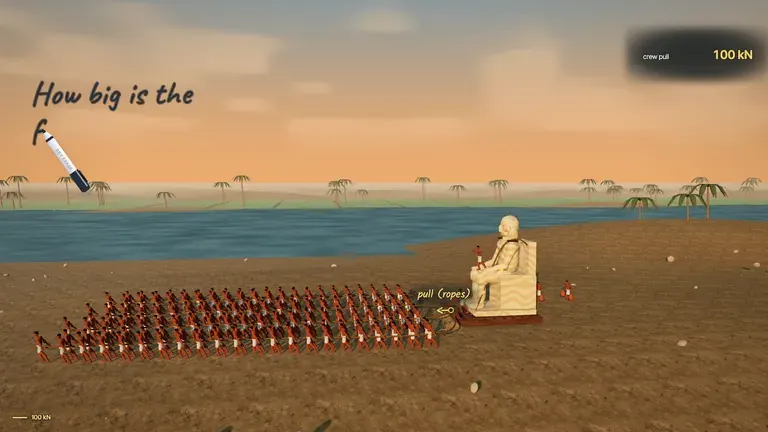
The rest of the left column covers Units 3 and 4. Energy and momentum laws start many free-response derivations, so you’ll copy these lines often.
Kinetic energy
Translational kinetic energy, in joules, of a mass moving at speed . It’s a scalar and never negative.
Because is squared, doubling the speed quadruples . And a change in kinetic energy is , not .
A 2 kg ball has 9 J at 3 m/s and 36 J at 6 m/s.
Work done by a constant force
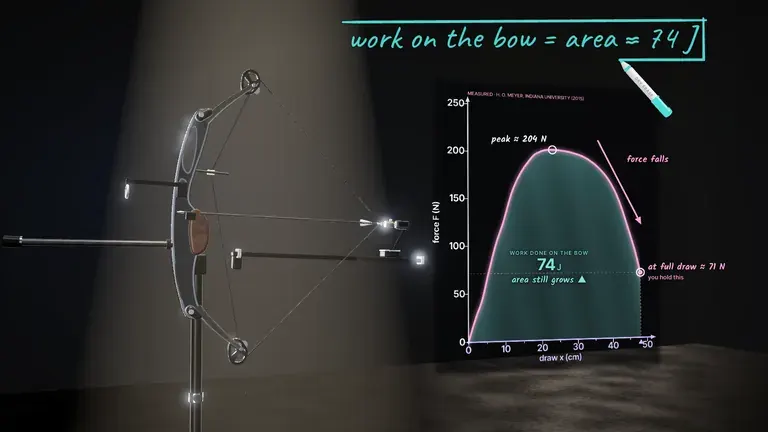
Work is the component of a force along the displacement, , times the displacement ; is the angle between the force and the displacement. Positive work adds energy, negative work takes it away, and a force at right angles to the motion, like the normal force on a level floor, does none.
Use the angle between the force and the motion, whatever the diagram shows. For gravity on a block sliding down a ramp tilted at , that angle is , not . And this is for a constant force only: for a changing one, work is the area under a graph of the force along the motion against position.
Pulling a sled 10 m with 50 N at 37° above the ground does J of work.
Work–energy theorem
An object’s change in kinetic energy equals the total work done on it by all the forces, each with its sign.
A 2 kg block sliding at 6 m/s ( J) across 4 m of floor against 5 N of friction loses 20 J, leaving 16 J and a speed of 4 m/s.
Spring potential energy
The energy stored in an ideal spring stretched or compressed by from its relaxed length. A stretch and a compression of the same size store the same energy.
A spring with N/m compressed 0.1 m stores J.
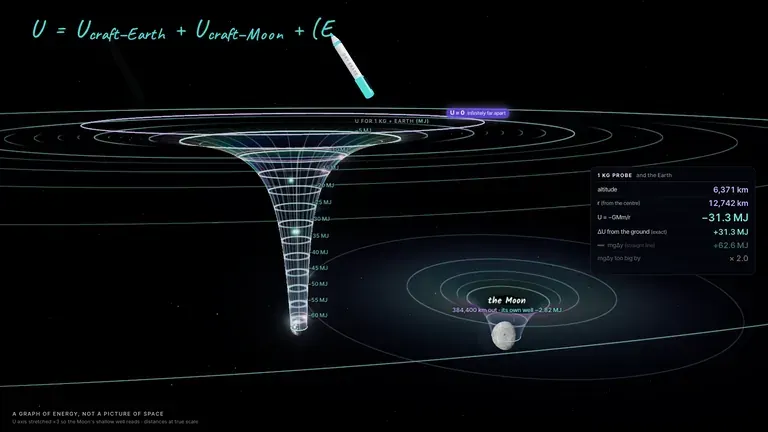
Gravitational potential energy of two bodies
The potential energy of two masses whose centers are apart. It’s defined as zero when they’re infinitely far apart, which makes it negative at every real distance. Use it for orbits and for escaping a planet.
Keep the minus sign, and don’t use for big changes in height, where itself changes. Moving the masses apart makes less negative, which means it increases.
Raising a satellite from to changes from to , an increase of .
Gravitational potential energy near Earth
The change in an object–Earth system’s potential energy when the object’s height changes by , close enough to the surface that stays constant.
A 3 kg box sliding 2 m down a 30° ramp drops 1 m, so J.
Average power
Power is how fast energy is transferred: work done, or energy changed, per second, measured in watts (J/s). On the left side of the sheet means power; on the right side the same letter means pressure.
Power isn’t energy and it isn’t force. Two people who carry the same box up the same stairs do the same work, and the faster one uses more power.
Lifting a 50 kg crate 2 m at constant speed takes 1,000 J; doing it in 4 s takes 250 W.
Instantaneous power
The power a force delivers at one instant: its component along the velocity times the speed at that moment. is the angle between the force and the velocity.
Use the speed at that instant, not an average, and don’t drop the angle. A force at right angles to the motion delivers no power at all.
A rope pulling a cart forward with 200 N while the cart moves at 3 m/s delivers 600 W.
Momentum
Mass times velocity, in kg·m/s. Unlike kinetic energy, momentum is a vector, so its direction is part of the answer.
Momentum changes when an object turns around, even if its speed doesn’t. A 0.5 kg ball that hits a wall at 4 m/s and bounces straight back at 4 m/s changes its momentum by kg·m/s, not zero.
A 1,200 kg car at 15 m/s has a momentum of 18,000 kg·m/s.
Net force and momentum
Newton’s second law in its momentum form: the net force equals the rate of change of momentum. For a constant mass it becomes the familiar . On a graph of momentum against time, the slope is the net force.
A 0.2 kg ball whose momentum changes by 3 kg·m/s in 0.01 s felt an average net force of 300 N.
Impulse
Impulse is the average force times the time it acts, in N·s, and it equals the change in momentum. It’s also the area under a force–time graph.
For a fixed change in momentum, a longer time means a smaller force: that’s the physics of an airbag. And the impulse that equals an object’s comes from the net force, not from one force among several.
Stopping that 18,000 kg·m/s car in 0.1 s takes an average force of 180,000 N; stretching the stop to 1 s cuts it to 18,000 N.
Velocity of the center of mass
A system’s total momentum divided by its total mass. With no net external force, the total momentum is constant, so this velocity doesn’t change, however hard the parts collide or push apart.
A 2 kg cart at 3 m/s hits a resting 1 kg cart and they stick: m/s before the crash, so the pair moves off at 2 m/s.

Rotation
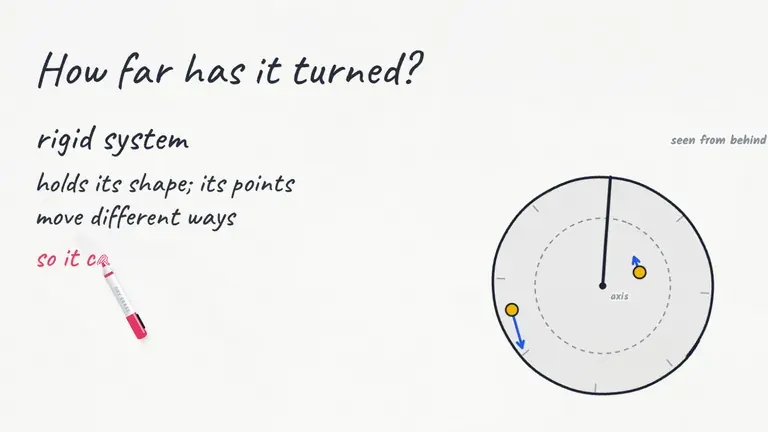
The right column starts with rotation, and most of it mirrors the left column: angle for position, angular velocity for velocity, angular acceleration for acceleration, torque for force, rotational inertia for mass. If you know the straight-line version of an equation, you know the shape of the rotational one. Angles here are in radians. Eight of these fifteen lines arrived with the 2025 redesign; what changed lists them.
Angular velocity at constant angular acceleration
is the angular velocity in rad/s at time , its value at , and the angular acceleration in rad/s², which has to be constant.
Convert revolutions per minute before you start: multiply by and divide by 60.
A wheel starting from rest with rad/s² reaches 20 rad/s after 5 s.
Angular position at constant angular acceleration
is the angular position at time , so is how far the object has turned, in radians.
To count turns, divide the radians by . Degrees or revolutions inside this equation give wrong answers.
That wheel turns rad in 5 s, a little under 8 revolutions.
Angular velocity and angle, without time
The rotational partner of , for when time isn’t given or asked.
When something is slowing down, has the opposite sign to . Leave the sign out and the equation describes something speeding up.
A fan spinning at 30 rad/s that slows at 3 rad/s² turns rad before it stops.
Tangential speed
A point a distance from the axis of a turning object moves around its circle at speed , with in rad/s.
Every point on a rigid object shares the same , but not the same : the farther out, the faster.
On a merry-go-round turning at 2 rad/s, a rider 1.5 m from the center moves at 3 m/s and one 0.5 m out moves at 1 m/s.
Tangential acceleration
The part of a point’s acceleration along its circular path, the part that changes its speed. It comes from angular acceleration.
Don’t confuse it with centripetal acceleration, which points to the center and changes the direction of motion. A wheel spinning at constant has , while every point on its rim still accelerates toward the center.
A disk with rad/s² gives a point 0.5 m from the axis m/s².
Torque
Torque measures how hard a force twists something about an axis, in N·m. is the distance from the axis to where the force acts, the angle between that line and the force, and the lever arm: the perpendicular distance from the axis to the force’s line of action.
A 20 N push at right angles to a door, 0.8 m from the hinges, gives 16 N·m. The same push at 30° to the door gives N·m.
Rotational inertia of point masses
Rotational inertia, in kg·m², is how hard something is to start or stop spinning. Each mass counts by the square of its distance from the axis, so where the mass sits matters more than how much there is. The course asks you to add up at most five objects this way, and formulas for rods, disks and spheres come in the question when you need them.
is measured from the axis of rotation, which isn’t always the center. Move the axis and changes.
Two 1 kg masses on the ends of a light 1 m rod have kg·m² about the middle, but kg·m² about one end.
Parallel-axis theorem
If you know an object’s rotational inertia about an axis through its center of mass, this gives it about any parallel axis a distance away. is the object’s total mass.
Start from the axis through the center of mass, and only move to a parallel axis. Starting from any other axis gives a wrong answer.
A uniform rod has , which a question would give you. About one end, , so .
Newton’s second law for rotation
For an object whose rotational inertia stays the same, net torque divided by rotational inertia gives angular acceleration, just as net force divided by mass gives acceleration.
Take every torque and the rotational inertia about the same axis. In pulley problems, a pulley with rotational inertia needs a net torque to speed up, so the string tensions on its two sides aren’t equal.
A disk with kg·m² and a net torque of 1 N·m has rad/s².
Rotational kinetic energy
The kinetic energy of spinning, in joules.
A rolling object has both kinds at once: for its center moving and for its spin about the center, and the sheet doesn’t add them for you. Leave out the spin and a ball rolling down a ramp seems to reach the bottom as fast as a block sliding without friction. It doesn’t, because part of its energy goes into turning.
A disk with kg·m² spinning at 4 rad/s has J.
Work done by a torque
A constant torque turning an object through an angle does this much work. For a torque that changes, the work is the area under a torque–angle graph.
has to be in radians: three turns is rad, not 3 and not 1,080.
A 10 N·m torque applied through 3 full turns does J of work.
Angular momentum of a rigid object
The angular momentum, in kg·m²/s, of an object spinning about an axis. With no net external torque it stays constant.
What stays constant is , not . A skater who pulls her arms in lowers her , so her goes up. Her kinetic energy goes up too, paid for by the work her muscles do.
If drops from 4 to 1 kg·m², a spin of 2 rad/s becomes 8 rad/s.
Angular momentum of a moving point mass
An object moving past a point has angular momentum about that point. is the distance from the point to the object and the angle between and the velocity, so is the perpendicular distance from the point to the object’s path.
Moving in a straight line doesn’t mean zero angular momentum. Only a path aimed straight through the point has none.
A 2 kg ball moving at 3 m/s on a path that passes 0.5 m from a pivot has kg·m²/s about the pivot.
Angular impulse
A net external torque acting for a time changes angular momentum by ; if the torque varies, use its average, or the area under the torque–time graph. It’s the rotational version of impulse.
Only external torques change a system’s angular momentum. Torques between parts of the system cancel.
A 0.5 N·m torque applied for 4 s adds 2 kg·m²/s of angular momentum.
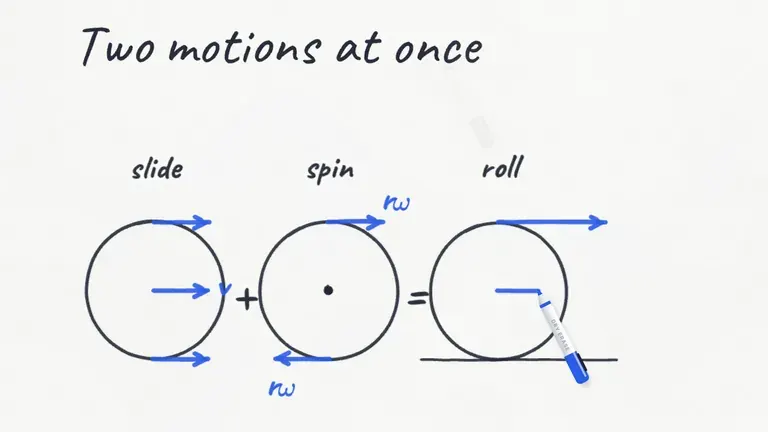
Rolling without slipping
A wheel or ball of radius that rolls without slipping moves its center forward one arc length for each angle it turns. The same link gives and for the center.
It fails the moment the object skids, like a bowling ball just after it leaves the hand. The course asks you to describe slipping in words, not to calculate it.
A wheel of radius 0.35 m that turns through 10 rad rolls 3.5 m.

Oscillations
Five lines cover simple harmonic motion: a mass on a spring, or a pendulum swinging through a small angle.
Period and frequency
is the time for one full cycle, in seconds; is the number of cycles per second, in hertz. Each is the reciprocal of the other, and the same pair describes circular motion.
A mass bobbing 4 times a second has Hz and s.
Period of a mass on a spring
The period of an object of mass on an ideal spring of constant . More mass makes it slower and a stiffer spring makes it faster. The period doesn’t depend on the amplitude or on gravity: a mass hanging from a vertical spring has the same period as one on a horizontal spring.
Use the total mass that moves. On the 2023 exam, when a block was dropped onto a cart already on a spring, some answers used only the added mass, , instead of the new total, .
A 0.5 kg mass on a spring with N/m has s; four times the mass doubles it.
Period of a pendulum
The period of a simple pendulum of length swinging through a small angle. A longer string makes it slower, and so does a smaller : the same pendulum swings more slowly on the Moon.
The mass of the bob isn’t in the formula, so a heavier bob has the same period. Neither is the amplitude, but only while the swing stays small; for wide swings the formula stops being accurate.
A 1 m pendulum with m/s² has s.
Position in simple harmonic motion
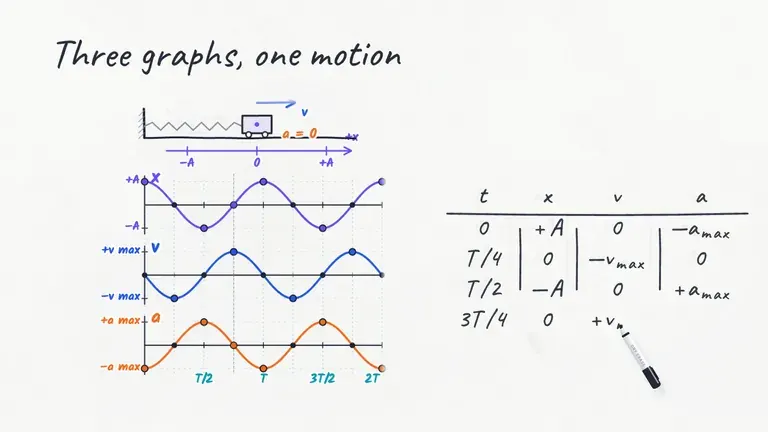
is the displacement from equilibrium at time , the amplitude (the largest displacement) and the frequency. Use cosine when the object starts at , released from rest at the end of its swing, and sine when it starts at equilibrium moving in the positive direction.
The angle is in radians, so put your calculator in radian mode here. Angles in force and torque questions usually come in degrees, so switch back afterward.
A mass released from m with Hz is at m a quarter-second later: half a cycle on, at the other end of its swing.
Fluids
The last seven lines are the Fluids unit, which joined the course in the 2024 revision and carries 10–15% of the multiple-choice score. The 2025 Chief Reader report called it a newer addition to the course and flagged a problem you can fix in a minute: students reading (rho, density) as the letter , and taking it for pressure or momentum.
Density
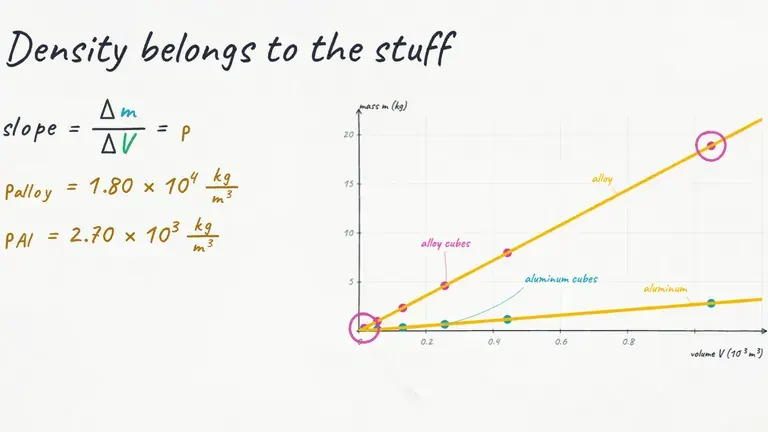
Mass per unit volume, in kg/m³. Fresh water is about 1,000 kg/m³. An object denser than a fluid sinks in it, and a less dense one floats.
is the Greek letter rho, not . When you justify an answer, write the word “density” so a reader can’t mistake it.
A 0.5 kg object with a volume of m³ has kg/m³, so it sinks in water.
Pressure
Pressure is the perpendicular force on a surface divided by the surface’s area, in pascals (N/m²). It’s a scalar: it has no direction of its own, and it pushes at right angles on any surface it meets.
A 600 N student standing on 0.04 m² of shoe sole presses on the floor with 15,000 Pa.
Pressure at a depth
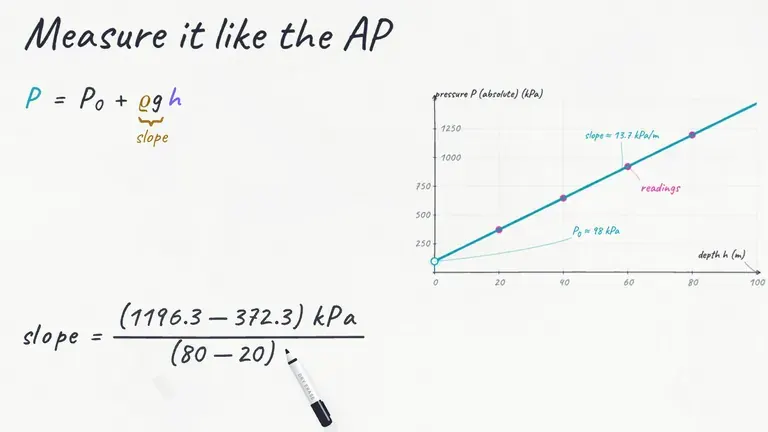
The absolute pressure at a depth below the surface of a fluid at rest, of density , where the pressure at the surface is (one atmosphere, if it’s open to the air).
is the vertical depth below the surface, not the distance along a slanted tube and not the height above the bottom. The shape of the container doesn’t matter, only the depth.
Five meters down in a swimming pool, Pa.
Gauge pressure
Gauge pressure is the pressure above atmospheric pressure. For a liquid open to the air it is , the liquid’s own contribution. A tire gauge reads gauge pressure.
Don’t mix gauge and absolute pressure in one equation. Decide which one the question wants and stick with it.
At that 5 m depth, the gauge pressure is Pa.
Buoyant force
The upward force a fluid exerts on an object equals the weight of the fluid the object pushes aside. is the density of the fluid, not the object, and is the volume of the object below the surface.
A block of volume 0.002 m³ held completely under fresh water feels N, whatever it’s made of.
Continuity
For an ideal fluid filling a pipe, the volume passing each point every second is the same everywhere, so where the pipe narrows, the fluid speeds up. is the cross-sectional area and the fluid’s speed. The product is the volume flow rate, in m³/s.
Water moving at 2 m/s in a hose of radius 1 cm leaves a nozzle of radius 0.5 cm at 8 m/s.
Bernoulli’s equation
Conservation of energy for an ideal fluid in steady flow, written per unit volume. It compares two points along the same flow: is the pressure, the height and the speed at each. Along that flow, at the same height, where the fluid moves faster its pressure is lower.
Use the same kind of pressure on both sides (absolute or gauge), and measure both heights from one level. And read the prompt: in 2025, some answers to a question that said to start “with Newton’s second law” began with Bernoulli’s equation instead.
Water leaking from a hole 0.8 m below the open surface of a wide tank has air pressure at both points and almost no speed at the top, so it leaves at m/s.
Using the sheet on a real exam question
This 2025 derivation is two lines from the sheet joined by a conservation law, with two substitutions. The worked solution below shows those steps; use the linked official rubric for its four points.
Open the 2025 released question, Question 2, part B for the prompt and diagrams. Our worked solution follows; the official scoring guidelines give the complete rubric.
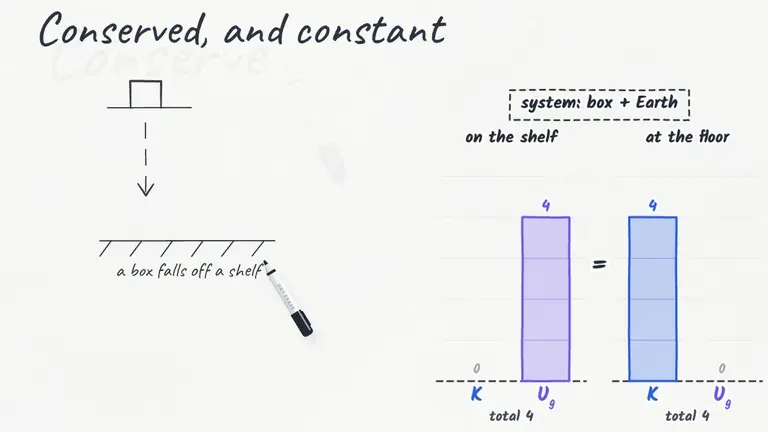
Energy of the block–spring–Earth system is conserved: .
The block is at rest at both instants, so there’s no kinetic energy at either end. At release the spring is relaxed, and at the stop the block is lower. So the gravitational energy lost becomes spring energy: , both terms copied from the sheet.
The block drops , and the spring compresses :
Why it works
- Both energy terms come straight off the sheet, and , and the law joining them is yours. The rest is two substitutions.
- The brackets in are on the sheet. Keep them when you substitute and becomes .
- A correct final expression for on its own earned three of the four points: equating the energies, the substitution and the answer. Only the conservation-of-energy point needed the derivation.
What the formula sheet leaves out
The sheet gives relationships. It doesn’t say which law to start from, and the course framework uses more equations than the sheet prints; in its own words, “Not all equations in this course framework appear on the equation sheet.” These are the ones to bring with you.
| What you need | Write it as | Where |
|---|---|---|
| Average velocity and acceleration | , | Topic 1.2 |
| Relative velocity, in one dimension | velocity seen from the ground = velocity relative to the moving frame + the frame’s velocity | Topic 1.4 |
| Balanced forces and torques | , | Topics 2.4, 5.5 |
| Weight, and away from Earth | , | Topic 2.6 |
| Kinetic friction and the static limit | while sliding; | Topic 2.7 |
| Net force in circular motion | inward part of the net force ; at constant speed; at the top of a loop at the slowest possible speed, | Topic 2.9 |
| Circular orbits (Kepler’s third law) | Topic 2.9 | |
| Conservation of mechanical energy | with no outside work and no mechanical energy turned into thermal energy or sound: | Topic 3.4 |
| Conservation of momentum | with no net external force: | Topic 4.3 |
| Collision types | elastic: total unchanged; inelastic: total decreases; perfectly inelastic: the objects stick and share one velocity | Topic 4.4 |
| Angular velocity and period | , so for steady rotation | Topic 5.1 |
| Conservation of angular momentum | with no net external torque, total stays constant; for one object changing shape, | Topic 6.4 |
| Rolling without slipping | , , | Topic 6.5 |
| Escape speed | Topic 6.6 | |
| Simple harmonic motion | restoring force , with measured from equilibrium; | Topics 7.1, 7.4 |
| Volume flow rate | Topic 8.4 | |
| Torricelli’s theorem | Topic 8.4 | |
| Graph slopes and areas | slope of – is ; slope of – is ; slope of – is ; area under – is ; area under – is the impulse; area under – is the work | Topics 1.3, 3.2, 4.2 |
Two things you can stop worrying about. You don’t need formulas for the speeds after an elastic collision: the course framework’s collision boundary says you won’t have to solve the simultaneous collision equations, though you may be asked to set them up. And you don’t need the rotational inertia of a rod, disk, hoop or sphere, because the question gives it when it matters.
The unit cheat sheets go further on each topic.
What changed from the old sheet
The sheet changed with the course. The course framework that took effect in fall 2024, first tested in May 2025, added the Fluids unit, gave rotation two units of its own, and came with a new sheet. Here it is next to the sheet printed in the May 2024 exam.
| May 2024 exam | Current sheet | |
|---|---|---|
| Fluids | density only, | adds pressure, pressure at depth, gauge pressure, buoyant force, continuity and Bernoulli’s equation |
| Center of mass | nothing | and |
| Rotation | two rotational kinematics equations, torque, , , | adds , , , , , , , |
| Newton’s second law | and | written for a system: and |
| Work and power | ; | ; adds ; ; adds |
| Momentum and impulse | ; | ; ; |
| Springs | , | , |
| Oscillations | ; cosine form only | ; cosine and sine forms |
| Gravity | as an equation | equation gone; N/kg listed as a constant |
| Constants | masses of the proton, neutron and electron, electron charge, speed of light, Coulomb’s constant, , | (now also in N·m²/kg²), one atmosphere, in two forms |
| Friction | , same meaning | |
| Symbol keys | one key; “radius or separation,” “height,” “work done on a system” | a key for each column; is power on the left and pressure on the right; adds , , , area as a meaning of ; “radius or distance,” “vertical position” |
| Unit symbols | also ampere, kelvin, coulomb, volt, ohm and degree Celsius | adds pascal; the electrical and temperature units are gone |
| Conventions | also: positive work is work done on the system; conventional current; ideal batteries and meters | drops those three; adds ideal springs and strings, and ideal fluids in full pipes |
| Geometry | on the equations page; no arc length | moves to page 1; adds and an arc diagram |
One loss matters in practice: is gone. You still need for anything turning steadily, so rebuild it from with one turn being rad.
The 2020 sheet that still turns up in searches is older again. It has an Electricity table (Coulomb’s law, current, resistance and circuits) and a Waves table (). None of that is in AP Physics 1 now.
Equation sheet questions
Do you get a formula sheet on the AP Physics 1 exam?
Yes. Every student gets College Board’s reference information as a printed booklet, and it’s also in Bluebook for the whole exam.
Can I bring my own formula sheet or notes?
No. Only the reference information College Board provides can be used.
Do I still have to memorize formulas?
Not the 48 on the sheet, though you need to know what each one means and when it works. You do need the short list in what the sheet leaves out: definitions like average velocity, weight, kinetic friction, , and the conservation laws.
Is there a new formula sheet for 2027?
College Board’s published changes for May 2027 are to the multiple-choice question count and section timing: 42 multiple-choice questions in 85 minutes instead of 40 in 80, and 95 minutes for the free-response section instead of 100. Its list of changes doesn’t mention the reference information, and the sheet it posts for exam day is the one printed in the current course framework.
What value of g should I use?
When a question needs a number, use 10 m/s², as the course framework says the exam does. Correct work with 9.8 or 9.81 isn’t penalized.
Sources
- AP Physics 1: Algebra-Based Exam Reference Information (the equation sheet, PDF)
- AP Physics 1: Algebra-Based Course and Exam Description (PDF): equations, boundary statements, g, exam weights
- AP Physics 1 Course and Exam Description Clarifications and Corrections, fall 2026 (PDF)
- Reference Information for Specific AP Exams (AP Central): exam-day rules
- AP Physics 1 exam page (AP Central)
- AP Exam Dates, 2027 (AP Central)
- 2025 AP Physics 1 Free-Response Questions (PDF)
- 2025 AP Physics 1 Scoring Guidelines (PDF)
- 2025 AP Physics 1 Chief Reader Report (PDF): part averages and common errors
- 2026 AP Physics 1 Free-Response Questions (PDF)
- 2026 AP Physics 1 Scoring Guidelines (PDF)
- 2023 AP Physics 1 Chief Reader Report (PDF)
- 2024 AP Physics 1 Free-Response Questions, with the sheet used that year (PDF)
- AP Physics 1 Table of Information: Equations, 2020 (PDF, out of date)